
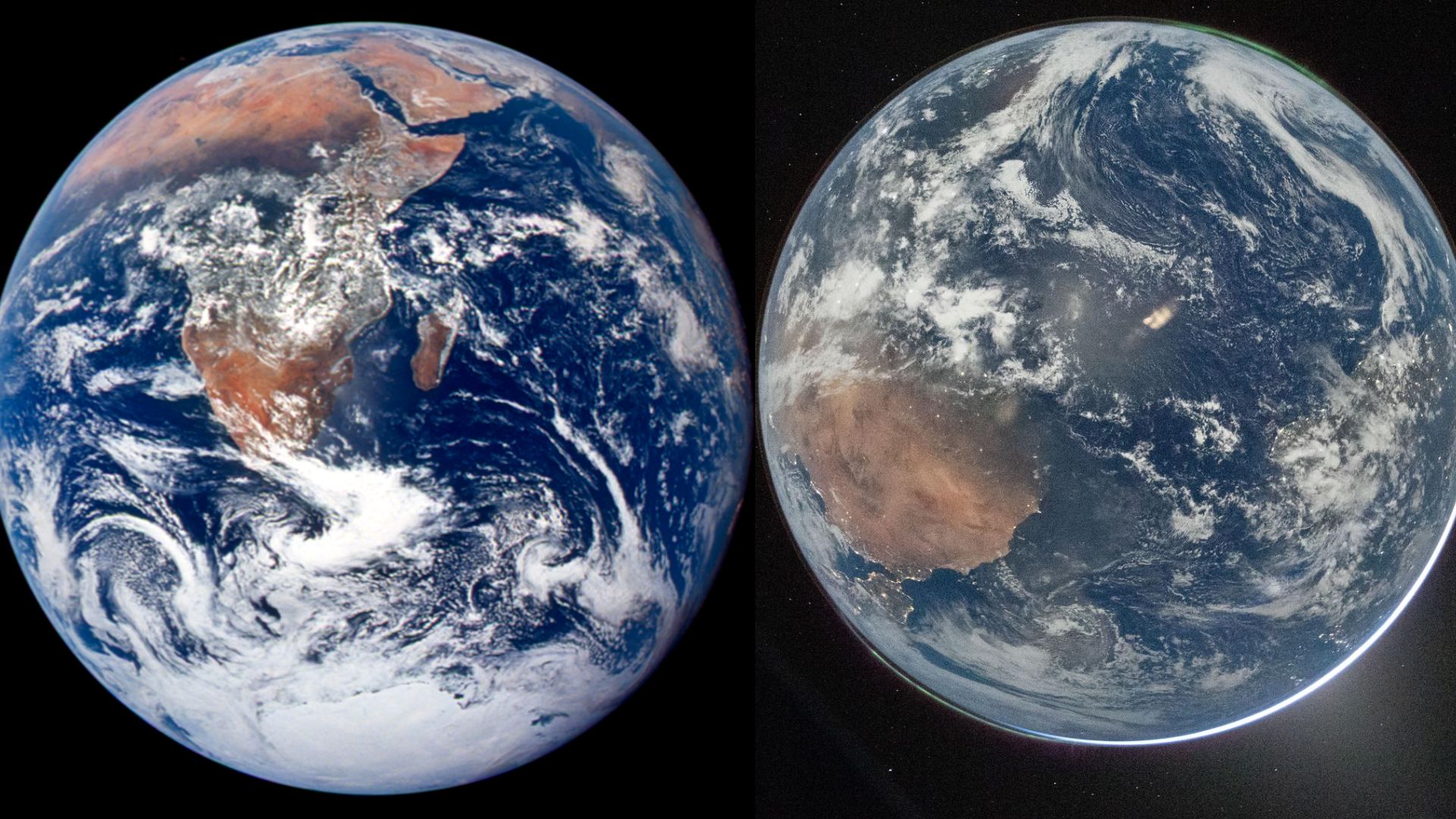

NASA has released the first high-resolution images of Earth taken by the Artemis II astronauts during their journey toward the Moon. These pictures were captured after the spacecraft completed a key engine burn that placed it on the path to the Moon. Mission commander Reid Wiseman took these “spectacular” images, according to NASA, as the crew began their historic trip.
‘Hello, World’ Image Shows Earth’s Beauty
The first image, named Hello, World, highlights the vast blue Atlantic Ocean. It also shows a thin glowing layer of Earth’s atmosphere as the planet partially blocks the Sun. Bright green auroras can be seen near both poles.
Interestingly, Earth appears upside down in the image. The western Sahara and the Iberian Peninsula are visible on one side, while the eastern part of South America appears on the other. NASA also pointed out a bright object in the frame, identifying it as the planet Venus.
1972 ➡️2026
— NASA (@NASA) April 3, 2026
Apollo 17 ➡️ Artemis II pic.twitter.com/wGc2wtY0e2
Key Engine Burn Sends Crew Toward the Moon
The images were taken after the spacecraft completed a trans-lunar injection burn early on Friday. This important maneuver pushed the Orion spacecraft out of Earth’s orbit. The four astronauts on board are now travelling more than 200,000 miles toward the Moon. The mission, Artemis II, is following a looping path that will take the crew around the far side of the Moon and then back to Earth. This marks the first time since Apollo 17 in 1972 that humans have travelled beyond Earth’s orbit.
Astronauts Amazed by Views from Space
After completing the burn, the astronauts were excited and spent time looking out of the spacecraft windows. Mission specialist Jeremy Hansen said the crew were “glued to the windows” while taking photos. "We are getting a beautiful view of the dark side of the Earth, lit by the Moon," he told mission control in Houston. Later, Wiseman contacted mission control again, asking how to clean the windows because they had become dirty from constant use.
We see our home planet as a whole, lit up in spectacular blues and browns. A green aurora even lights up the atmosphere. That's us, together, watching as our astronauts make their journey to the Moon. pic.twitter.com/6JkKufBgtJ
— NASA (@NASA) April 3, 2026
Challenges in Capturing Space Photography
At first, Wiseman found it difficult to take clear photos of Earth from such a long distance. Adjusting the camera settings was not easy. "It's like walking out back at your house, trying to take a picture of the moon," he told mission control. "That's what it feels like right now." However, as the mission progressed, capturing images became easier.
It’s not a straight shot to the far side of the Moon! 🌕
— NASA (@NASA) April 2, 2026
Over approximately 10 days, the Artemis II astronauts will orbit Earth twice before looping around the far side of the Moon in a figure eight and returning home. pic.twitter.com/udjejhxgVx
Rare Views of Earth’s Light and Darkness
One of the images shows Earth divided into two halves—one in daylight and the other in darkness. This dividing line is known as the terminator. Another image released later shows Earth almost completely in darkness, with city lights glowing across the planet. NASA also shared a comparison between this 2026 image and a similar photograph taken during the Apollo 17 mission in 1972. "We've come so far in the last 54 years, but one thing hasn't changed: our home looks gorgeous from space!" NASA said.