
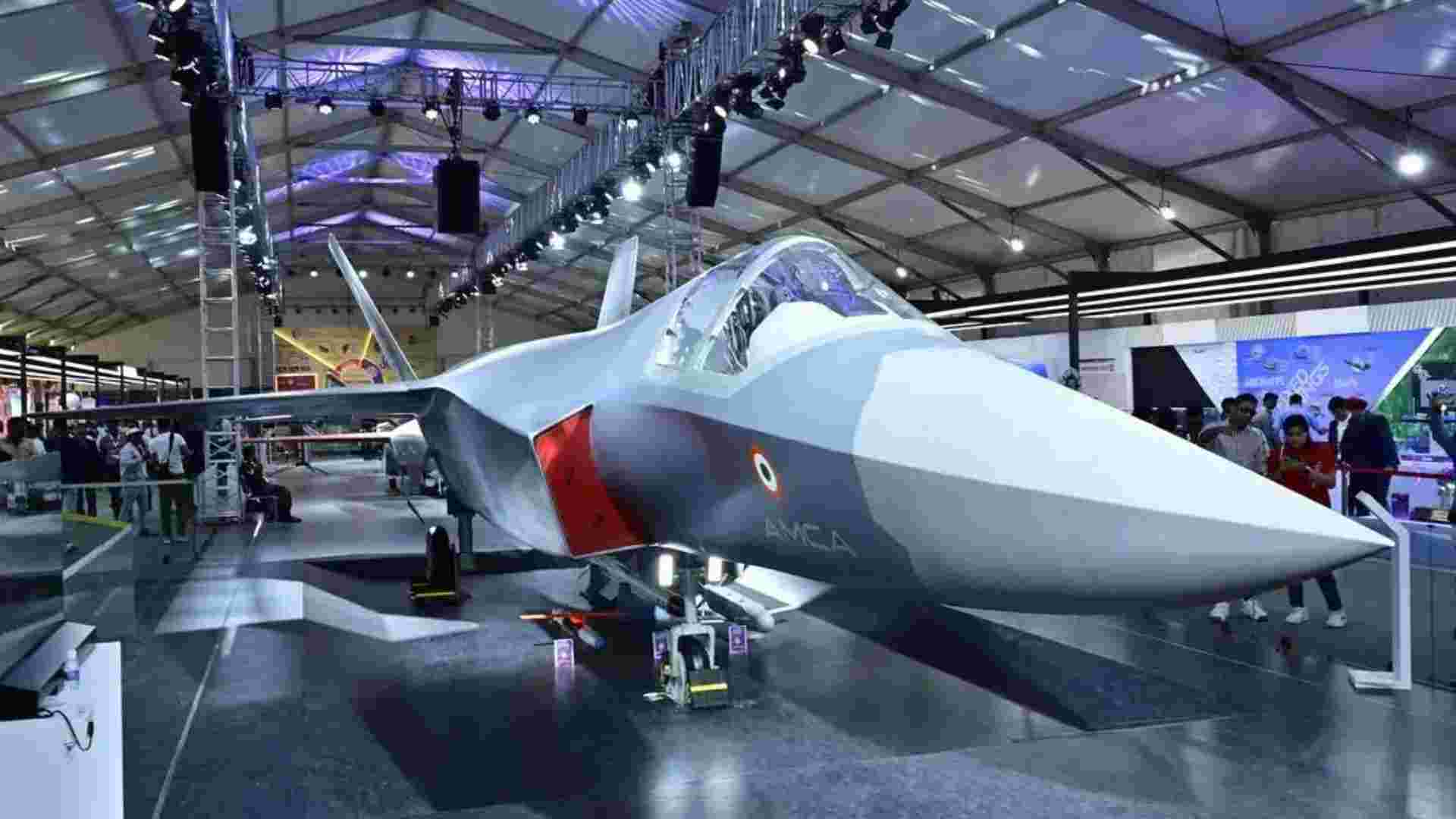

The Defence Ministry on Wednesday issued Requests for Proposals (RFPs) to three shortlisted bidders for the development and production of five prototypes of the Advanced Medium Combat Aircraft (AMCA). The project is estimated to cost around ₹15,000 crore and is expected to pave the way for India’s second fighter jet production facility outside Hindustan Aeronautics Limited (HAL).
The three shortlisted bidders are Tata Advanced Systems Limited (TASL), Larsen and Toubro in partnership with Bharat Electronics Limited (BEL), and Bharat Forge along with Bharat Earth Movers Limited.
The Aeronautical Development Agency (ADA) under the Defence Research and Development Organisation (DRDO) will lead the aircraft’s design and development. The AMCA will initially use the American GE-414 engine.
India Targets Fifth-Generation Fighter Capability
Officials expect the first AMCA prototype to be ready by early 2027. The fifth-generation fighter aircraft is likely to make its first flight between 2028 and 2029.
India plans to begin serial production of the aircraft during the mid-2030s. Future versions of the fighter jet are expected to use 120 kN engines developed by French company Safran and manufactured in India.
Earlier this month, authorities laid the foundation stone for the ₹15,803 crore Integration and Flight Testing Complex at Puttaparthi in Andhra Pradesh. The Cabinet Committee on Security had already approved the development of five AMCA prototypes.
AMCA To Compete With Global Stealth Fighters
The AMCA will feature advanced stealth technology, internal weapon bays, super-cruise capability, and artificial intelligence-based systems.
India plans to position the fighter against some of the world’s leading stealth aircraft, including the American F-35, China’s J-20, and Russia’s Su-57.
The aircraft will eventually replace the Indian Air Force’s Su-30 MKI fleet.
The fighter jet will carry indigenous Astra air-to-air missiles, air-to-surface missiles, laser-guided bombs, and glide bombs. It will also include advanced radar and sensor systems designed to avoid enemy air defence detection.
Debate Continues Over Foreign Fighter Jets
At the same time, the Indian Air Force has proposed acquiring two squadrons of Russian Su-57 fighters under the “Make in India” programme. However, the government has not yet taken a final decision on the proposal.
The article also noted that recent conflicts raised questions about the stealth capabilities of fifth-generation fighters. It referred to reports claiming that Iranian air defence systems damaged an American F-35 using a heat-seeking missile during the ongoing West Asia conflict.
India Expands Defence Manufacturing Push
Amid changing global geopolitics, India is increasing efforts to strengthen domestic defence production and reduce dependence on foreign suppliers.
The government believes private Indian companies must prove their capability by producing advanced fifth-generation fighter jets outside HAL facilities.
Meanwhile, India has also started cost negotiations with France’s Dassault Aviation for the direct acquisition and later local production of 114 fighter aircraft. The move aims to maintain the Indian Air Force’s operational strength.
The article further stated that Operation Sindoor, conducted over four days from May 7, 2025, highlighted the changing nature of warfare. According to the report, modern conflicts now rely more on aircraft launching long-range missiles and bombs from stand-off distances rather than traditional tank and infantry battles.