
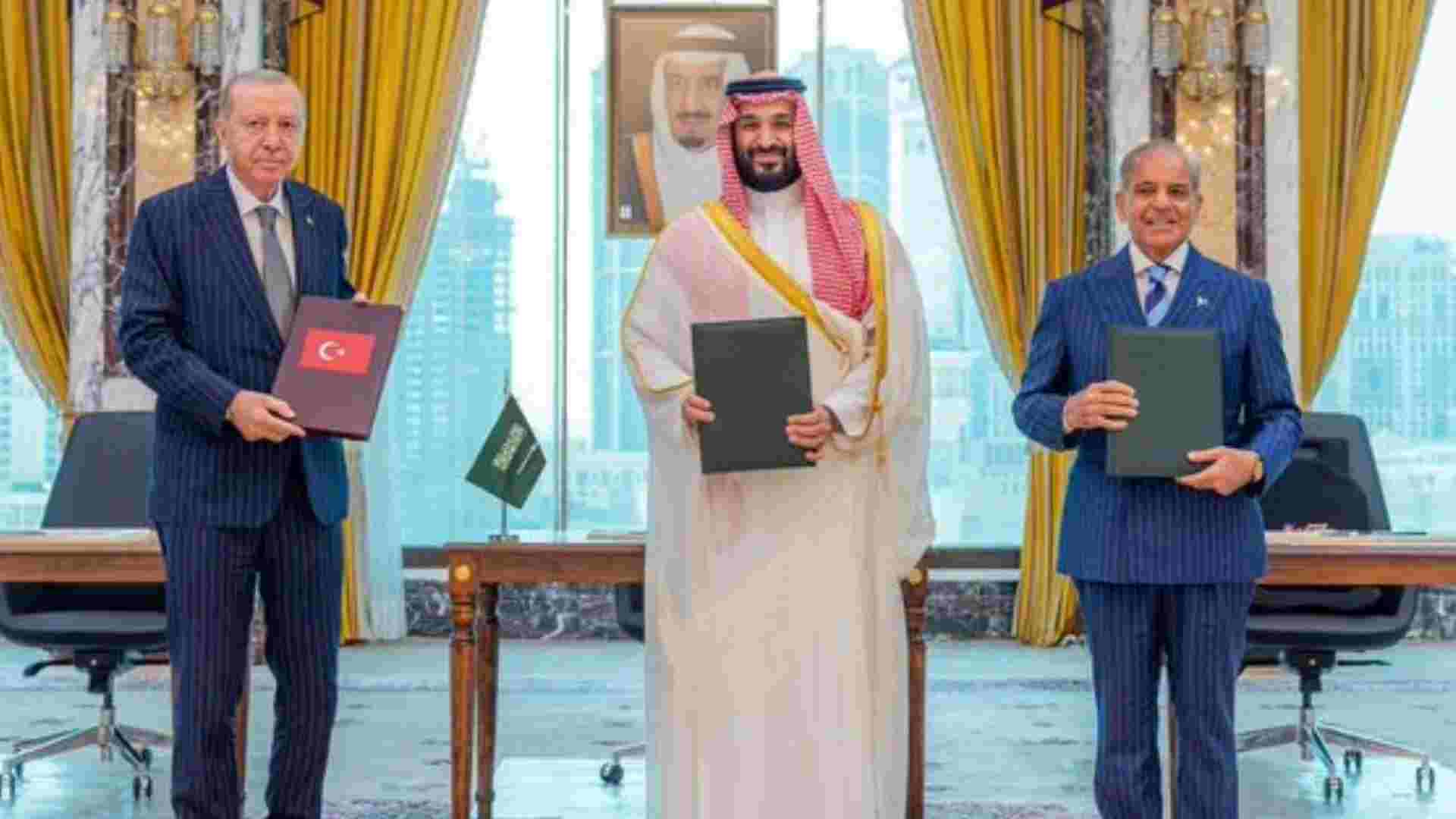

Senior officials from Turkey, Saudi Arabia and Pakistan are set to meet in Istanbul on Monday for the first time under their newly signed Mecca Joint Defence Agreement. A Turkish Foreign Ministry source told Reuters that the meeting will bring together senior representatives from the three countries. The countries signed the agreement on August 7 amid growing concerns over the Iran war and wider instability in the Middle East. Foreign and defence ministers, along with military chiefs from the three nations, are expected to attend the Istanbul meeting.
What does the Mecca Defence Pact say?
The agreement aims to strengthen military cooperation and joint deterrence among Turkey, Saudi Arabia and Pakistan. The pact states that an armed attack on any one of the three members would be treated as an attack on all three. This provision resembles NATO’s Article 5, which forms the basis of the alliance’s collective defence system.
However, the agreement does not clearly state what military action the other members must take after an attack. Therefore, the pact does not automatically mean that Turkey or Saudi Arabia would enter a conflict on Pakistan’s side. Any response would depend on the nature of the attack, the circumstances and the type of assistance requested.
The new security arrangement has attracted attention because all three countries maintain close relations with the United States, while the region faces growing security challenges.
Why India is watching the pact
India has several reasons to closely monitor the new defence arrangement. However, it would be too early to describe the pact as a direct military threat to New Delhi. Pakistan’s participation remains the biggest concern for India.
Pakistan could deepen military cooperation
The agreement could provide Pakistan with greater opportunities for military cooperation with Turkey and Saudi Arabia. It could also expand access to defence technology, training and other military resources. Pakistan and Turkey already maintain close defence ties. Their relationship could become stronger under the new agreement.
During India’s Operation Sindoor last year, Turkey reportedly supplied drones to Pakistan. That development had already raised concerns in New Delhi about growing defence cooperation between Ankara and Islamabad. The new pact could provide another platform for the two countries to expand their military relationship.
At the same time, the collective defence clause does not guarantee military intervention in every conflict involving Pakistan. If Pakistan becomes involved in a future conflict with India, Turkey and Saudi Arabia would not necessarily be required to send troops or directly enter the conflict. The agreement leaves room for members to decide what assistance they provide.
Gulf region remains important for India
India also has strong economic and strategic interests in the Gulf. Saudi Arabia plays an important role in India’s energy security. The country also has significant trade and investment links with India. Millions of Indians live and work across the Gulf region. Their employment and safety are closely linked to stability in the region.
Any major change in the Gulf’s security structure could therefore have wider consequences for India. Pakistan has maintained close military relations with Saudi Arabia for decades. The new agreement could formalise and expand that cooperation.
It could also increase Pakistan’s role in the regional security system. India will closely watch any such development because it has major economic and strategic interests in the Gulf.
Bangladesh could join the pact
Another development has added to India’s concerns. Bangladesh is reportedly considering joining the Mecca Defence Pact. If Bangladesh eventually becomes a member, India would face a new regional security situation involving two of its immediate neighbours, Pakistan and Bangladesh.
Bangladesh’s possible participation is particularly important because Pakistan helped establish the agreement. India-Bangladesh relations have also faced tensions in recent years. Dhaka has accused Indian border forces of pushing people across the border. Bangladesh has also sought the extradition of former Prime Minister Sheikh Hasina. She has remained in India since she left Bangladesh following protests in August 2024.
If Bangladesh joins a formal defence arrangement with Pakistan, Saudi Arabia and Turkey, it could represent a significant change in Dhaka’s foreign and security policy.
Bangladesh has traditionally tried to maintain balanced relations with different global and regional powers. Joining a formal military alliance could therefore mark a new direction.
Bangladesh says pact will not limit its ties
Bangladesh has sought to ease concerns over its possible participation. Dhaka said on Sunday that it did not see any risk in joining the defence pact with Saudi Arabia, Turkey and Pakistan.
Bangladesh also said membership would not prevent it from maintaining relations and cooperation with other countries. The country’s position suggests that Dhaka views the pact as an additional security partnership rather than a move towards a single geopolitical bloc.
For India, however, the developments will require close monitoring. The future of the pact, the level of military cooperation among its members and Bangladesh’s possible entry could all influence the security balance in South Asia and the Gulf.