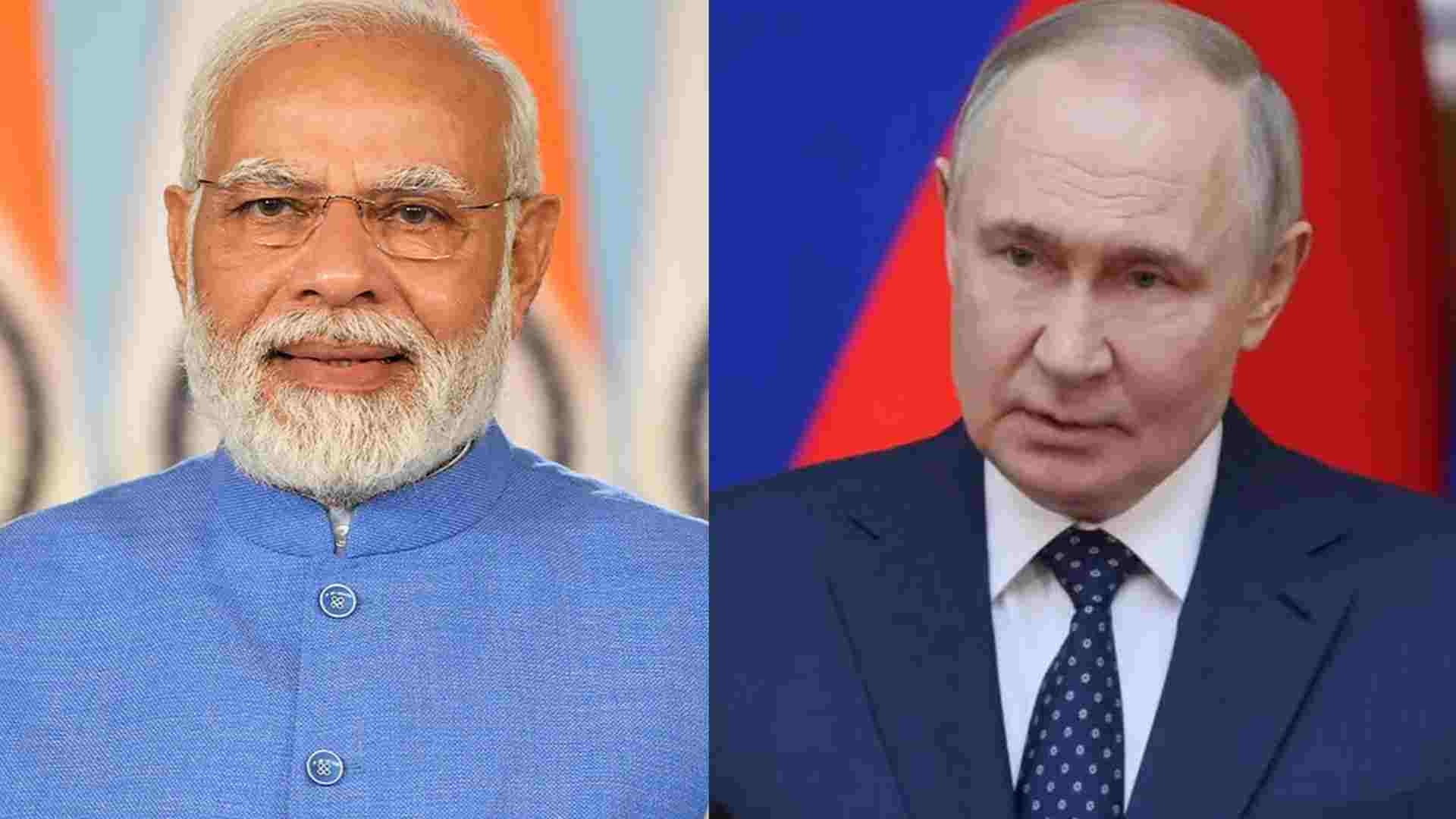
Prime Minister Narendra Modi and Russian President Vladimir Putin are scheduled to meet in New Delhi on Friday, ahead of the
BRICS summit. Trade and economic cooperation are expected to be among the key issues in their bilateral discussions, along with wider strategic matters.
The meeting comes at an important stage in India-Russia economic ties. Bilateral trade has grown sharply in recent years, largely because of India's increased purchases of Russian crude oil. However, both countries now face a bigger challenge: how to expand trade beyond oil and create a more balanced economic relationship.
India and Russia have also developed alternative payment arrangements to keep trade moving despite Western financial restrictions. Moscow has recently said that it remains open to different payment methods and does not seek formal “de-dollarisation”.
India-Russia Trade: How Close Is The $100 Billion Target?
India-Russia merchandise trade reached about $65.7 billion in 2023-24, according to India's Ministry of External Affairs. India's exports were worth $4.26 billion, while imports from Russia stood at $61.44 billion.
The relationship has expanded further. Indian government data shows that bilateral trade reached $68.72 billion in FY2024-25, comprising $4.88 billion in Indian exports and $63.84 billion in imports from Russia.
This means the trade relationship remains heavily tilted towards Russia. Russian oil and other commodities account for a major share of India's imports, while Indian exports to Russia remain comparatively small.
During the 2024 India-Russia summit, both sides agreed to work towards taking bilateral trade beyond $100 billion by 2030. The official roadmap calls for reducing non-tariff barriers, improving investment, strengthening payment systems and developing new transport routes.
The key question is therefore not simply whether trade can reach $100 billion, but what products and investments will drive the additional growth.
India-Russia Trade Imbalance: Why Does It Matter?
The biggest challenge for India is the large trade deficit with Russia. India exports pharmaceuticals, chemicals, electrical machinery, mechanical equipment, iron and steel and other goods to Russia. Russia, meanwhile, supplies India with crude oil and petroleum products, fertilisers, minerals, precious stones and metals, among other commodities.
The sharp increase in Russian energy purchases has made Russia one of India's major import sources. At the same time, India's relatively low exports to Russia mean that the trade relationship has become increasingly one-sided.
For India, expanding exports is therefore essential if the $100-billion target is to represent broader economic cooperation rather than simply larger energy imports.
India-Russia Trade: How Are Payments Being Made?
Payment mechanisms have become a major part of India-Russia economic cooperation since Western sanctions complicated conventional financial channels involving Russia.
Russia has said that the overwhelming majority of its commercial transactions with India are now settled in national currencies. The two governments have also been working to strengthen bilateral settlement mechanisms and introduce digital financial instruments.
At the same time, Moscow has clarified that it is not pursuing a formal policy of “de-dollarisation”. Kremlin spokesman Dmitry Peskov recently said Russia remains open to different acceptable payment methods.
For India, the priority is mainly to ensure that payment restrictions do not disrupt legitimate trade. A smoother financial system could also help businesses expand bilateral commerce beyond government-linked transactions.
What Can India Export More To Russia?
If India wants to reduce the trade imbalance, increasing exports will be crucial. Pharmaceuticals, engineering products, chemicals, machinery, agricultural goods, electronics and manufactured products offer potential areas for expansion. India's existing export base already includes several of these categories.
Both countries have also identified investment and industrial cooperation as important parts of their long-term economic roadmap. The official plan includes greater investment, improved connectivity and the development of new trade routes, including the International North-South Transport Corridor, Northern Sea Route and Chennai-Vladivostok maritime link.
Can India-Russia Trade Move From Oil To Investment?
The next stage of the relationship could involve a greater focus on investment, joint production and technology, rather than simply buying and selling commodities.
Russian companies already have investments in sectors such as oil and gas, petrochemicals, banking, railways and steel in India. Indian companies have also invested in Russian oil and gas and pharmaceutical businesses.
Greater industrial cooperation could help both sides create longer-term economic links. Instead of India mainly importing Russian commodities, companies from both countries could increasingly participate in joint ventures and manufacturing projects.
Modi-Putin Talks: What Role Will BRICS Play?
The Modi-Putin meeting comes just before the BRICS summit in New Delhi, giving the two leaders an opportunity to discuss bilateral issues alongside broader economic questions involving emerging economies. Payment systems, investment, trade connectivity and greater use of national currencies are among the issues being discussed more widely within BRICS.
However, BRICS is not officially structured as an anti-Western economic bloc. Its framework focuses on cooperation in areas including politics and security, economic and financial matters, and cultural and people-to-people exchanges. For India, the grouping also provides a platform to strengthen ties with Russia while maintaining relations with other major economies.
What Could be Discussed in the Modi-Putin Meeting?
Trade and economic cooperation are expected to feature prominently in the talks. Other reported areas of discussion include defence cooperation, the Russian Su-57 fighter programme, nuclear energy projects and the impact of US sanctions.
The discussions come as India and Russia seek to maintain their longstanding strategic partnership while adapting to a changing global economic and geopolitical environment.
The two countries therefore have several immediate issues to address: expanding trade, improving payment arrangements, increasing Indian exports and strengthening investment and connectivity.
What is the Next Big Step For India-Russia Trade?
India and Russia have already made significant progress in keeping bilateral trade moving despite sanctions and financial restrictions. The bigger challenge now is to determine how the relationship can become more balanced and diversified.
The $100-billion target will be easier to achieve if growth comes from pharmaceuticals, engineering, agriculture, manufacturing, technology, investment, energy and connectivity rather than being driven primarily by crude oil.
For Russia, India offers a major consumer market and an important economic partner in Asia. For India, Russia remains significant for energy, fertilisers, defence, nuclear cooperation and other strategic commodities.
The Modi-Putin talks in New Delhi could therefore be important not only for the next phase of India-Russia relations but also for determining whether the two countries can turn their rapidly growing trade into a broader, more balanced and investment-led economic partnership.