
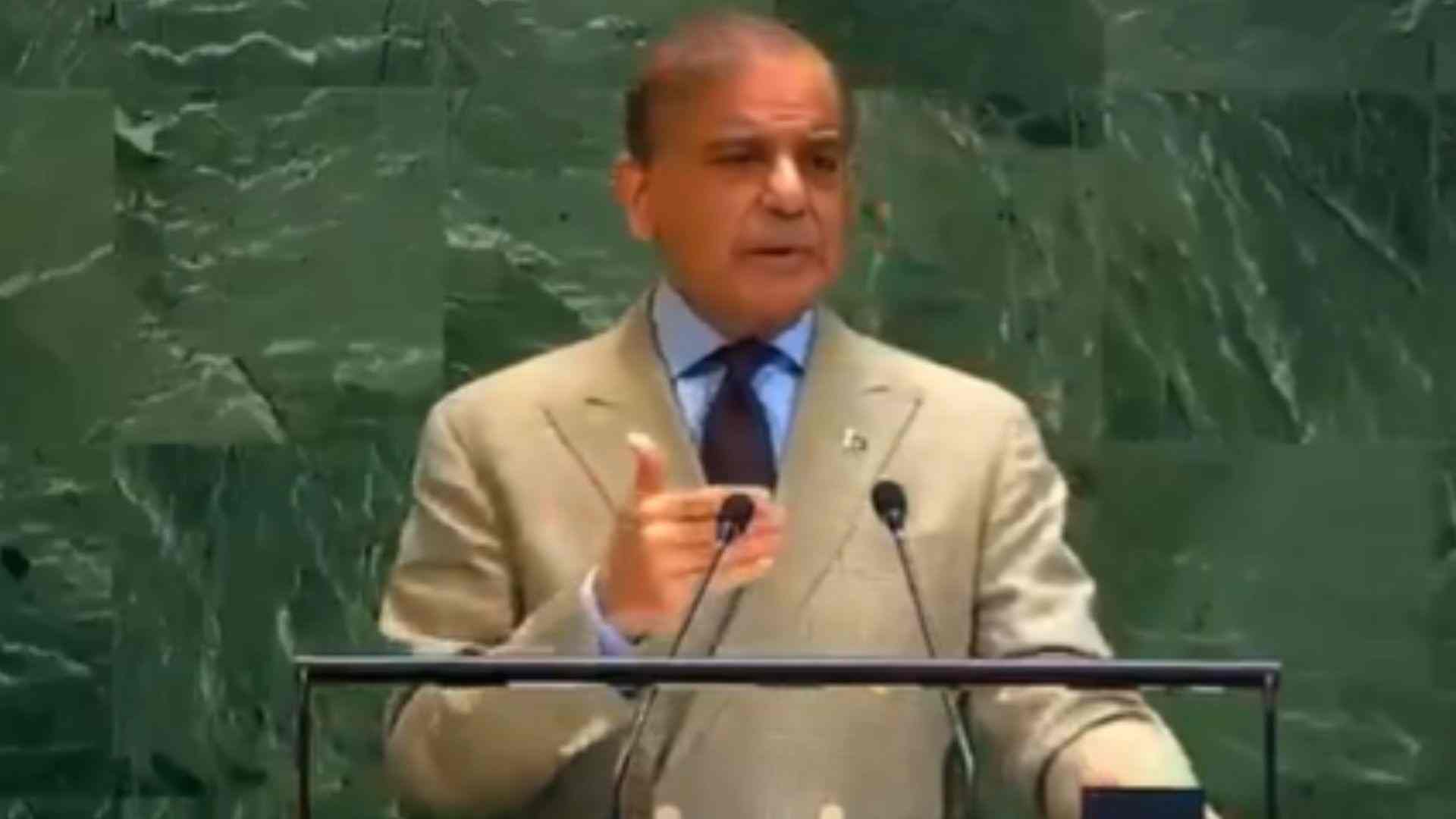

Pakistan Prime Minister Shehbaz Sharif raised the Kashmir issue and the Indus water dispute during his address to the 81st United Nations General Assembly (UNGA) in New York on Friday. He also credited US President Donald Trump’s “timely intervention” with helping bring about a ceasefire between India and Pakistan during their 2025 military conflict.
Sharif warned that any attempt by India to stop, restrict or divert Pakistan’s share of river waters would be treated by Islamabad as an “act of war”. His remarks came as he called for restraint and a long-term settlement of disputes in South Asia.
Sharif calls for a ‘just and fair’ Kashmir resolution
Addressing the UNGA, Sharif said South Asia should not return to a situation where another military confrontation becomes possible. He called for a “just and fair” resolution to the Kashmir issue and praised Trump for what he described as “resolute and visionary leadership” in helping broker the May 2025 ceasefire.
Sharif said Trump’s intervention had prevented further loss of life. “Who knows the extent of devastation that could have taken place had President Trump not stepped in at this critical moment with clarity of thought and action?” he said. “We must therefore ensure that South Asia never reaches this precipice ever again.”
Sharif argued that lasting peace in the region would require addressing the Kashmir dispute. He said Pakistan continued to support what it described as the right of Kashmiris to self-determination.
“For eight decades, the Kashmiri people have waited for the United Nations to fulfill its solemn commitment of a free and impartial plebiscite,” he said. He also alleged that Kashmiris had faced “illegal occupation, arbitrary detention, extrajudicial killings, enforced disappearances, sexual violence and collective punishment”.
Pakistan’s government has continued to make Kashmir a central part of its diplomatic position. India has consistently rejected Pakistan’s claims regarding Kashmir and maintains that Jammu and Kashmir is an integral part of India. India is also expected to exercise its Right of Reply after the Pakistani prime minister’s address.
Sharif recalls 2025 India-Pakistan conflict
Sharif also referred to the military confrontation between India and Pakistan in May 2025, which followed the April 22 Pahalgam terror attack. India blamed Pakistan-based elements for the attack, which killed 26 civilians, while Pakistan denied involvement.
India launched Operation Sindoor on May 7, targeting what it described as terrorist infrastructure in Pakistan and Pakistan-occupied Kashmir. Sharif praised Pakistan’s armed forces for their response during the confrontation and again credited Trump with helping secure the ceasefire.
Trump has repeatedly said that he helped stop the conflict, including in remarks at the UN General Assembly earlier this week. India, however, has consistently rejected claims of third-party mediation in the ceasefire.
Pakistan warns India over river waters
A major part of Sharif’s UNGA address focused on the Indus Waters Treaty (IWT) and Pakistan’s concerns over its share of river waters. “Water must never be weaponised. Rivers should nourish nations, not divide them. Therefore, any attempt to stop, impede or divert Pakistan’s share of the waters will be treated as an act of war. India must make no mistake about it,” Dawn quoted Sharif as saying.
Sharif criticised India’s decision to hold the Indus Waters Treaty in abeyance following last year’s conflict. He argued that the move lacked a legal basis.
He also referred to findings by UN experts and the Permanent Court of Arbitration, saying they supported Pakistan’s position on the treaty and had left Islamabad “vindicated beyond any doubt”.
Pakistan has repeatedly described the Indus Waters Treaty as a vital national interest and has warned against any attempt to stop or divert water flows allocated to it under the agreement.
Sharif highlights Pakistan’s role in US-Iran diplomacy
Beyond India and Kashmir, Sharif also discussed conflicts and diplomatic developments in the Gulf and wider West Asia. He highlighted the humanitarian and economic impact of the regional conflict, along with the importance of major maritime routes such as the Strait of Hormuz and Bab al-Mandab. Sharif said Pakistan had sought to promote dialogue between Washington and Tehran.
“At this critical moment, Pakistan chose to act swiftly. Through concerted efforts, Pakistan brought Washington and Tehran under one roof in Islamabad,” PM Shehbaz said, referring to talks held in Islamabad that resulted in the signing of the Islamabad Memorandum of Understanding between the United States and Iran in June.
The UN has also acknowledged Pakistan’s role in efforts to facilitate dialogue between Iran and the United States. A UN spokesperson said Secretary-General António Guterres appreciated Pakistan’s efforts to help end the violence and described Islamabad’s role as important in the diplomatic process.
Sharif calls for open global waterways
Sharif said major maritime routes must remain open and should not become centres of confrontation. “Amid the roar of missiles, drones and guns, the voice for diplomacy must echo even louder and stronger,” the Pakistani prime minister said.
“The Strait of Hormuz and Bab al-Mandab are arteries of the global economy. They must remain open, connecting nations, not becoming choke points of confrontation,” he added.
He also condemned recent Houthi attacks against Saudi Arabia and described them as “deplorable”. Sharif expressed Pakistan’s solidarity with Saudi Arabia.
The Pakistani prime minister further referred to the Makkah Joint Defence Agreement involving Pakistan, Turkiye and Saudi Arabia, presenting it as part of Islamabad’s stated commitment to regional security and stability.
“This alliance is not directed against any country; it is a collective commitment for defence, stability and peace in the region, and nothing more,” he stressed.