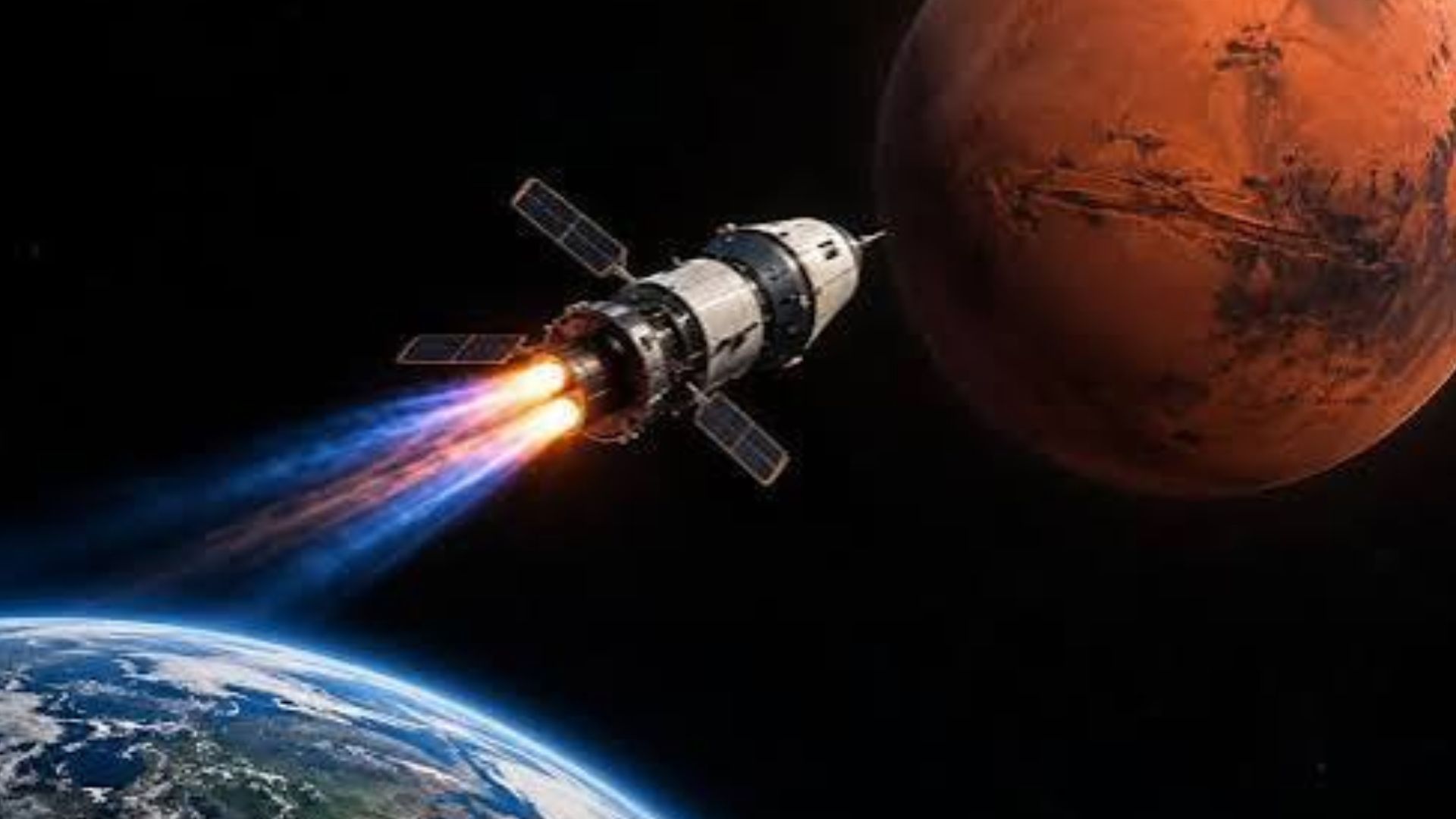
Japan has begun an ambitious space exploration mission aimed at studying Mars’ two moons and bringing samples from one of them back to Earth. The mission could help scientists uncover how these moons were formed and gain a deeper understanding of the Red Planet’s early geological history.
The Japan Aerospace Exploration Agency (JAXA) launched its Martian Moons eXploration (MMX) spacecraft on Tuesday using an H3 rocket from the Tanegashima Space Center in southern Japan.
The rocket took off from Pad-2 at 4:41 am Japan Standard Time. About 71 minutes later,
JAXA confirmed that the spacecraft had separated from the launch vehicle and entered its designated trajectory.
“The spacecraft was injected into the predetermined orbit,” JAXA stated, acknowledging the contributions of its Japanese and international partners to the mission.
The spacecraft weighs approximately four tonnes and is expected to cover a distance of 500 million to 600 million kilometres before reaching Mars. Its mission is to examine the planet’s two moons, Phobos and Deimos, collect surface material from Phobos and transport the samples back to Earth.
The return capsule is expected to touch down in South Australia in 2031.
Unravelling the Mystery Behind Mars’ Two Moons
One of the central objectives of the MMX mission is to determine how Phobos and Deimos came into existence. Scientists have proposed two main explanations for their formation.
The first theory suggests that both moons were asteroids captured by Mars’ gravitational force. The alternative theory proposes that they formed from debris released into space following a massive collision with Mars billions of years ago.
By studying their surface features, mineral content and geological properties, researchers hope to identify evidence that could help distinguish between these competing explanations.
The MMX spacecraft is expected to arrive in the Martian system in August 2027. It will spend roughly three years observing Phobos and Deimos from designated orbits, gathering data about their structure, physical characteristics and surface composition.
The mission will also investigate whether Phobos contains rocks and other materials originating from Mars. Because Phobos travels relatively close to the planet, major impacts on Mars could have propelled debris into space, allowing some of it to settle on the moon.
Examining this material could reveal additional details about Mars’ geological past and the conditions that prevailed on the planet billions of years ago.
How Japan Plans to Collect Samples From Phobos
Gathering samples from Phobos will require highly precise operations because of the moon’s small size and extremely weak gravitational pull.
Phobos is approximately 22 kilometres wide, and its gravity is considerably weaker than Earth's. The spacecraft will therefore need to execute carefully controlled manoeuvres to reach the surface, collect material and complete its sampling operations safely.
JAXA intends to make one or two touchdown attempts, with the goal of collecting at least 10 grams of regolith, or loose surface material, from two different locations on Phobos.
Specially developed sampling mechanisms will allow the spacecraft to gather material from the moon’s surface and below it. Direct access to these samples could give researchers a more detailed picture of Phobos’ composition and origin than observations made from orbit alone.
Scientists will also look for possible fragments of Martian material within the collected samples. Finding such material could provide valuable evidence about Mars’ ancient geological conditions and help researchers reconstruct aspects of its early history.
Following collection, the samples will be secured inside a sealed capsule for transportation back to Earth, where scientists will examine them using laboratory techniques.
International Collaboration Supports the MMX Mission
Japan’s MMX mission has received support from several international partners, including the United States, France, Germany and the European Space Agency (ESA).
NASA has contributed a gas-sampling instrument along with a gamma-ray and neutron spectrometer. These scientific instruments are designed to help researchers study the composition of Phobos and identify the materials present on its surface.
France’s National Centre for Space Studies (CNES) and the German Aerospace Center (DLR) have jointly developed a compact rover called IDEFIX, which weighs around 30 kilograms. The rover is scheduled to reach Phobos’ surface in 2029 to examine the terrain and study surface conditions before the spacecraft begins collecting samples.
The European Space Agency is providing communication equipment and tracking support through its network of ground stations. This infrastructure will help scientists and mission controllers maintain contact with the spacecraft during its journey and operations around Mars.
The partnership brings together expertise in planetary science, spacecraft engineering, communications and surface exploration, supporting the mission’s complex scientific and technical objectives.
MMX Builds on Japan’s Previous Sample-Return Missions
The latest mission builds on Japan’s experience with the Hayabusa and Hayabusa2 asteroid exploration projects. Those missions successfully returned asteroid samples to Earth in 2010 and 2020, respectively.
However, collecting material from a moon orbiting another planet introduces additional difficulties. The MMX spacecraft must navigate the Martian system, examine both moons, conduct controlled surface operations in a low-gravity environment and ensure the collected material reaches Earth safely.
If the mission succeeds, it will deliver the first samples collected directly from Phobos. Scientists could use the material to investigate the origins of Mars’ moons and gain fresh insights into the development of the Martian system.
The sample-return capsule is scheduled to reach Earth in 2031, with its landing planned for the Woomera region of South Australia.
Once the capsule has been recovered, researchers will analyse the samples to establish their mineral composition, determine their age and investigate whether they contain debris originating from Mars. The results could help answer long-standing questions about the formation of Phobos and Deimos while expanding scientific knowledge of the Red Planet’s early history.