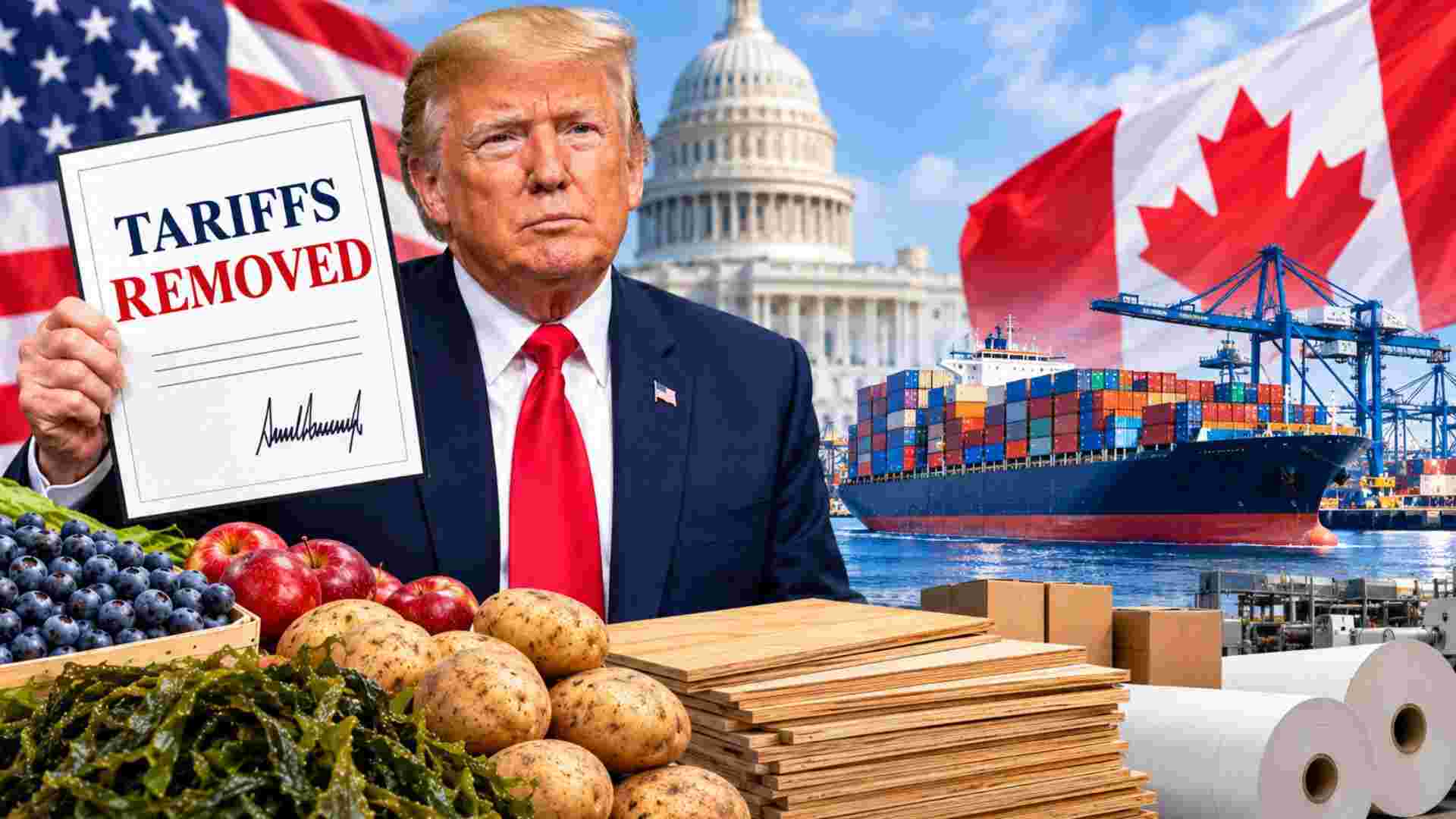
US President Donald Trump has removed tariffs on several Canadian goods, citing the need to “better serve the public interest”, the White House announced on Friday. The decision comes ahead of the US midterm elections and could help Republican Senator Susan Collins, who is facing a closely contested re-election race in Maine.
Collins has served in the US Senate for nearly three decades. She is facing a challenge from Democrat Troy Jackson, a former logger who previously served in the Maine State Senate. The contest is considered highly competitive, and a Democratic victory could help the party gain control of the Senate.
The tariff exemptions cover several agricultural products and business-related materials that Maine companies depend on. The decision could ease pressure on local industries that rely on cross-border trade with Canada.
Trump Administration Grants Tariff Relief on Maine Products
Following the White House announcement, Collins said the exemptions would cover nine agricultural products, including blueberries, potatoes, apples and seaweed.
She explained that many farmers in Maine depend on specialised equipment and materials imported from Canada. These products are either “unavailable from American suppliers or cannot be replaced without incurring significant expense”.
Collins said she had repeatedly raised the issue with senior administration officials and would continue seeking further relief.
“In my repeated conversations with Ambassador Greer, Secretary Lutnick, and other senior administration officials, I have asked for tariff relief for these important products, and I will continue working directly with administration officials to seek additional relief and encourage a broader trade agreement with Canada, our neighbour, ally, and largest trading partner,” she wrote.
The White House also announced exemptions for selected industrial and processing materials. These include plywood sheets, packing boxes, paper products and certain types of machinery.
According to the administration, these materials are important for businesses in Maine, particularly those operating near the Canadian border. Removing the tariffs could help reduce their operating costs and ease supply-chain pressures.
Explaining the decision, the White House said the move adjusted earlier tariff measures introduced on July 20 and September 8.
“President Trump is further refining the scope of the July 20 and September 8 actions to better serve the public interest, and to ensure these measures continue to effectively offset the burden or disadvantage to US commerce from Canada’s discriminatory measures,” the White House said in a news release.
How the Tariff Exemptions Could Help Susan Collins
The timing of the decision has drawn attention because Collins is fighting to retain her Senate seat in a closely watched election. Democrats hope to defeat her and gain greater control of Congress.
The exemptions could provide economic relief to Maine businesses and farmers affected by the trade dispute with Canada. They may also give Collins an opportunity to highlight her efforts to secure concessions from the Trump administration.
Maine shares a close economic relationship with Canada, making trade policy particularly important for the state. Industries such as logging, lobster harvesting and fishing have long played a major role in its economy. Trump's earlier tariff announcements raised concerns that these sectors could face higher costs and reduced trade opportunities.
By securing exemptions for selected products and materials, the administration could ease some of the pressure on local businesses. The decision may therefore become an important issue in Collins's re-election campaign.
Canada-US Trade Dispute Puts Pressure on Both Economies
The tariff relief comes amid continuing trade tensions between the United States and Canada. The two countries maintain extensive commercial ties, and tariffs have affected businesses and consumers on both sides of the border.
Canadian Prime Minister Mark Carney recently warned that American tariffs were hurting households and businesses in both countries. He said Canadian auto exports to the United States had fallen by 10 per cent, while US exports to Canada had declined by more than 20 per cent.
Carney criticised the disruption to the long-standing trade relationship between the neighbouring countries.
“US tariffs have upended a trade bargain that’s existed for decades,” Carney said. “They’ve raised costs for American families while putting Ontario workers and businesses at a disadvantage and under a cloud of uncertainty.”
The tariff exemptions could provide limited relief to selected sectors, particularly in Maine, but they do not amount to a broader resolution of the trade dispute.
With the midterm elections approaching, the decision could have both economic and political implications. It offers some relief to Maine's farmers and businesses while potentially strengthening Collins's position in a competitive re-election contest. However, the wider impact will depend on whether the United States and Canada make further progress towards a broader trade agreement.