
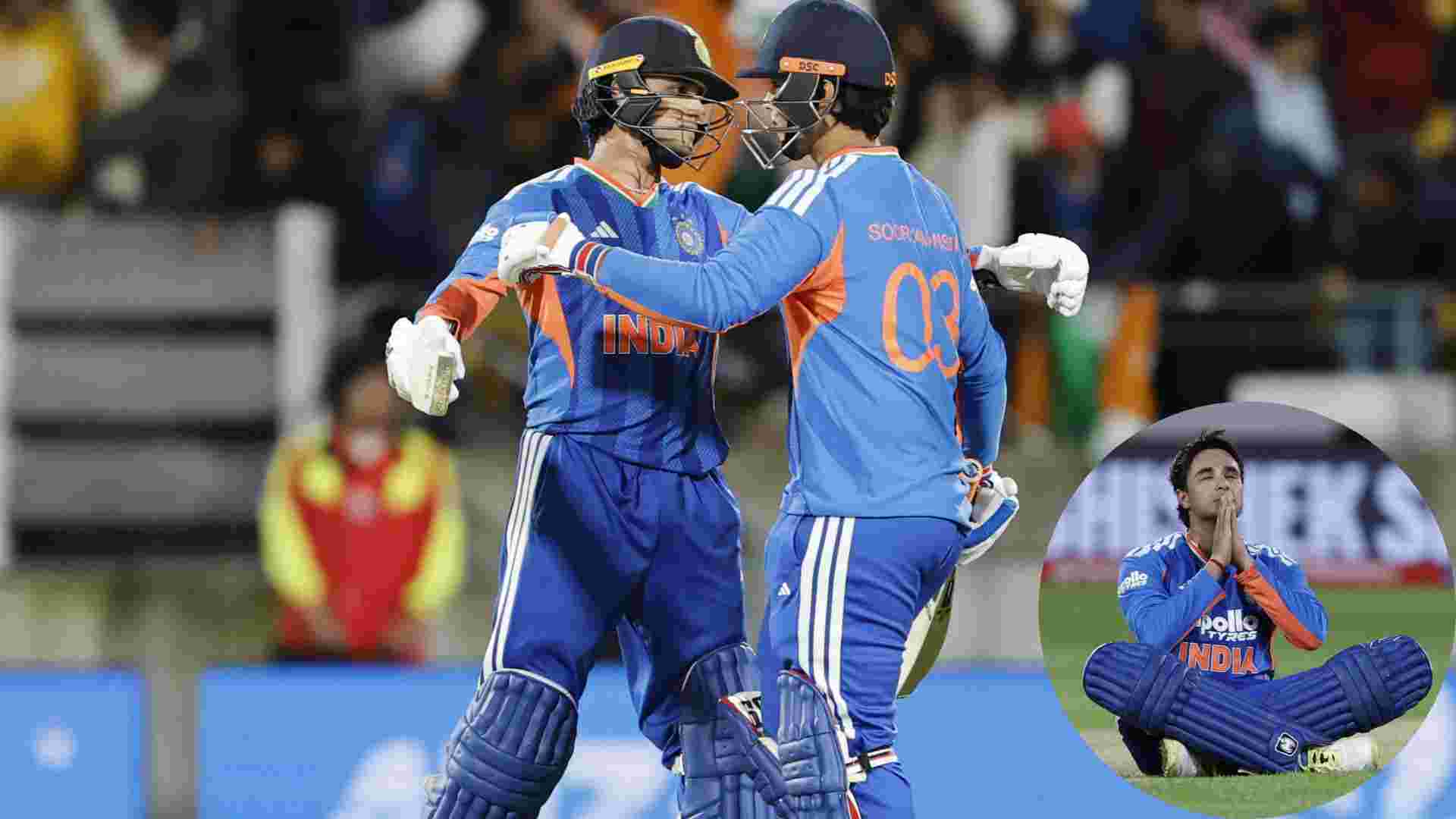

India crushed New Zealand by six wickets in the third T20I of the five match series in Wellington. After being asked to bat first, New Zealand scored 198/3 in 20 overs. Daryl Mitchell smashed 89 runs off 52 balls, while Finn Allen and Bevon Jacobs played quick-fire knocks to help New Zealand post a competitive total. Arshdeep Singh (1/33 in 4 overs) was India's most successful bowler.
During the chase, Abhishek Sharma led India's charge with a breathtaking innings. He reached his half-century in just 15 balls and completed his fourth T20I century in only 35 deliveries. His explosive batting overshadowed the impressive contribution of young opener Vaibhav Sooryavanshi. The pair added 133 runs for the opening wicket in just 7.1 overs. Together, they powered India to a record 118/0 during the powerplay in a T20 international.
New Zealand's bowlers struggled to find an effective response. India's batters attacked relentlessly and gave the opposition few opportunities to control the scoring rate. Mitchell Santner (1/17 in 3 overs) was the only New Zealand bowler to make a significant impact.
Abhishek and Sooryavanshi put New Zealand's bowlers under pressure from the start. Their ability to create room, change positions at the crease and target gaps across the field made it difficult for the bowlers to execute their plans. India completed the chase with 40 balls remaining. With this victory, India took an unassailable 3-0 lead in the five-match series.
Abhishek and Sooryavanshi Take Batting to Extraordinary Levels
Jacob Duffy opened the bowling for New Zealand but endured a disastrous first over. He conceded a front-foot no-ball and bowled a high bouncer that the wicketkeeper could not stop, allowing the ball to reach the boundary. Abhishek and Sooryavanshi then struck a six each over point, taking full advantage of the fielding restrictions. India collected 26 runs from the over, giving the innings an explosive start. It was India's fourth over of 20 or more runs in the series. New Zealand had not managed a single over of that kind. By the end of the match, India had recorded seven such overs compared with New Zealand's zero. The difference reflected both the superior boundary-hitting ability of India's batters and their attacking mindset. Players such as Abhishek and Sooryavanshi consistently looked for scoring opportunities rather than waiting for the bowlers to make mistakes. New Zealand, apart from Finn Allen, lacked batters who could match India's power and range of shots. India's approach also involved careful positioning and a clear understanding of the field. The batters repeatedly targeted areas with fewer fielders, especially during the powerplay.Short Boundaries Help India Dominate the Powerplay
Hnry Stadium's playing dimensions played an important role in India's strategy. The ground has relatively short square boundaries and longer straight boundaries, creating opportunities for batters to attack the off side and leg side. Abhishek and Sooryavanshi repeatedly moved across the crease to create room for shots through the off side. When bowlers followed them, the openers used pulls and whips to target square leg and midwicket. Their aggressive approach produced extraordinary scoring milestones. India reached 50 runs in just 2.2 overs, matching the fastest recorded mark in T20 internationals where ball-by-ball data is available. The team then crossed 100 in exactly five overs. India began the chase with a required run rate of 9.95 runs per over. By the end of the powerplay, that figure had dropped to 5.78, leaving the team in complete control. The remaining task was to determine how quickly Abhishek could reach his century and how soon India could finish the match. Abhishek dominated the opening partnership and reached his hundred in only 35 balls. India briefly lost Shreyas Iyer and Sanju Samson near the finish, with both batters departing when the team needed only one more big hit. Those wickets did little to change the outcome, as India completed the chase comfortably.India Adjust Their Bowling Strategy to the Wellington Ground
India's fast bowlers also played an important role in the victory by adapting their tactics to the ground's dimensions. During the first two matches in Christchurch, India's bowlers had operated at Hagley Oval, where the square boundaries are much larger. Shorter deliveries proved more effective there because batters found it harder to clear the field. According to Cricinfo's ball-by-ball data, India's fast bowlers conceded 10.03 runs per over when bowling fuller deliveries, including full tosses, yorkers, full-length balls and good-length deliveries. Their economy rate improved to 8.92 when they bowled shorter deliveries. Hnry Stadium required a different approach. Its shorter square boundaries made short-pitched bowling more vulnerable to pulls and flat-batted shots. India took some time to adjust, allowing New Zealand to make a strong start.Finn Allen Attacks Before Nitish Kumar Reddy Strikes
New Zealand reached 88 for one by the end of the eighth over. Finn Allen and Daryl Mitchell had already struck eight sixes between them, with many coming from pulls and powerful shots against shorter deliveries. Nitish Kumar Reddy then provided India with a crucial breakthrough in the ninth over. His bowling has been one of India's major gains during the tour, and he demonstrated the value of targeting the longer straight boundary. Reddy dismissed Allen for 40 with a full, straight delivery. Allen could not generate enough power to clear the boundary, which stretched beyond 80 metres. India's other seamers followed a similar plan. They bowled fuller deliveries and used reverse swing to make scoring more difficult for New Zealand's batters. The change in approach helped India regain control after the hosts' aggressive start.Daryl Mitchell Fights On Despite India's Bowling Comeback
Daryl Mitchell continued to score after Allen's dismissal, reaching his half-century in just 26 balls. However, India's improved bowling restricted his scoring rate during the later stages of the innings. Mitchell managed only 35 runs from his final 26 deliveries. He remained unbeaten on 89 off 52 balls, providing New Zealand with a strong individual contribution despite India's recovery. Bevon Jacobs supported him effectively. The pair added an unbeaten 75 runs for the fourth wicket from 48 balls, with Jacobs finishing on 39 not out from 23 deliveries. Their partnership helped New Zealand post a competitive target of 199. However, India's openers erased the deficit with such extraordinary speed that the hosts' batting effort ultimately proved insufficient.India Seal the Series With Two Matches Remaining
India's emphatic victory underlined the gap between the two teams' attacking potential in this series. The bowlers adapted after an expensive start, while Abhishek and Sooryavanshi delivered an opening partnership that effectively ended the contest during the powerplay. Abhishek's 35-ball century stood out as the defining performance of the match. Sooryavanshi's contribution at the other end further strengthened India's dominance and gave New Zealand no opportunity to recover. By chasing 199 in just 13.2 overs, India secured the series with two matches still to play. The performance also reinforced the team's aggressive batting philosophy, built around relentless scoring, calculated risks and the ability to attack from the first ball.New Zealand (NZ) : 198/3 (20)
Daryll Mitchell 89*(52), Finn Allen 40(25), Bevon Jacobs 39*(23);
Arshdeep Singh 1/33(4), Axar Patel 1/36(4)
India (IND) : 199/4 (13.2)
Abhishek Sharma 113(38), Vaibhav Sooryavanshi 45(19), Sanju Samson 18(13);
Kyle Jamieson 2/45(3.2), Mitchell Santner 1/17(3)
Player of the Match: Abhishek Sharma
New Zealand posted 198/4 in 20 overs, a total that looked competitive. However, one of the most destructive opening pairs in T20 cricket made a mockery of the target. Abhishek Sharma and Vaibhav Sooryavanshi smashed 133 runs in just 7.1 overs during their chase of 199 in the third T20I. What a demolition!
India produced a remarkable batting display on Tuesday, chasing down the target in just 13.2 overs in Wellington. The victory highlighted the team's aggressive approach to T20 cricket and sealed the series with two matches remaining.
Such rapid chases have happened before. The Netherlands famously chased 190 against Ireland in just 13.5 overs at the 2014 T20 World Cup to qualify for the Super 10 stage. However, that performance came with a specific net run-rate target to achieve. India, by contrast, chased 199 with remarkable ease, demonstrating their aggressive approach to the shortest format.
The contrast between the two innings was striking. India's fast bowlers had used the unusual dimensions of Hnry Stadium effectively. They bowled full and straight to restrict New Zealand's scoring and generate reverse swing. However, the same conditions offered little protection once Abhishek and Sooryavanshi launched their assault. Stay tuned with JUSZNEWS for regular updates!