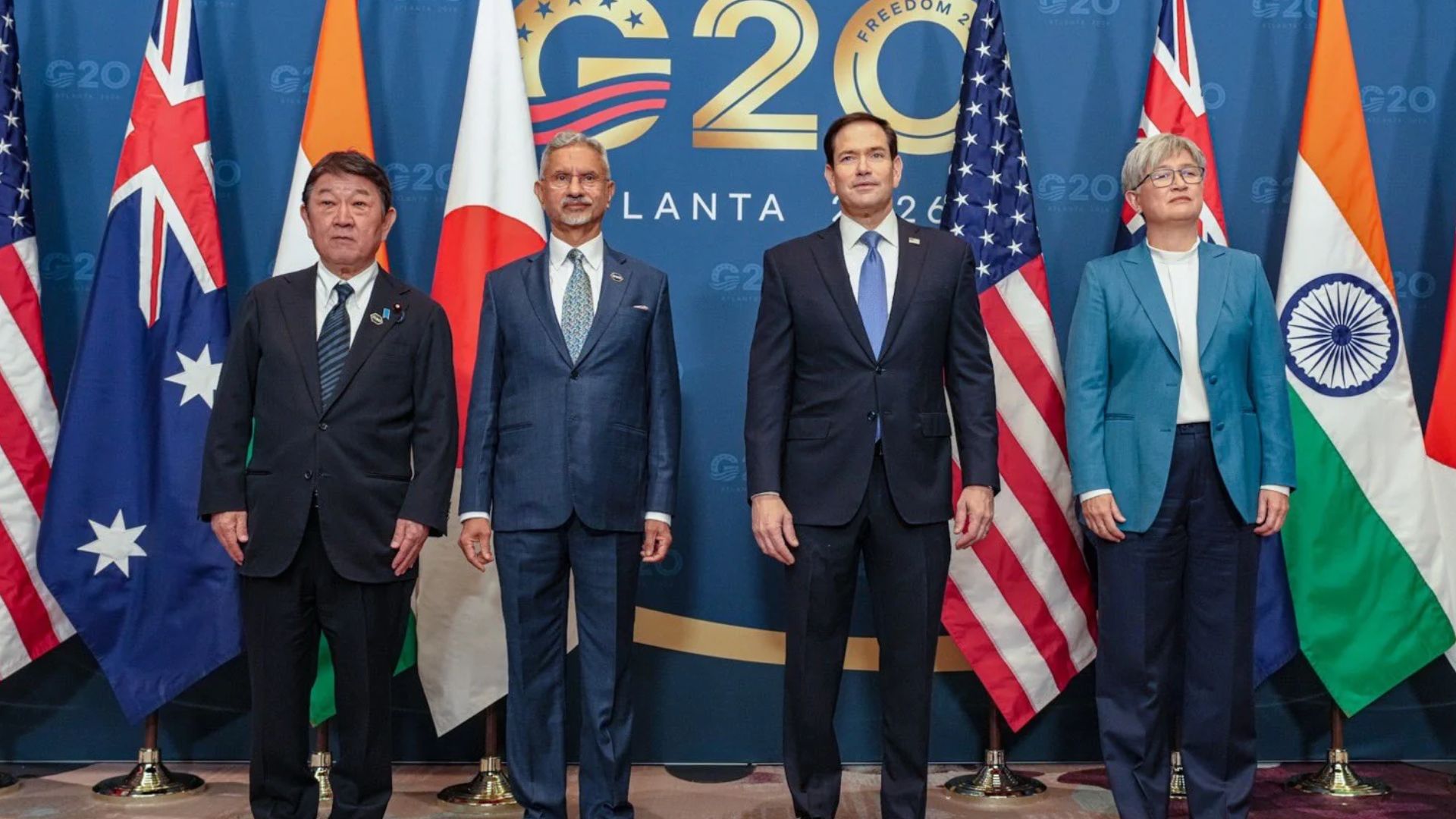
India, the United States, Japan and Australia have announced more than $85 million in technical and financial support to improve access to trusted artificial intelligence (AI) across the Indo-Pacific region. The United States has also pledged $10 million to develop critical minerals recycling infrastructure in India and Southeast Asia.
The announcements came in a joint statement released after the Quad foreign ministers met in Atlanta on Saturday, October 31. The meeting took place on the sidelines of the
G20 Foreign Ministers' Meeting.
The discussions were attended by India's External Affairs Minister S Jaishankar, US Secretary of State Marco Rubio, Japanese Foreign Minister Toshimitsu Motegi and Australian Foreign Minister Penny Wong.
Apart from AI and critical minerals, the four countries discussed ways to strengthen semiconductor supply chains, improve maritime security, expand digital connectivity and tackle cyber fraud and international criminal networks.
Quad Countries Expand AI Cooperation and Critical Minerals Initiatives
The four foreign ministers announced plans to provide more than $85 million in technical and financial assistance to promote the use of trusted AI technologies across the Indo-Pacific. The initiative will also receive support through the Quad AI Accelerator.
The ministers underlined the growing importance of artificial intelligence in driving economic development. They also highlighted initiatives such as Pax Silica as important elements of future technological and economic cooperation.
The Quad countries agreed to identify potential weaknesses in global semiconductor and AI hardware supply chains. Their objective is to prevent disruptions and establish more secure and reliable supply networks for advanced semiconductors and AI-related equipment.
US Secretary of State Marco Rubio also highlighted the group's progress in strengthening cooperation on technology and supply chains.
In a post on X, Rubio said the four countries were continuing their efforts to establish open and reliable supply chains, improve maritime cooperation and secure critical mineral resources.
On critical minerals, the ministers welcomed Washington's commitment of $10 million towards developing recycling infrastructure in India and ASEAN countries.
The funding will support facilities that recover valuable minerals from electronic waste and discarded materials, reducing dependence on conventional sources of critical minerals.
Quad Focuses on Maritime Security and Freedom of Navigation
Protecting important maritime routes was another major issue discussed during the meeting.
The four countries stressed the importance of keeping key international shipping routes open and secure. They also called for uninterrupted movement of commercial goods and energy supplies through strategically important waterways.
The joint statement specifically highlighted the need to protect navigational rights and freedoms in the Strait of Hormuz, the Red Sea and the Bab el-Mandeb Strait.
The ministers said these rights must be respected under international law, particularly the United Nations Convention on the Law of the Sea (UNCLOS).
They also stressed that ships and their crews should be allowed to pass safely through these waterways without facing additional tolls or restrictions.
The statement further highlighted the successful completion of the second Quad-at-Sea Ship Observer mission.
The mission travelled from Chennai to Perth between September 25 and October 7. Representatives from all four Quad countries participated in the exercise aboard an Indian Coast Guard offshore patrol vessel.
The initiative aims to improve cooperation and coordination among maritime security agencies in the Indo-Pacific.
Quad Pledges Joint Action Against Cyber Scams and Criminal Networks
The foreign ministers also expressed serious concerns about the growing threat of online fraud and cyber scams.
They pointed out that criminal organisations involved in these activities often operate international human trafficking networks. Victims are sometimes forced to participate in fraudulent online operations.
According to the joint statement, these criminal networks cause financial losses worth billions of dollars every year to citizens across the four Quad countries.
The ministers agreed to strengthen cooperation to dismantle such operations and ensure that those responsible, including the leaders of transnational criminal organisations, are held accountable.
The meeting also reviewed cooperation in energy security, port development and regional infrastructure.
The four countries discussed the first Quad Fuel Security Forum, which took place in September. The forum focused on improving energy security by strengthening strategic petroleum reserves and maintaining adequate fuel stocks.
In Fiji, the Quad partners are working with the local government to modernise three important ports: Suva, Lautoka and Rokobili.
The countries also highlighted their contribution of more than 2,000 infrastructure fellowships across the Pacific, Southeast Asia and South Asia.
India to Host Disaster Response Exercise in November
Disaster management and humanitarian assistance were also important parts of the discussions.
Australia, Japan and the United States will send observers to India's annual joint humanitarian assistance and disaster relief exercise scheduled for November.
The Quad countries also reported progress in developing standard operating procedures for the Indo-Pacific Logistics Network.
The progress followed a tabletop exercise organised by Japan's Defence Ministry in September. The initiative is aimed at improving coordination and ensuring faster delivery of assistance during natural disasters and humanitarian emergencies.
Marco Rubio Says Quad Is Delivering Tangible Results
Following the meeting, US Secretary of State Marco Rubio said the four countries were making meaningful progress in converting their shared priorities into practical benefits for the Indo-Pacific region.
In a post on X, Rubio said:
"I was pleased to meet with my Quad counterparts in Atlanta and discuss the real progress we have made in turning our shared priorities into real benefits for the Indo-Pacific.
As our nations continue building reliable and open supply chains, supporting next-generation technologies, increasing maritime cooperation, and securing critical minerals, the United States, Australia, India, and Japan are delivering results for our people and the nations in the region."
The foreign ministers also expressed their intention to continue working together on regional peace, stability and economic prosperity.
They said they were looking forward to the next Quad leaders' summit and another meeting of the group's foreign ministers.