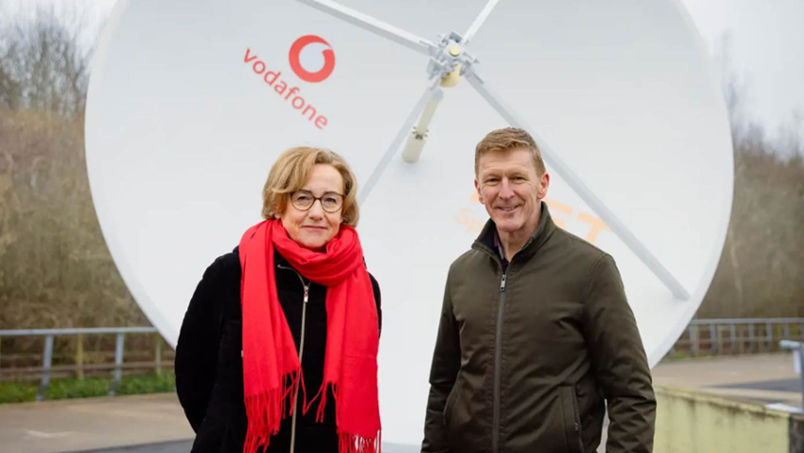
Vodafone has made the UK's first satellite-enabled smartphone video call. This milestone occurred on a mountain in Ceredigion, West Wales. It is part of the company’s strategy to bring satellite connectivity to its UK network by the end of this year and to Europe by 2026.
Ending "Not Spots"
According to Vodafone CEO Margherita Della Valle, this technology could help eliminate "not spots." These are areas with no mobile signal, which Ofcom estimates affect 9% of the UK. However, experts point out that more satellites must be launched and regulatory challenges need to be addressed. Additionally, astronomers are concerned that the growing number of satellites could interfere with space research.
How It Works
Satellite connectivity allows regular phones to work as usual, including full internet access, even when there is no cellular coverage. Currently, many smartphones support emergency satellite text messaging. However, Vodafone has now expanded this to include video calls. The test call was made between an engineer in West Wales and Della Valle.
“This is a very important moment. We are opening the door to universal connectivity,” Della Valle explained. She likened satellites to "antennas in the sky," adding that they would not replace existing towers but will provide an extra layer of coverage. Furthermore, no extra equipment will be needed for users, although the cost remains unknown.
AST SpaceMobile Partnership
Vodafone partnered with AST SpaceMobile, a company with a limited number of satellites. The test call was carefully timed for when one of their satellites was in position. Luke Pearce from CCS Insight noted, “AST SpaceMobile needs more satellites for consistent coverage.” He also pointed out that regulatory issues must be resolved, which is a challenge for services like Elon Musk’s Starlink. Ofcom is set to consult on this issue in early 2025.
Concerns About Space Congestion
Meanwhile, astronomers are increasingly worried about more satellites crowding space. The International Astronomy Union (IAU) warned that satellites could leave bright streaks in astronomical images. Additionally, Dr. Megan Argo, an astrophysicist, mentioned that the rise in satellites is “making it harder to study the universe outside our atmosphere.” She also warned that the growing number of satellites is making it more difficult to spot potentially dangerous asteroids.
Room for More Satellites?
Despite these concerns, astronaut Tim Peake, who joined the Vodafone video call, believes there is "plenty of room" for more satellites. He emphasized the need for careful management of satellite launches to protect the space environment while maximizing the benefits for people on Earth.
Overall, while technological advancements in satellite connectivity offer promising solutions for global communication, it is crucial to balance this progress with efforts to safeguard scientific exploration and the environment.