
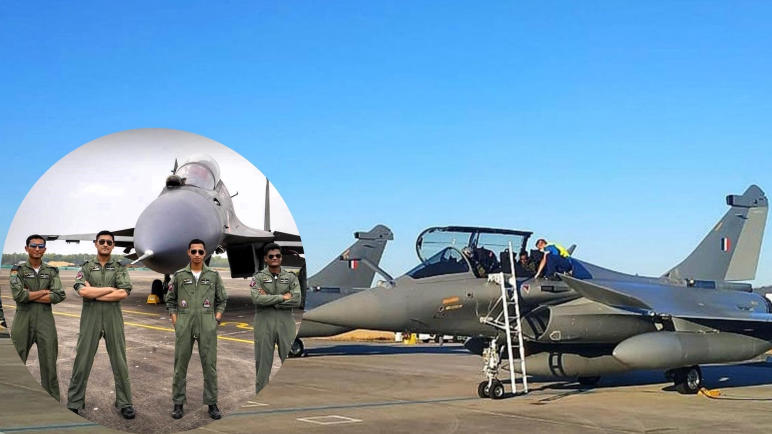

Every year on October 8, India proudly celebrates Indian Air Force (IAF) Day to honour the courage, discipline, and dedication of the men and women who protect the nation’s airspace. From combat operations to humanitarian missions, the IAF stands as a symbol of precision, power, and commitment.
During the celebrations, spectacular flypasts and aerial displays capture the imagination of the entire nation. As a result, many young Indians dream of wearing the blue uniform and soaring through the skies in a fighter jet. However, turning that dream into reality requires hard work, discipline, and relentless training.
Eligibility: The First Step Toward the Skies
To begin with, aspiring pilots can join the IAF through three main routes — National Defence Academy (NDA), Combined Defence Services Examination (CDSE), and Air Force Common Admission Test (AFCAT).
For NDA entry, candidates must be unmarried males aged between 16.5 and 19.5 years. Meanwhile, applicants through CDSE or AFCAT must hold a graduate degree with Physics and Mathematics at the 10+2 level or possess a B.Tech degree. The age limit usually ranges from 20 to 24 years, though candidates with a commercial pilot licence receive age relaxation.
Furthermore, physical fitness plays a crucial role. Candidates must meet strict medical and vision standards. In other words, perfect eyesight, sharp reflexes, and excellent overall health are essential for anyone aiming to become a fighter pilot.
The Selection Process: Testing Skill and Potential
After meeting eligibility conditions, candidates must clear a written examination, followed by the Service Selection Board (SSB) assessment. This multi-stage process includes psychological tests, group discussions, personal interviews, and a medical examination.
Importantly, the most decisive phase is the Computerised Pilot Selection System (CPSS), which replaced the earlier Pilot Aptitude Battery Test (PABT). This test evaluates a candidate’s coordination, reflexes, and ability to handle aircraft controls. Only those who pass CPSS qualify for the flying branch of the IAF.
Rigorous Training
Once selected, cadets begin intensive training at the National Defence Academy (NDA) in Pune or the Air Force Academy (AFA) in Dundigal, near Hyderabad.
Training occurs in three stages — Basic Flying Training, Intermediate Flying Training, and Advanced Fighter Training. Initially, cadets start with basic trainer aircraft like the Pilatus PC-7 MkII. Later, they advance to jets such as the Kiran or Hawk AJT (Advanced Jet Trainer).
Each phase helps cadets develop flying skills, quick thinking, and confidence under pressure. Eventually, they are commissioned as Flying Officers and posted to frontline fighter squadrons. At that point, they begin flying combat aircraft like the Tejas, Mirage-2000, or Su-30MKI.
Life as a Fighter Pilot
Being a fighter pilot is both challenging and rewarding. Pilots must constantly train for combat missions, aerial dogfights, and strategic operations. Therefore, every sortie demands precision, teamwork, and focus.
According to an Air Force officer, training at the AFA ensures the all-round growth of each cadet. It focuses equally on academic knowledge, physical endurance, and mental strength.
“The goal is to mould individuals into confident, composed and battle-ready pilots capable of handling extreme conditions even at the height of 30,000 ft.,” he said.
He also explained the physical and mental challenges of the job. “The mental and physical challenges undergone in a mission are multiple. From the cramped cockpits to high G manoeuvres, the trainee has to maintain his situational awareness to take the right decision at the right time.”
At the academy, cadets follow an intense schedule that combines aerodynamics, combat tactics, simulator sessions, and real flight missions. The program tests their endurance, judgment, and calmness under pressure.
Offering advice to aspirants, the officer said, “Staying motivated, being physically active and more inclined to have a life as a military aviator will give a strong motivation to join the IAF as fighter pilots.”
Why the IAF Still Inspires Generations
Despite its challenges, the Indian Air Force remains a dream career for thousands. It offers honour, adventure, and a deep sense of purpose. Moreover, it provides the unique opportunity to serve the nation while mastering the skies.
With the induction of next-generation aircraft such as the Rafale, Tejas Mk1A, and the upcoming Su-75 Checkmate, the IAF continues to evolve into a high-technology force.
Ultimately, for young Indians, becoming a fighter pilot is more than a profession — it is a mission of courage, pride, and service to the nation.