
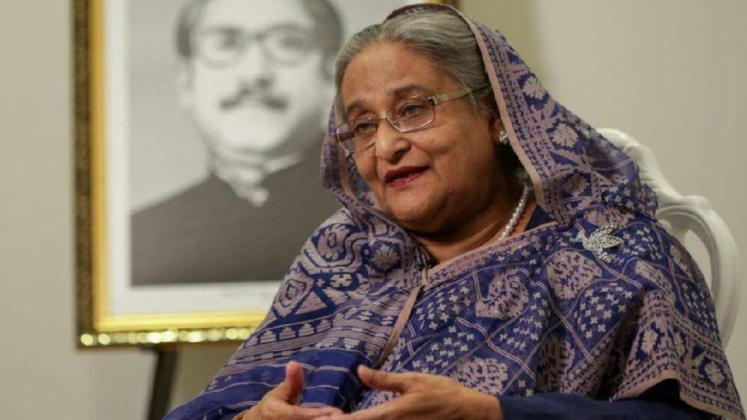

Bangladesh’s International Crimes Tribunal (ICT) on Monday sentenced former Prime Minister Sheikh Hasina to death in a case involving crimes against humanity. The court convicted her on multiple charges, including inciting killings, ordering killings, and failing to act, which resulted in deaths during last year’s mass protests.
Prosecutors had sought the death penalty, blaming Hasina for the violent unrest and street protests that toppled her government. Former Home Minister Asaduzzaman Khan and former police chief Chowdhury Abdullah Al-Mamun were also convicted. Khan received a death sentence, while Mamun was handed a five-year prison term. Hasina and Khan were tried in absentia, whereas Mamun appeared in court.
Hasina Rejects Verdict
Sheikh Hasina dismissed the judgment, calling it the decision of a “rigged tribunal established and presided over by an unelected government with no democratic mandate.”
She stated, “In their distasteful call for the death penalty, they reveal the brazen and murderous intent of extremist figures within the interim government to remove Bangladesh’s last elected prime minister, and to nullify the Awami League as a political force.”
Previously, Hasina had described the ICT as a kangaroo court and criticized Bangladesh’s interim ruler, Muhammad Yunus, calling him a front for extremists.
Charges Against Hasina and Others
The ICT framed five major charges against Hasina and Khan:
-
Giving provocative speeches.
-
Ordering the killing of protesters using lethal weapons.
-
Shooting Abu Sayeed, a student at Begum Rokeya University in Rangpur.
-
Shooting six people in Dhaka’s Chankharpul area.
-
Burning six others to death in Ashulia.
The court ruled, “Sheikh Hasina has committed crimes against humanity. Six protesters at Chankharpul were killed using lethal weapons on August 5. By issuing orders and through the inaction of Sheikh Hasina, the then Home Minister, and the IG of police, the students were killed. These killings happened under the orders and full knowledge of PM Sheikh Hasina. By such acts, they committed crimes against humanity.”
Background of the Protests
After protests and street violence escalated last year, Hasina fled to India on August 5. The agitators and the Bangladeshi military backed Yunus as the country’s interim ruler.
Prosecutor’s Statement
Bangladesh’s Chief Prosecutor, Tajul Islam, described Hasina as the “mastermind and principal architect” behind the alleged atrocities.
Islam had earlier said that Hasina should ideally be sentenced 1,400 times for the deaths of 1,400 people during the protests. Since that was impossible, he demanded at least one death sentence. “We demand the highest punishment for her. For a single murder, one death penalty is the rule. For 1,400 murders, she should be sentenced 1,400 times but since that is not humanly possible, we demand at least one,” Islam said.
He added that Hasina was “the nucleus around whom all the crimes committed during the July–August uprising revolved.”
Trial Details
The ICT concluded hearings on October 23 after 28 working days and heard testimonies from 54 witnesses.
The charge sheet ran into 8,747 pages, including 2,018 pages of references, 405 pages of seized documents, and a 2,724-page list of deceased individuals, according to Dhaka Tribune.