
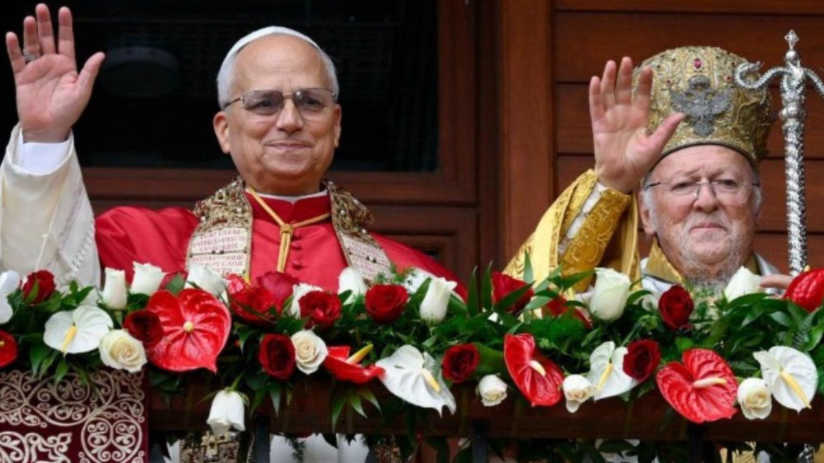

Pope Leo XIV strongly repeated the Vatican’s long-standing support for a two-state solution to the Israeli-Palestinian conflict. Speaking to reporters during his first in-flight press conference on Sunday, he said it remained the “only solution” that could bring justice to both sides.
He made the statement as he arrived in Lebanon, a nation still suffering from the recent war between Israel and Hezbollah and its ongoing impact.
A Peace Mission Begins in Turkey and Lebanon
This visit to Lebanon came after his first stop in Turkey, marking the beginning of his first overseas journey since he became the leader of the world’s 1.4 billion Catholics in May. During the flight, Leo said he came to the region as a “messenger of peace” and hoped his presence would encourage stability and dialogue across the Middle East.
Lebanon gave him a grand welcome. Officials laid out a red carpet. A 21-gun salute was fired. Children and a brass band performed. Ships in the port blew their horns. As his aircraft approached Beirut, two Lebanese military jets flew alongside it.
People gathered along the route to greet him. Among them was Zahra Nahleh, a 19-year-old from the conflict-hit south of Lebanon. She said, “I came to say that the Lebanese are one people and we are united.” She added that the pope was respected by both Christians and Muslims. “We want him to bless our land. We wish he could visit the south.”
Talks on Regional Conflicts and Turkey’s Role
Pope Leo confirmed that the conflicts in the region were discussed. He said that Turkey plays “an important role” in current peace efforts. He pointed out that President Erdogan’s government had already helped with early negotiations aimed at ending the Russia-Ukraine war.
“Unfortunately we still haven’t seen a solution. But today there are new, concrete proposals for peace.” He added that the Holy See hopes Turkey will continue talks with Ukraine, Russia, and the United States to help secure a ceasefire and end the nearly four-year war.
Strong Stand on Gaza and Palestinian Statehood
On the issue of Gaza, the Pope repeated the Vatican’s support for a two-state solution. This includes the creation of a Palestinian state in east Jerusalem, the West Bank, and Gaza. The Holy See officially recognized a Palestinian state in 2015. Support for this position grew stronger this year during the Israel-Hamas war, as more countries formally recognized Palestine at the U.N.
“We know that in this moment, Israel doesn’t accept this solution, but we see it as the only one that can offer a solution to the conflict that they are living in,” he said. “We are also friends with Israel and we try with both sides to be a mediating voice that can help bring them closer to a solution with justice for all.”
While in Turkey, the pope avoided directly speaking about the Gaza war. He also did not mention his visit to Istanbul’s Blue Mosque when speaking to journalists, even though it had been one of the most visible moments of his trip to the Muslim-majority country.
Focus on History, Faith, and Christian Unity
Instead, he spoke mainly about the historical importance of his trip. He came to commemorate the 1,700th anniversary of a major gathering of Christian bishops in A.D. 325 in what is now Iznik, Turkey. That meeting led to the creation of the Nicaean Creed, a statement of Christian belief still recited by millions today.
Despite long-standing divisions within Christianity, the Nicaean Creed remains one of the few points of unity among Catholic, Orthodox, and most Protestant churches.
While in Istanbul, Leo also met with Orthodox church leaders. During a joint meeting on Saturday, he suggested a future gathering in Jerusalem in 2033. The purpose would be to mark the 2,000th anniversary of Christ’s crucifixion and resurrection as a strong sign of Christian unity.
“Obviously is an event that all Christians want to celebrate,” he said. “We have years to prepare,” but he confirmed that the Orthodox leaders welcomed the idea.