
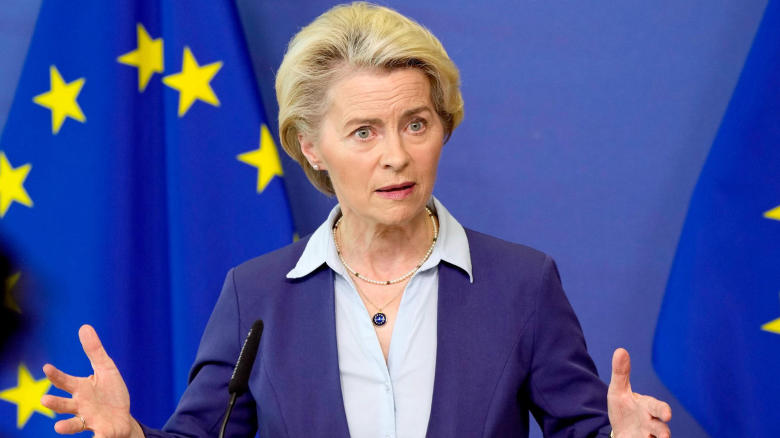

European Commission President Ursula von der Leyen announced a new proposal on Wednesday. The European Union (EU) plans to use frozen Russian assets to support Ukraine with 90 billion euros over the next two years. At the same time, international partners will cover the remaining cost. However, Belgium has strongly opposed the idea.
Von der Leyen explained that the EU wants to give Ukraine the strength to protect itself and negotiate peace from a position of power. She said the funds would help Ukrainians “equip them with the means to defend themselves and to lead peace negotiations from a position of strength.”
She added, “Since pressure is the only language the Kremlin responds to, we can dial it up. We have to increase the costs of war for Putin’s aggression, and today’s proposal gives us the means to do this.”
How the Plan Will Work
The EU could raise the money in two ways. First, it could borrow the funds itself. Second, it could use Russian central bank assets that have been frozen in Europe. This money would support a so-called “reparations loan,” a plan backed by the European Commission and several member countries.
Von der Leyen explained the method clearly.
“We propose to cover all financial institutions that have accumulated such cash balances, and these institutions would have to move the cash into the instrument of the reparations loan. So in other words, we’re taking the cash balances, we’re providing them to Ukraine as a loan, and Ukraine has to pay back this loan if and when Russia is paying reparations,” she said.
Most of this money will go toward making and buying military equipment inside Europe and EEA countries. Only in special cases would purchases come from outside the region.
Belgium Raises Strong Objections
Belgium holds most of the frozen Russian assets through Euroclear, an international financial group based in its country. Because of this, it fears serious legal and economic retaliation from Russia.
Belgian Foreign Minister Maxime Prevot said the legal proposals “do not address our concerns in a satisfactory manner”.
He also warned, “We have repeatedly said that we consider the option of the reparations loan the worst of all, as it is risky, it has never been done before.”
Instead, Belgium prefers that the EU raise money by borrowing from financial markets.
“This explains why we keep on pleading for an alternative, namely the EU borrowing the amounts needed on the markets.”
Commission Promises Strong Safeguards
In response, von der Leyen said the European Commission has listened carefully to Belgium’s worries. She said most of those concerns have already been addressed.
She promised that “very strong safeguards” will protect Belgium from any legal risk. She also assured that responsibility will be shared by all EU members.
“We will share the burden in a fair way,” she said.
To strengthen this protection, the Commission has created a so-called “three-tier defence” system. This system aims to reduce legal danger for Belgium. At the same time, the EU is also considering gaining access to another €25 billion in frozen assets located in other EU countries.
Adjusted Target and Widening Support
Earlier, the proposal aimed to reach €140 billion. Now, officials have reduced it. EU economy chief Valdis Dombrovskis said that €210 billion in Russian assets are potentially available, with more funds added only if necessary.
Under the plan, Ukraine will repay the loan only if Russia agrees to compensate for the destruction caused by the war.
Even if Belgium continues to resist, the proposal could still move forward through a weighted majority vote. Most EU countries have already shown strong support.
Germany’s Foreign Minister Johann Wadephul said, “We support this and, of course, take Belgium’s concerns seriously.”
He added, “They are justified, but the issue is solvable. Solvable if we stand together and are willing to take responsibility.”