
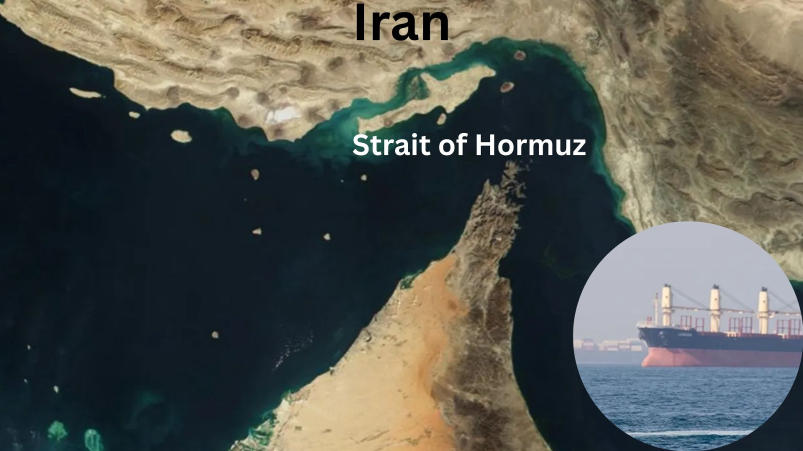

Investors fear a possible shutdown of the Strait of Hormuz, the world’s key oil shipping route, after the United States and Israel stepped up military strikes against Iran. Iran claims it has already closed the strait. However, it is still not clear whether vessels have fully stopped moving through the channel.
For India, which relies heavily on crude oil from the Middle East, any disruption could mean higher fuel prices, rising inflation and broader economic strain.
What Is the Strait of Hormuz?
The Strait of Hormuz lies between Iran and Oman. It connects the Persian Gulf to the Gulf of Oman and the Arabian Sea. At its narrowest point, it is just 33 kilometres wide. The actual shipping lanes are even tighter — only about 3 kilometres wide in each direction.
Despite its small size, around 20% of the world’s oil and gas supply passes through this narrow corridor every day. That equals roughly 20 to 21 million barrels of crude, condensate and refined fuels. It is also a critical route for liquefied natural gas, especially exports from Qatar.
This makes the strait one of the most strategically important trade routes on the planet.
Why It Matters to Global Energy Markets
Most oil exports from OPEC members — Saudi Arabia, Iraq, Kuwait, United Arab Emirates and Iran — travel through this passage, mainly to Asian markets. Qatar ships nearly all its LNG through these waters.
Even the possibility of disruption can drive oil prices sharply higher. Brent crude has already climbed amid fears of escalation. Analysts warn that if the strait remains blocked for long, prices could rise above $100 per barrel. In extreme scenarios, they could reach $120 to $150.
Oil markets respond to risk expectations. If tankers stop moving, insurers withdraw coverage, or freight costs surge, prices jump immediately — even if no formal closure is announced.
Recent reports suggest dozens of tankers are waiting outside the Gulf, delaying cargo movement and tightening supply.
Iran’s Strategic Position and Risks
Iran holds the world’s fourth-largest proven oil reserves — about 170 billion barrels. Beyond its own exports, its strategic power comes from its geography.
Tehran has repeatedly warned that it could shut the strait in response to military attacks. It has the tools to disrupt traffic, including sea mines, fast attack boats, submarines, drones and missile systems.
However, a complete closure would also harm Iran. It would stop its own oil exports and could strain relations with major buyers such as China. Analysts believe blocking the strait would likely be a last-resort move during a full-scale war.
Still, even limited disruptions — such as ship detentions, harassment or targeted strikes — could trigger major economic consequences worldwide.
Why India Faces High Risk
India imports about 55% of its crude oil from the Middle East. That equals roughly 2.7 million barrels per day. Compared to China, which reportedly holds up to six months of crude reserves, India’s buffer is much smaller.
The government says total storage could last about 74 days. However, refining sources suggest effective working inventories may cover only 20 to 25 days under current conditions.
If flows through the Strait of Hormuz slow significantly, India could face immediate pressure.
Possible Impact on India
Higher fuel prices: A jump in Brent crude would directly increase petrol and diesel costs.
Inflation: Costlier fuel would raise transport and manufacturing expenses, pushing up food and goods prices.
Wider trade deficit: More expensive imports would increase pressure on foreign exchange reserves.
Fiscal strain: If the government cushions retail fuel prices, subsidy costs could rise.
Currency volatility: Higher oil bills often weaken the rupee.
India has diversified its oil purchases in recent years, including increased imports from Russia. However, Middle Eastern crude remains central to its energy supply. A prolonged disruption would force India to compete in global markets for alternative supplies, likely at higher prices.
Wider Global Effects
Asian countries buy nearly 90% of Middle Eastern oil exports. Japan and South Korea depend heavily on Gulf energy but hold much larger strategic reserves — more than 200 days of supply.
Although Europe and the United States import less oil directly from the Gulf, they would still feel the impact. Oil prices are set globally, so disruptions anywhere affect markets everywhere.
Shipping costs are already rising. Freight rates for very large crude carriers have reportedly doubled. LNG shipping costs have climbed more than 40%. Insurance premiums have surged, and some major shipping lines have paused bookings to Gulf ports.
If tensions continue, global supply chains could face serious disruption similar to previous oil crises.
A Long History of Tension
The Strait of Hormuz has been a flashpoint before. During the 1980–88 Iran–Iraq War, both sides attacked oil tankers in what became known as the “Tanker War.”
In 2012, Iran threatened to block the strait in response to sanctions. In recent years, several tankers have been seized or attacked during periods of rising tension.
However, a complete and sustained shutdown would be unprecedented — and could trigger severe economic shock across the world. In short, the Strait of Hormuz remains a narrow waterway with enormous global importance. Any serious disruption could send energy prices soaring and place heavy pressure on economies like India’s that depend on Gulf oil.