
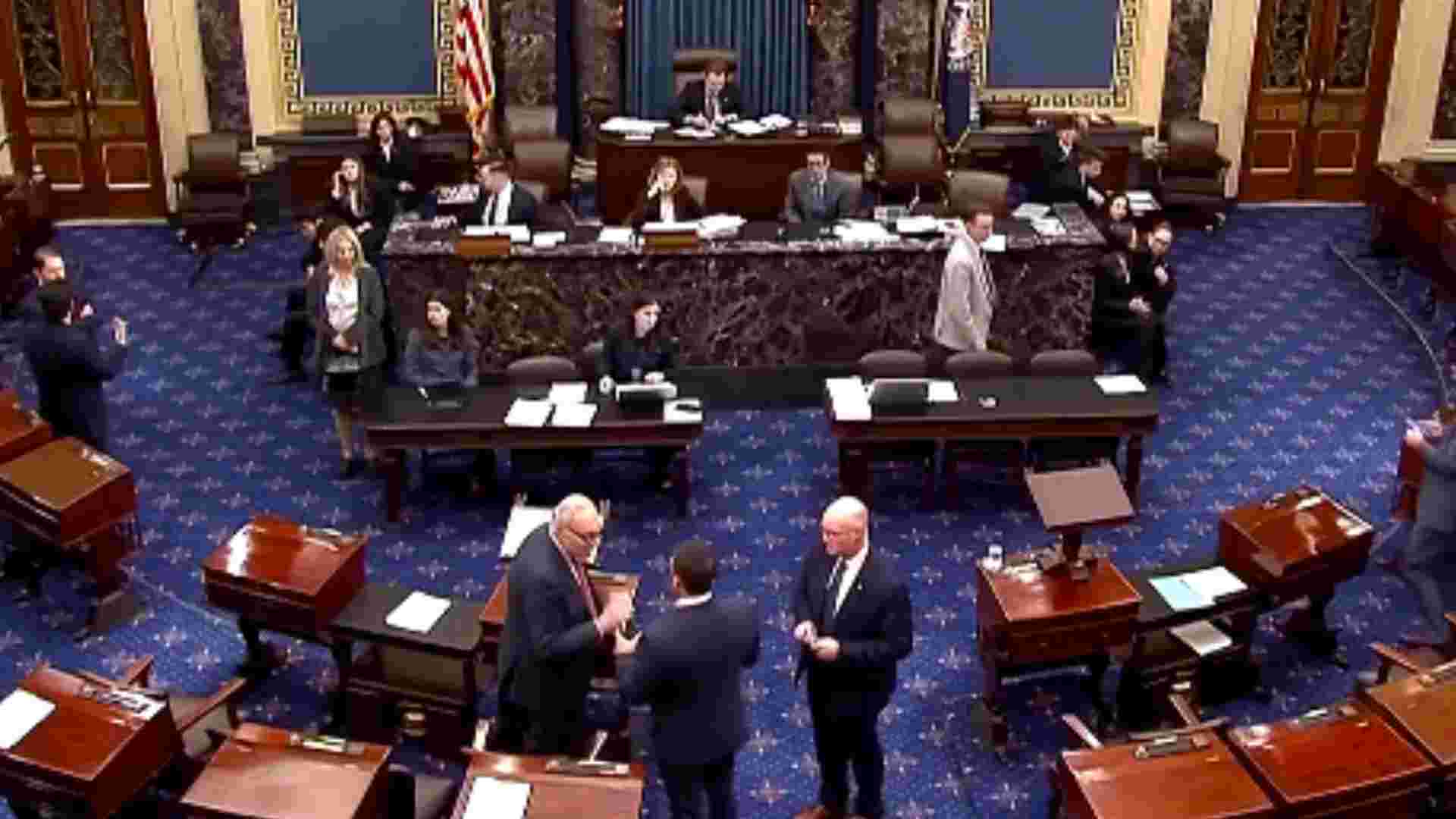

The US Senate on Tuesday passed a War Powers resolution that orders President Donald Trump to stop military operations against Iran unless Congress gives clear approval.
The vote marked the first war powers measure related to the Iran conflict to pass both chambers of Congress since the fighting began in February 2026. The House of Representatives had already approved the resolution on June 3 by a narrow 215-208 vote.
Republicans Join Democrats
The Senate remains under Republican control. However, four Republican senators broke ranks and voted with Democrats to pass the measure. The Republicans who supported the resolution were Susan Collins, Lisa Murkowski, Rand Paul, and Bill Cassidy.
One Democrat, John Fetterman, voted against the measure. The absence of two Republican senators also helped the resolution pass. Among them was former Senate Majority Leader Mitch McConnell, who recently entered a hospital for an undisclosed issue.
Resolution Bypasses Presidential Veto
Lawmakers approved the measure as a concurrent resolution. This status allows it to bypass the President’s desk. As a result, Trump cannot formally veto it. However, the White House plans to challenge whether the resolution has legal force.
Conflict Has Cost Lives and Money
Democratic Senator Tim Kaine led the effort to pass the resolution. The push came after months of fighting that started on February 28. On that day, US and Israeli forces launched coordinated airstrikes on Iran.
According to Gregory Meeks, the top Democrat on the House Foreign Affairs Committee, the conflict has killed 14 US service members and cost taxpayers billions of dollars.
Schumer Attacks Trump’s Iran Strategy
Senate Democratic Leader Chuck Schumer strongly criticized the administration during the debate. He said the Senate had now voted 10 times on efforts to limit Trump’s military campaign.
“For years, Trump promised to put maximum pressure on Iran, but he ended up delivering maximum confusion, maximum chaos, maximum cost to the American people with his disastrous war,” Schumer said. “It’ll go down in the history books as one of the worst foreign policy forays America has ever made.”
Schumer argued that the conflict has drained resources and created uncertainty at home and abroad.
Ceasefire Talks Face New Pressure
The vote came at a sensitive moment for the White House. Vice President JD Vance is leading talks to turn a preliminary agreement into a formal deal. Leaders signed the memorandum of understanding last week.
The agreement created a fragile ceasefire and opened a 60-day period for negotiations on Iran’s nuclear program.
Republicans Split Over Reconstruction Plan
Many Republicans oppose parts of Trump’s proposal. The biggest concern is a planned $300 billion reconstruction fund for Iran. Conservatives argue that the amount is too large.
They have compared it with the $1.7 billion refunded by the administration of Barack Obama in 2015. Republicans strongly criticized that payment at the time. The reconstruction proposal has widened divisions inside the Republican Party.
Pentagon Requests Emergency Funding
The Pentagon has also asked Congress for an $80 billion emergency funding package. Officials want the money to replace weapons, ammunition, and military supplies used during the conflict.
The request gives lawmakers additional influence over future military decisions.
Congress and White House Clash Over War Powers
The White House continues to argue that the War Powers Resolution of 1973 is unconstitutional. Administration officials also say US forces are not involved in active hostilities because the ceasefire has paused the fighting. Supporters of the Senate measure disagree. They say Congress must control decisions about war.
“The most solemn power for Congress is Congress has the power to declare war, not the president,” Kaine told reporters.
Trump Tries to Unite Republicans
Trump will travel to Capitol Hill on Wednesday to meet Republican senators behind closed doors. He hopes to strengthen support for his Iran strategy and calm growing opposition within his party.
The Senate vote highlights rising tensions between Congress and the White House. It also shows growing divisions inside the Republican Party as lawmakers debate America’s future role in the Iran conflict.