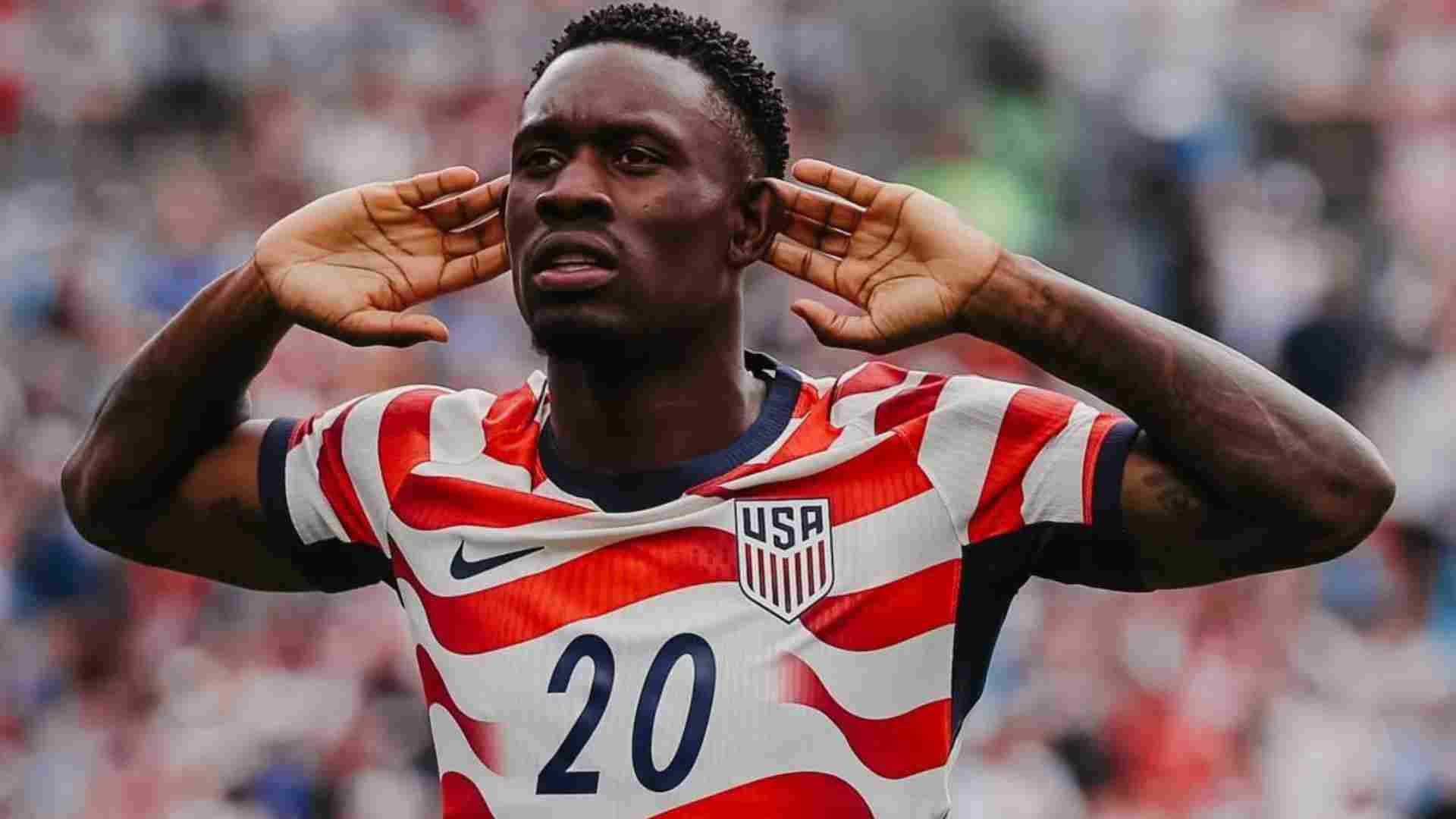
Folarin Balogun's suspension became one of the biggest controversies of the
FIFA World Cup after FIFA allowed the United States striker to play against Belgium despite receiving a red card in the previous round.
Balogun received a straight red card against Bosnia and Herzegovina in the Round of 32. The dismissal carried an automatic one-match suspension. However, FIFA later suspended the ban after US President Donald Trump requested a review during a phone call with FIFA President Gianni Infantino. The decision sparked criticism across the football world. Many questioned whether political influence had affected FIFA's disciplinary process.
Why Did Folarin Balogun Receive a Red Card?
The incident happened during the USA's Round of 32 match against Bosnia and Herzegovina on July 1. In the 64th minute, Balogun chased a loose ball and caught Bosnian defender Tarik Muharemovic on the ankle with his boot.
Referee Raphael Claus stopped play and consulted the Video Assistant Referee (VAR). He then reviewed the challenge on the pitch-side monitor before showing Balogun a straight red card. The USA still won the match 2-0 and reached the Round of 16. At that point, Balogun was expected to miss the knockout match against Belgium.
Donald Trump Requested a FIFA Review
The situation changed on Sunday. FIFA announced that it had suspended Balogun's one-match ban. Soon after, Donald Trump confirmed that he had spoken with FIFA President Gianni Infantino.
"I asked for a review because I didn't think it was a foul. All I did was ask for a review, I didn't say you have to do this," Trump said. The red card stayed on Balogun's record, but FIFA allowed him to play against Belgium.
Which FIFA Rule Allowed Balogun to Play?
FIFA based its decision on Article 27 of its Disciplinary Code. The rule allows FIFA's judicial body to suspend a disciplinary punishment and place a player on probation instead. Balogun received a one-year probation period.
If he commits another similar offence during that period, FIFA can enforce the suspended ban along with any new punishment. FIFA said Article 27 does not apply to match-fixing cases. However, it can apply to other disciplinary matters.
Has FIFA Done This Before?
The decision has very few precedents. Since FIFA introduced automatic one-match suspensions for red cards in 1970, no player has avoided serving the ban for a red card received during a World Cup. Before that rule existed, Brazil legend Garrincha received a red card in the 1962 World Cup semi-final. A disciplinary panel later cleared him to play in the final.
Cristiano Ronaldo also benefited from a deferred suspension before the 2026 World Cup. However, that punishment came from another competition and not from a World Cup match. There is no known modern World Cup case in which FIFA suspended a one-match ban for a red card shown during the tournament.
Belgium Objected to FIFA's Decision
Belgium's football federation strongly opposed FIFA's ruling. Officials argued that the decision went against Article 66.4 of the FIFA Disciplinary Code, Article 10.5 of the 2026 FIFA World Cup Competition Regulations and FIFA World Cup 2026 Circular No. 16. Those rules state that a player sent off with a red card must serve an automatic one-match suspension.
FIFA Defends Its Decision
FIFA's disciplinary committee defended the ruling. The committee said Article 27 gives it "the discretion to suspend the implementation of any disciplinary measures so long as they do not relate to match manipulation - which, of course, did not occur here".
It also said there are "no provisions" in the disciplinary code that "prohibit" the committee from using that discretion. The committee is chaired by UAE lawyer Mohammad Al Kamali. FIFA Congress elects its members for four-year terms.
Coaches and Football Legends Criticise FIFA
Several leading figures questioned FIFA's decision. Norway coach Stale Solbakken said, "What about the next red card? What happens then?. It’s a bad, bad, bad, bad, bad decision that will hurt the World Cup."
England coach Thomas Tuchel also raised concerns. He accepted that Balogun may not have deserved a red card. However, he pointed out that VAR had already reviewed the challenge.
"Who overturns this decision then, and when? And on what grounds? How far does this go now? This is strange for me … Where does this start and where does this end," Tuchel said.
Former England striker Ian Wright also criticised FIFA. "We're talking about integrity, people talking about transparency, but you look at some of the things that’s happened in this tournament with certain teams, it’s been… shameful," he said.
Gianni Infantino Responds
Gianni Infantino confirmed that Donald Trump had contacted him. He said he regularly speaks with world leaders, government officials and football stakeholders.
"On this matter, I did receive a call from President Donald Trump, just as I receive calls from heads of state, government officials, football stakeholders and business executives from around the world on many different issues," Infantino said. He added that FIFA's independent judicial bodies handled the review and insisted that he did not interfere in their work.
USA Exit Despite Balogun's Return
Balogun returned for the Round of 16 after FIFA suspended his ban. However, the decision did not change the result. Belgium beat the United States 4-1 and knocked the co-hosts out of the FIFA World Cup. The controversy may have ended with the USA's exit, but FIFA's decision continues to raise questions about consistency and transparency in the tournament's disciplinary process.