
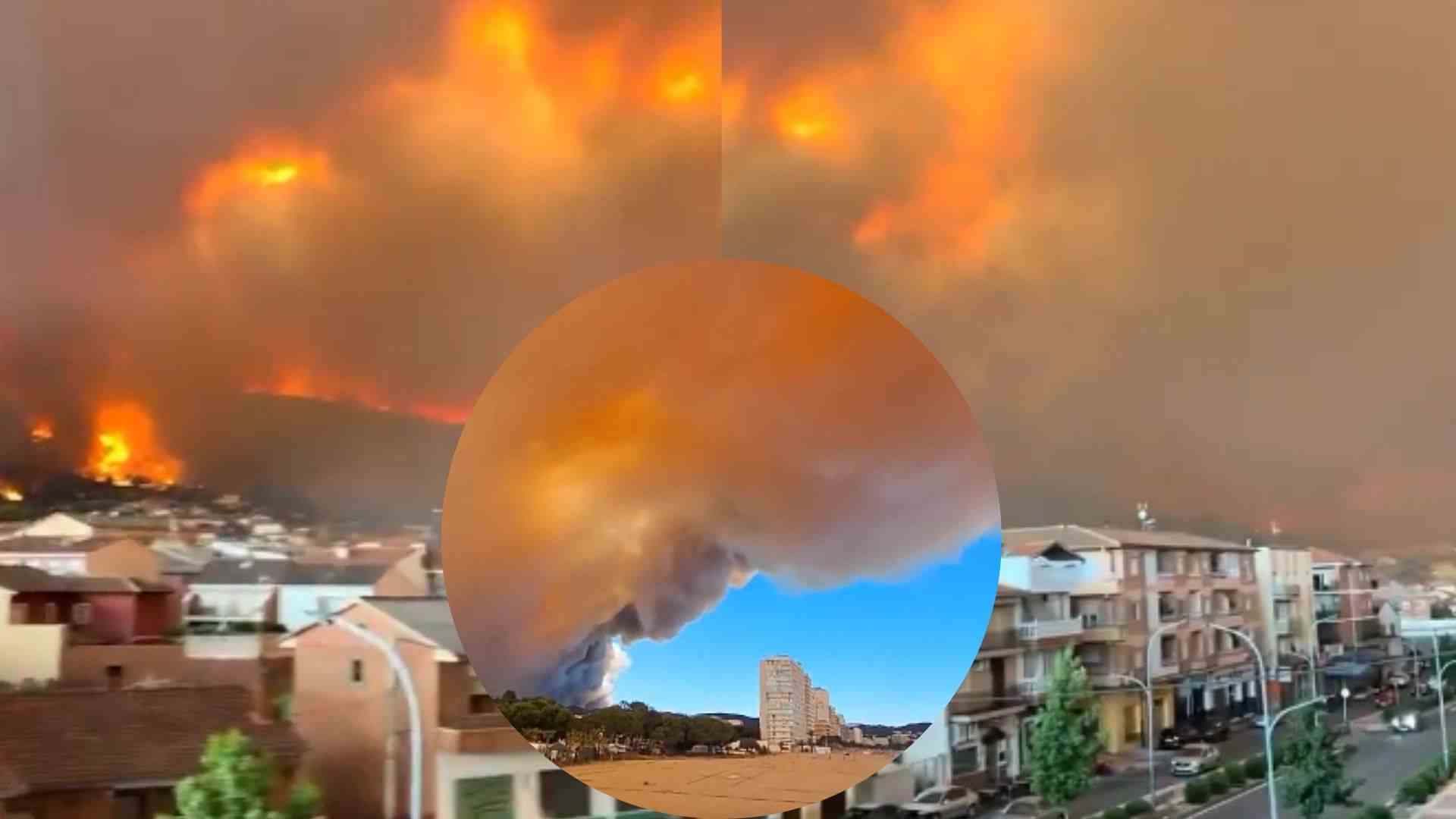

France and Spain are battling some of the worst wildfires in recent history, with firefighters struggling to contain fast-moving blazes. Thousands of people have fled their homes as the fires continue to spread, while officials warn that dangerous weather conditions are making the situation even worse.
France has evacuated tens of thousands of residents from the Gironde region near Bordeaux. At the same time, Spain is racing to control massive fires burning west of Madrid.
Adding to the crisis, France is facing an unusual and dangerous phenomenon known as fire clouds, which create their own weather and make wildfires far more difficult to control.
France and Spain Continue Fight Against Massive Wildfires
French President Emmanuel Macron said firefighters had managed to contain one wildfire in southwest France. However, a much larger blaze near Bordeaux continues to burn.
In Spain, Interior Minister Fernando Grande-Marlaska said the next few hours would be "absolutely decisive" in efforts to bring the fires under control west of Madrid. Authorities in both countries remain on high alert as extreme heat, dry conditions and strong winds continue to fuel the flames.
What Are Fire Clouds?
Fire clouds, scientifically known as pyrocumulonimbus or pyroCb clouds, are giant storm clouds created by intense wildfires. According to the Royal Meteorological Society, these clouds form in much the same way as ordinary thunderstorm clouds. However, instead of heat from the sun, the powerful upward movement of air comes from massive wildfires or volcanic eruptions. The word "pyro" comes from the Greek word for fire.
When a wildfire becomes extremely hot, it releases huge amounts of heat and energy. This hot air rises rapidly in a thick smoke plume. As it climbs higher into the atmosphere, the air cools, allowing moisture to condense into a cloud. These clouds can then generate strong winds, thunderstorms and lightning, creating even more dangerous conditions.
NASA Says Fire Clouds Can Reach the Stratosphere
According to NASA, extremely large wildfires can produce fire clouds that rise high enough to enter the stratosphere. Scientists sometimes describe these massive clouds as the "fire-breathing dragon of clouds" because of their enormous size and destructive power.
Jean-Baptiste Filippi, a researcher at France's National Center for Scientific Research (CNRS), compared the process to a condensing boiler. Heat forces moist air upward, where it cools and forms clouds. The condensation then releases more heat, pushing the cloud even higher.
He told Le Monde that this process is currently taking place in France's Gironde region.
France Records Fire Clouds for the First Time
Fire clouds have appeared before in countries such as the United States, Canada and Australia. Scientists also observed them in Siberia during recent Arctic heatwaves.
These extreme wildfires often burn at temperatures above 800°C and become so powerful that they create their own weather systems. However, France is witnessing this phenomenon for the first time. The country's National Firefighters Federation said it had never previously recorded a pyrocumulonimbus cloud.
Officials said the first fire cloud developed two days after the wildfire started. Higher humidity weakened it overnight, but it reappeared several times afterward.
Officials Describe an Unprecedented Situation
Sophie Broacs, the prefect of Gironde, described the situation as unlike anything firefighters had experienced before. She told Le Monde, "Yesterday evening (July 27), we faced another firestorm, the same incredible, unprecedented, unknown phenomenon as the one we saw on Friday, when we realised we were entering a new dimension."
She added that it is "a completely unpredictable phenomenon, combining both fire and the storm it itself creates, with lightning strikes sparking new fires and winds fanning the flames. All of this is happening in a department with one of the largest forests in Europe, so there is an abundance of combustible material."
Why Fire Clouds Are So Dangerous
Fire clouds pose an extreme danger because they create their own weather systems. Experts say these clouds generate powerful and unpredictable winds that can suddenly change the speed and direction of a wildfire. As a result, flames can spread into new areas without warning.
The clouds also produce lightning, which can ignite fresh wildfires several kilometres away from the main fire. Rick McRae, an adjunct professor with the University of New South Wales' bushfire research group, told The Guardian, "These things, they get up to roughly 10,000 cubic kilometres of the atmosphere, so they have a big impact."
Firefighters Face an Unpredictable Enemy
French firefighters say the fire clouds have made their work much harder. A spokesperson for France's National Firefighters Federation (FNSPF) told The Independent that the fires no longer behave like normal wildfires.
"[It is] unlike a standard fire that spreads in a conical pattern. The result is that it spreads in every direction and develops multiple fire fronts. We don’t know how the blaze will spread; the fire front is constantly shifting.
“We cannot fight it directly. It’s a David-versus-Goliath scenario.”
Christophe Chantepy, a specialist at France's National Forests Office, also warned about the risks.
He told Le Monde, "It (a fire cloud) is dangerous because it creates its own weather conditions. It is more powerful, erratic, and therefore unpredictable. Spot fires are much more likely, with burning embers [flaming plant debris] that can be thrown out of the convection column."
Fire Clouds Can Affect Climate and Air Quality
Scientists warn that fire clouds do more than spread flames. They push enormous amounts of smoke into the lower stratosphere, where it can remain for months or even years. Unlike smoke in the lower atmosphere, rainfall cannot easily remove it.
Researchers say large fire clouds can have effects similar to a moderate volcanic eruption. Once the smoke reaches high altitudes, winds can carry it across continents and even around the world. This can affect air quality and may also influence the global climate.
Climate Change is Increasing the Risk
Experts say climate change is making fire clouds more common. In the past, these clouds mainly appeared during severe wildfire seasons in Australia and California. Now they are emerging in places such as France, where they were once considered extremely rare.
According to the European Union's Copernicus Climate Change Service, rising global temperatures have brought repeated heatwaves and prolonged droughts across Europe. These conditions create large amounts of dry vegetation that fuels massive wildfires and the formation of fire clouds.
Scientists warn that Europe is likely to experience more frequent heatwaves in the coming years. As a result, they expect dangerous fire clouds to become an increasingly common threat.