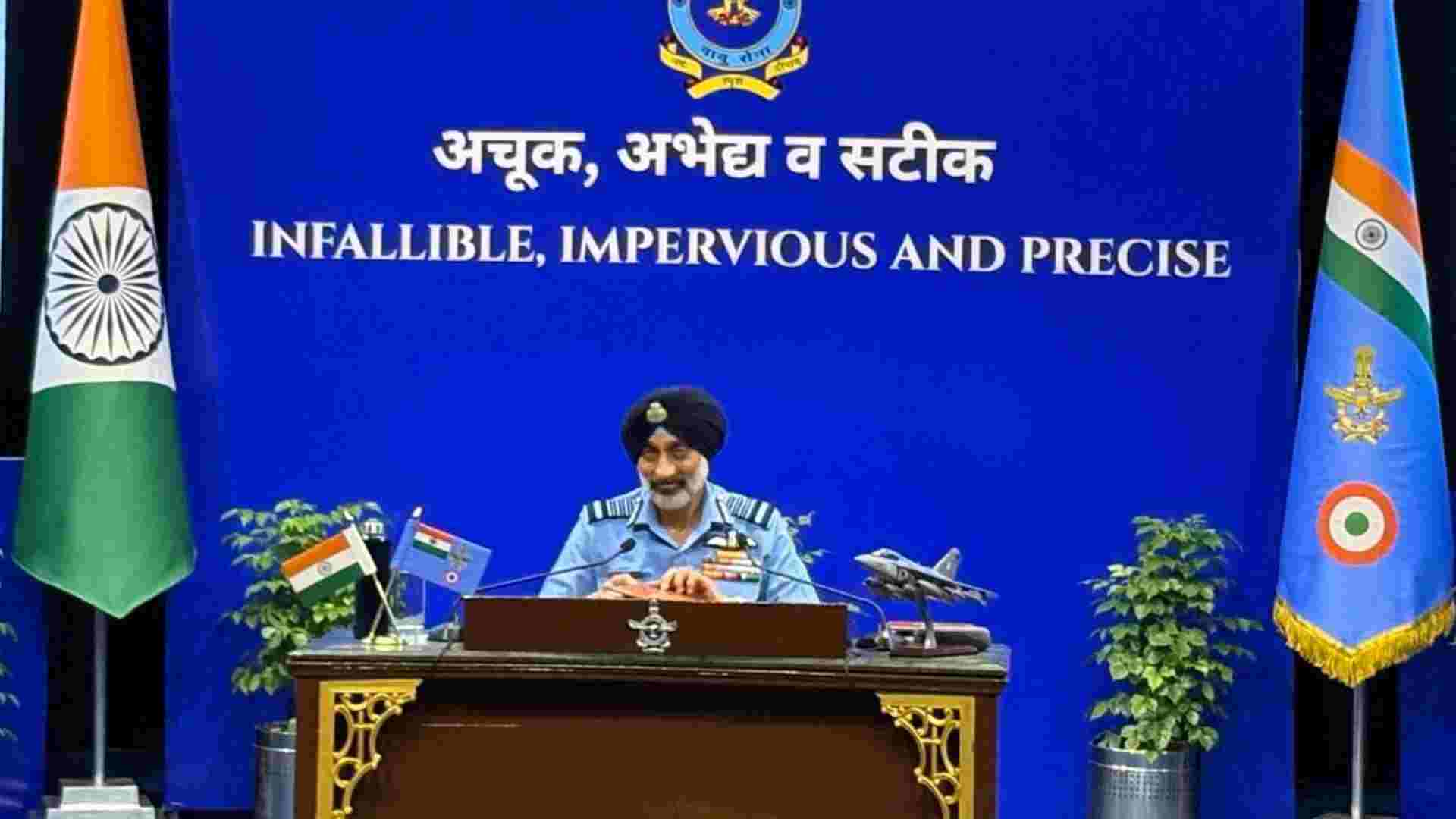
The Indian Air Force (IAF) needs to induct around 36 to 40 fighter aircraft every year to prevent its squadron strength from declining further, Air Chief Marshal AP Singh said.
Speaking at the IAF’s Annual Press Conference, Singh explained the scale of aircraft production and induction required to strengthen the service’s combat fleet. The
IAF currently needs the equivalent of almost two fighter squadrons every year. This would first help stop the decline below 30 squadrons and later allow the force to move towards its authorised target of 42 squadrons.
“In case we have to target some time... we need almost two aircraft squadron inductions every year,” Singh said. This works out to around 36–40 fighter aircraft annually. However, the Air Chief said the IAF’s actual requirement could eventually be higher.
Tejas Engine Supply Is Critical
The availability of engines for the Tejas Mk1A will play a major role in determining how quickly the IAF can receive new aircraft. Singh said Hindustan Aeronautics Limited (HAL) is discussing a production capacity of around 24 Tejas aircraft per year. However, reaching that level will depend heavily on solving the engine supply problems that have affected the programme.
According to Singh, 12 additional engines are expected to arrive during the current year. After that, around 20 engines per year have been promised. If HAL produces about 20 aircraft annually instead of its planned capacity of 24, other fighter programmes could help make up the shortfall, Singh said.
The situation highlights an important difference between manufacturing capacity and actual deliveries. A company may have the capacity to build a certain number of aircraft, but engine availability and other supply issues can determine how many aircraft actually reach operational squadrons.
MRFA and Su-30 Could Increase Annual Inductions
The proposed Multi-Role Fighter Aircraft (MRFA) programme could provide another major source of fighter aircraft for the IAF if the contract moves ahead. Singh said the programme could eventually deliver around 12 aircraft every year. If the IAF receives about 20 Tejas Mk1As and 12 MRFA aircraft annually, total additions could reach roughly 32 aircraft before counting other deliveries.
The IAF also has a contract for 12 additional Su-30 aircraft. Singh indicated that six of these aircraft could be delivered in one year and the remaining six in the following year. Such deliveries could further increase the annual induction rate and help push it closer to the required 30–40 aircraft range.
The combined contribution from Tejas, MRFA and Su-30 programmes could therefore bring the IAF closer to the pace required to rebuild its fighter strength. However, this depends on the programmes moving ahead according to schedule.
IAF First Needs to Stop the Decline
The IAF’s immediate goal is not to reach 42 squadrons at once. Its first priority is to stop its fighter strength from falling further as older aircraft gradually retire. The mathematics behind the challenge is straightforward. The IAF must induct new aircraft faster than it retires ageing fighters if it wants to reverse the decline.
This makes several factors crucial. Engine availability, Tejas production, future fighter contracts and delivery schedules will all determine how quickly the IAF can increase its combat fleet. Singh said the IAF remains hopeful that its different fighter programmes will progress and allow the service to achieve its planned growth rate.
For the IAF, the requirement is clear: it needs roughly two fighter squadrons, or about 36–40 aircraft, every year to first maintain its existing strength and then begin rebuilding its combat fleet towards the 42-squadron target.