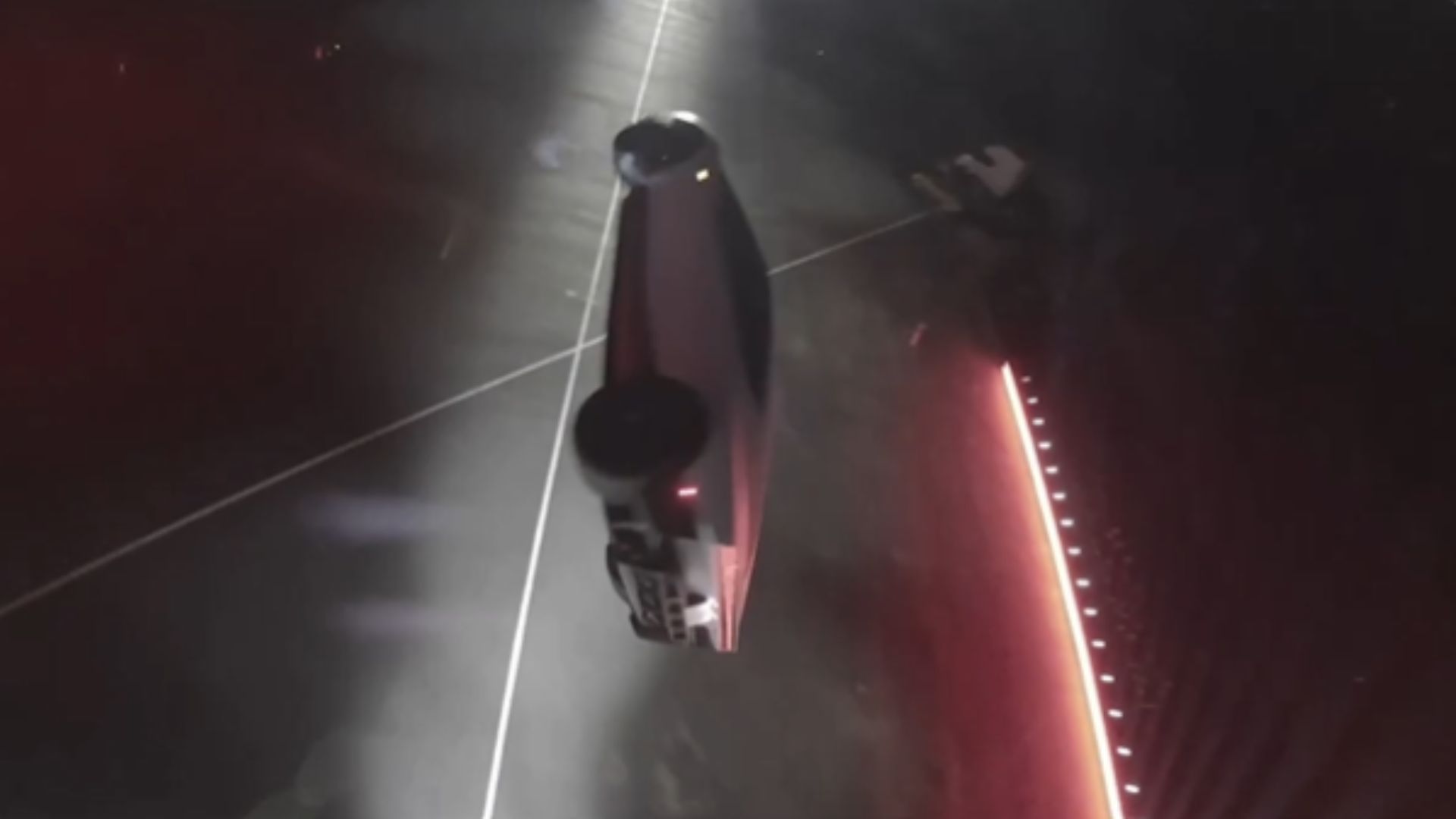
Tesla has unveiled a redesigned version of its next-generation Roadster electric sports car, showcasing advanced features such as built-in thrusters and flying-car-like manoeuvres. The reveal comes nearly nine years after the company first presented the prototype, with production now targeted for 2028.
The demonstration took place on Thursday at a SpaceX test site in McGregor, Texas. The vehicle was shown driving upside down on a ramp using a suction system, rotating in mid-air and landing with the help of built-in thrusters. The Roadster is being developed in collaboration with SpaceX, the rocket company founded by Tesla CEO Elon Musk.
However, questions remain about whether these features would be practical, safe or legally permitted on public roads.
Tesla Roadster Launch Date: Why Is Production Expected in 2028?
Tesla first unveiled the prototype of its second-generation Roadster in 2017 and initially promised deliveries in 2020. The latest announcement moves the expected production start to 2028, extending the wait for the electric sports car by several years.
Musk had previously said the four-seat Roadster would offer a driving range of 620 miles (1,000 km) on a single charge. However, the final production specifications and performance capabilities remain to be confirmed.
Despite the excitement surrounding the vehicle, Musk has played down its expected contribution to Tesla's finances. In 2023, he described the project as a "small potato situation" that would not "move the needle in a major way financially."
Nevertheless, analysts see the Roadster as an opportunity for Tesla to showcase its engineering capabilities and strengthen its position in the premium electric vehicle market.
"Tesla does not currently have a halo car, or high-performance luxury vehicle designed to showcase an automaker's best engineering and technology. The Roadster will be Tesla's new halo car," Morningstar analyst Seth Goldstein said in a note last month.
Goldstein expects Tesla to sell around 2,000 Roadsters annually. This would be a small proportion of the company's overall sales, considering that Tesla sold approximately 1.6 million vehicles last year.
Can the Electric Sports Car Perform Flying Manoeuvres?
The latest demonstration highlighted the unusual technology planned for the next-generation Roadster. The vehicle performed an upside-down manoeuvre on a ramp with the help of a suction system, rotated in mid-air and landed using built-in thrusters.
These features distinguish the Roadster from conventional electric sports cars and reflect the collaboration between Tesla and SpaceX. However, the demonstration does not establish that the vehicle can fly like an aircraft or that these manoeuvres will be available during everyday driving.
The technology also raises questions about safety, engineering requirements and regulatory approval. Tesla has yet to establish how these features would work in a production model or whether they would be permitted on public roads.
How the Original Electric Sports Car Changed EVs
The original Tesla Roadster was launched in 2008 and remained on sale until 2012. Built on a Lotus Elise chassis, it was Tesla's first electric vehicle and helped challenge the perception that electric cars could not deliver high performance.
Tesla later expanded its lineup with the Model S and Model 3 sedans, followed by the Model X and Model Y SUVs. These vehicles helped the company reach a broader customer base and become a major name in the electric vehicle industry.
The next-generation Roadster marks a return to Tesla's performance-car roots. However, its extended development timeline has made it one of the company's most anticipated vehicle projects.
Tesla Shifts Focus to AI, Autonomous Driving and Optimus Robots
The Roadster reveal comes as Tesla increasingly focuses on artificial intelligence, autonomous driving and robotics alongside its electric vehicle business.
The company has been developing its Optimus humanoid robot programme and has introduced the Cybercab, a two-seat robotaxi designed without conventional manual driving controls.
Tesla has also been reallocating production capacity towards its Optimus programme, including plans to wind down production of the Model S and Model X. This reflects the company's broader effort to expand beyond traditional electric vehicle manufacturing.
The Roadster could help Tesla demonstrate its engineering expertise and reinforce its technology-focused brand image, even if annual sales remain limited compared with its mainstream vehicles.
Production, Price, Specifications and What to Expect
Tesla's latest demonstration has renewed interest in the long-awaited electric sports car, but the company must still turn the concept into a production-ready vehicle.
The planned 2028 production start remains a target and does not guarantee that customer deliveries will begin that year. Details about the final design, price, performance specifications and regulatory compliance will be important as development continues.
For Tesla, the Roadster represents an opportunity to showcase high-performance electric vehicle technology while the company pursues its wider ambitions in artificial intelligence, autonomous transport and robotics.