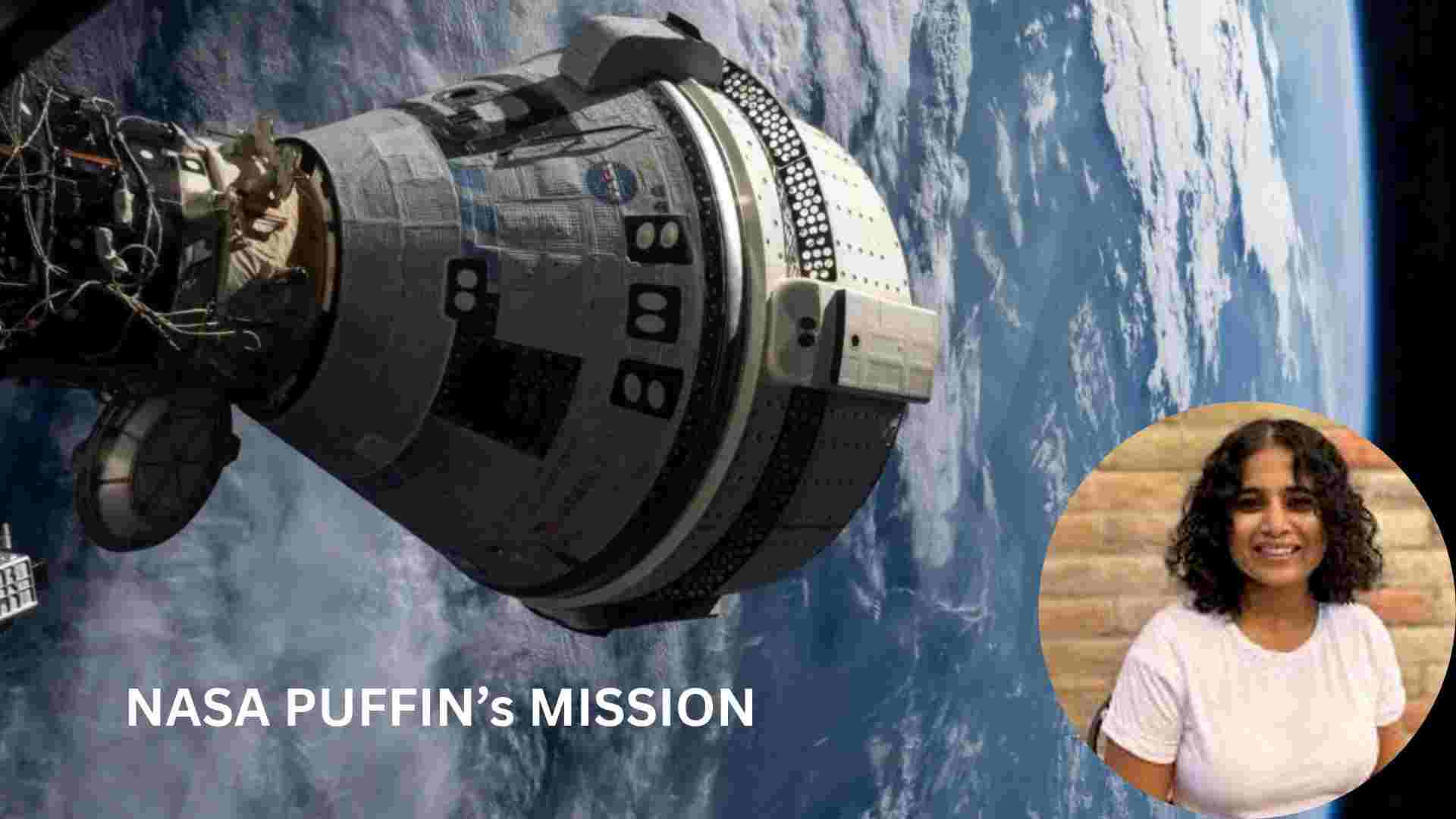
Dr Ramya Manjunath Anche, an assistant research professor at the University of Arizona’s Steward Observatory, has been chosen to lead NASA’s PUFFINS mission. The project will investigate tiny dust particles found in the space between stars.
NASA has allocated $20 million for the mission, which is scheduled for launch in 2030.
PUFFINS stands for Polarimetry in the Ultraviolet to Find Features in INterStellar dust. The mission will use a small satellite equipped with a telescope measuring approximately 10 inches across. It will observe ultraviolet light from around 70 stars to help scientists understand the properties, distribution and behaviour of interstellar dust.
These particles are extremely small, with some measuring less than 50 nanometres. Despite their size, they play an important role in how light travels through space and in the processes that lead to the formation of stars and planets. However, their tiny dimensions make them difficult to examine through conventional optical and infrared observations.
How NASA’s PUFFINS Mission Will Study Interstellar Dust
The PUFFINS mission will use ultraviolet spectropolarimetry to investigate interstellar dust. This technique measures the polarisation of ultraviolet light across different wavelengths, allowing scientists to study how light changes as it passes through dust particles in space.
By analysing these changes in starlight, researchers hope to determine how dust grains align with the Milky Way’s magnetic field. The observations could also reveal more about the physical characteristics of these particles and how they behave in different conditions.
According to the mission team, ultraviolet polarisation measurements of interstellar dust remain limited. Some of the earlier space-based observations in this field date back to the early 1990s.
PUFFINS aims to expand the available scientific data and address important gaps in researchers’ understanding of interstellar dust. Its findings could provide fresh insights into the material that exists between stars and its influence on astronomical observations.
International Collaboration Includes Indian Research Institutions
The mission brings together researchers from the University of Arizona, McDonald Observatory and several scientific institutions around the world.
India will also contribute to the project through the Inter-University Centre for Astronomy and Astrophysics (IUCAA) in Pune and the Indian Institute of Astrophysics (IIA) in Bengaluru.
The participation of these institutions will strengthen international collaboration in space science and astronomical research. The project will also provide opportunities for graduate and undergraduate students to participate in instrument design and development.
Involving students in the mission is expected to give young researchers practical experience in developing scientific instruments and working on a space-based research project.
Ramya Anche’s Journey From Bengaluru to NASA Mission Leadership
Anche grew up in Devanahalli, near Bengaluru, and pursued her education and research in India before moving to the United States.
She joined the Indian Institute of Astrophysics in 2012, where she later completed her doctoral research. In 2021, she joined the University of Arizona’s Steward Observatory as she continued developing her research career in astronomy.
Her areas of expertise include astronomical polarimetry, optical design, high-contrast imaging and space telescopes. These fields are closely connected to the techniques and instruments required for the PUFFINS mission.
Anche submitted the proposal for PUFFINS while working as a postdoctoral researcher. NASA selected the project through a competitive proposal process under its Astrophysics Pioneers programme, which supports missions led by early-career scientists.
Her appointment as principal investigator places her at the forefront of the mission’s scientific direction and development.
PUFFINS Could Support Future Searches for Habitable Planets
Beyond studying interstellar dust, the mission could help scientists plan future space-based observations. Its findings may prove useful in developing techniques and instruments for upcoming astronomical projects.
One potential area of application is NASA’s proposed Habitable Worlds Observatory, which is intended to study planets beyond the solar system that could potentially support life.
Understanding interstellar dust is important because these particles can affect the light astronomers observe from distant stars and planetary systems. Better knowledge of their properties could help scientists interpret astronomical data more accurately.
With its planned 2030 launch, PUFFINS aims to improve understanding of interstellar dust while advancing ultraviolet observation techniques. The mission will also strengthen international research partnerships and create opportunities for emerging scientists to contribute to space exploration.