
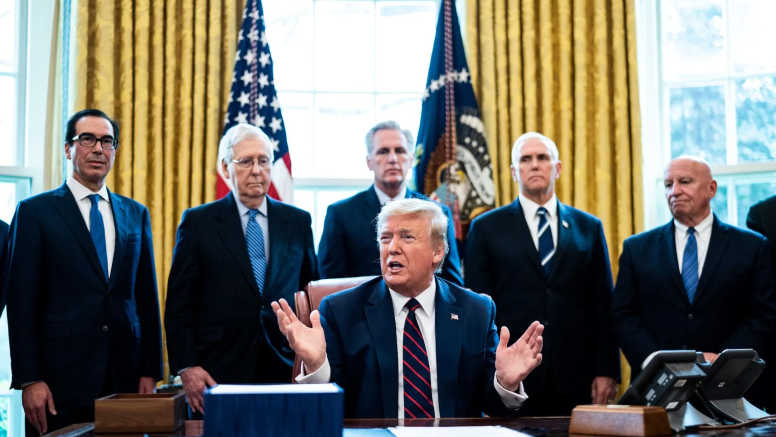

The Trump administration is urging the US Supreme Court to allow restrictions on birthright citizenship. Meanwhile, legal battles continue as US President Donald Trump tries to change this long-standing constitutional right.
Trump Seeks Emergency Approval
The administration filed an emergency request on March 13. It asked the court to let officials deny citizenship to children born in the U.S. after February 19 if their parents are in the country illegally.
Shortly after taking office in January, Trump signed this order. However, district judges in Maryland, Massachusetts, and Washington blocked it. As a result, the policy is currently suspended nationwide.
Birthright Citizenship in the U.S.
According to the 14th Amendment, anyone born in the U.S. automatically becomes a citizen, including children of undocumented immigrants. This law has been in place since the Civil War era.
Trump and his supporters argue that the U.S. should tighten citizenship laws. In his executive order, he described U.S. citizenship as “a priceless and profound gift.” However, legal experts insist that the 14th Amendment makes it difficult to change this policy.
Trump’s Repeated Opposition
For years, Trump has criticized birthright citizenship. He has called it “ridiculous” and falsely claimed that the U.S. is the only country that allows it. In contrast, many nations, especially in the Americas, follow the same principle.
Critics warn that ending birthright citizenship would cause chaos. Millions of people might struggle to prove their nationality. More importantly, they argue it could harm America’s identity as a nation built by immigrants.
Alex Nowrasteh, vice president at the Cato Institute, warned, “Eliminating birthright citizenship could eventually place every single person in America in the precarious position of having to prove American citizenship.”
Meanwhile, a 2019 Migration Policy Institute report found that 5.5 million children live with at least one undocumented parent. Notably, most of these children are U.S. citizens.
The 14th Amendment Debate
The 14th Amendment, ratified in 1868, states: “All persons born or naturalized in the United States, and subject to the jurisdiction thereof, are citizens of the United States.”
However, its protections have not always been universal. For example, Native Americans only gained birthright citizenship in 1924.
Trump and his allies claim that the phrase “subject to the jurisdiction thereof” allows the government to deny citizenship to children of undocumented immigrants. Nevertheless, most legal scholars reject this interpretation. In fact, they cite Supreme Court rulings that reaffirm birthright citizenship.
A Fight Over Executive Power
Interestingly, Trump’s appeal does not directly challenge birthright citizenship. Instead, he wants to limit federal judges’ power to block presidential orders nationwide.
The Justice Department argues that district courts should not have the authority to suspend national policies. Meanwhile, some conservative Supreme Court justices have expressed concerns about nationwide injunctions, though the court has never issued a ruling on them.
If the Supreme Court rules in favor of Trump, it could reshape how courts handle legal challenges. Moreover, it might make it harder to block controversial policies in the future.