
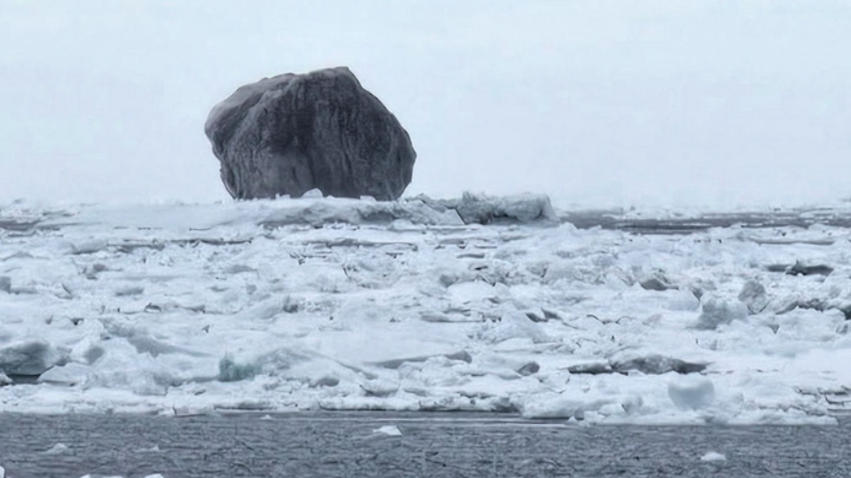

A rare black iceberg recently appeared off the coast of Labrador, Canada. This unusual sight shocked many people and quickly went viral online.
Fisherman Hallur Antoniussen discovered the iceberg last month. At the time, he was fishing for shrimp near Carbonear aboard his boat, Saputi. To his surprise, he saw a dark iceberg floating among pale white ice chunks.
Fisherman Describes the Scene
Antoniussen said he had never seen anything like it before. "I have seen icebergs that are rolled, what they say have rolled in the beach with some rocks in it. This one here is completely different. It's not only that he is all black. He is almost in a diamond shape," he told CBC Radio.
Moreover, he guessed the iceberg was huge—at least three times bigger than a bungalow. He didn’t have a camera ready, but he acted fast.
"So, I just ran to my room and took my phone and snapped this picture," he said.
Social Media Reacts to Viral Image
Soon after Antoniussen posted the photo, it spread rapidly across social media. Many users expressed surprise. "I have seen lots of big icebergs but never a black one," said one person. Another added, "This is my first time seeing a black iceberg!!"
Additionally, some tried to explain the strange color. One user commented, "It's likely a boulder resting on the surface of the ice that rolled or fell onto the glacier on land prior to the iceberg being calved at tidewater on the coast of Greenland."
Experts Explain the Color
Usually, icebergs appear white. This happens because small air bubbles inside them scatter light in all directions. However, as ice gets older and compresses, it loses air. Then it becomes clear, like glass.
At the same time, some icebergs turn black or grey. This happens when dark material like dirt or rocks becomes trapped in the ice. Often, the iceberg rolls over a dirty surface, picking up debris along the way.
Glaciologist Offers a Theory
Glaciologist Lev Tarasov from Memorial University in Canada offered more insight. He said the black iceberg likely broke off a larger glacier and fell into the ocean.
As it drifted through Baffin Bay and along the Labrador coast, it slowly melted.
"Over time, as it travels around Baffin Bay and down the coast of Labrador, it's melting away," said Mr. Tarasov.
"Maybe the part that's clean is underneath, right? Again, 90 per cent of the ice is underneath the water. So we're only seeing the tip of the iceberg on top."