
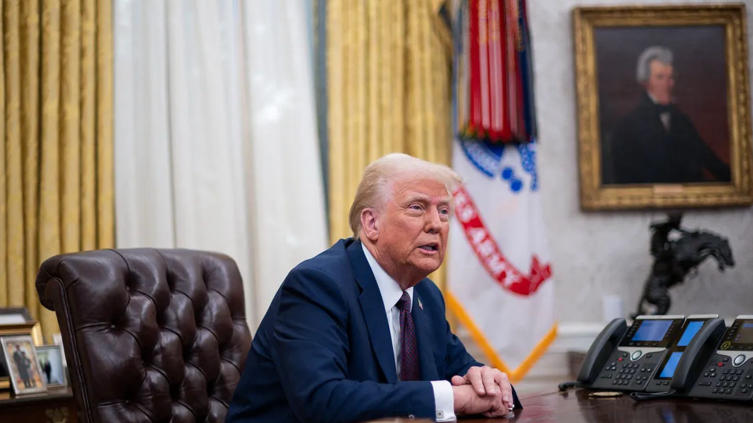

US President Donald Trump has declared that starting August 1, he will impose 30 percent tariffs on goods coming from Mexico and the European Union. This decision, announced on Saturday through two separate posts on Truth Social, threatens to further strain trade relationships with two of the United States’ biggest economic allies.
Trump accused Mexico of “failing to stop the Cartels” and expressed disappointment over stalled trade talks with the EU. These new tariffs come at the end of a turbulent week in international trade, during which Trump targeted over 20 countries with either new or increased trade duties. He also revealed plans to introduce a 50 percent tariff on copper, unsettling global markets that were already nervous about his aggressive economic moves.
Europe Caught Off Guard Despite Ongoing Talks
In his message to European leaders, Trump repeated earlier warnings of more penalties if talks did not lead to favorable terms for the U.S. Despite weeks of negotiations, including efforts by European officials who traveled between Brussels and Washington, the former president appears determined to press ahead with the tariffs.
Both sides had been discussing the removal or reduction of several existing duties. These included a 25 percent tariff on cars and auto parts, and proposals to eliminate taxes on aircraft, alcoholic beverages, and industrial machinery. The EU, in an attempt to lower its €198 billion goods trade surplus with the U.S., had offered to increase its purchases of American liquefied natural gas and military equipment. However, Trump’s new tariff plan shows that these efforts haven’t changed his position.
Under his administration, the U.S. had already enforced a 25 percent tariff on EU steel and aluminum, and a 10 percent base tariff on most other imports. So far, the EU has avoided retaliating but warned that countermeasures are ready if Washington goes ahead with the new duties.
Mexico Faces Renewed Tariff Threats
Mexico is also under fresh pressure. Earlier this year, Trump had targeted both Mexico and Canada with 25 percent tariffs, citing immigration problems and fentanyl trafficking. However, he had exempted most Mexican goods from higher duties under the United States-Mexico-Canada Agreement (USMCA), signed in 2020.
Between January and March, nearly 87 percent of Mexican exports entered the U.S. without any tariffs, according to Mexico’s economy ministry as cited by the Financial Times. But the new 30 percent tariff raises serious concerns. It suggests that the USMCA exemptions may no longer protect Mexico’s economy, especially with Trump signaling dissatisfaction over what he sees as weak border enforcement by Mexican authorities.
More Sectors Under Scrutiny
Alongside the tariff announcement, Trump’s administration has also launched new national security investigations. These probes could lead to additional tariffs on a wide range of critical goods, including semiconductors, aerospace components, pharmaceuticals, lumber, and consumer electronics. This move shows the administration’s intention to expand trade penalties beyond just traditional disputes and into key global supply chain sectors.
As the August 1 deadline approaches, businesses and world governments are on edge. If these tariffs are implemented, they could disrupt trade between the U.S. and two of its largest trading partners, adding even more instability to the already fragile global economy.