
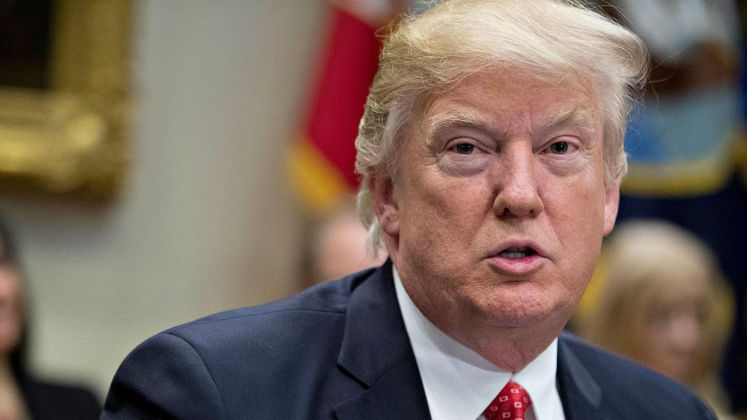

Since Volodymyr Zelenskyy became Ukraine's President, he's been labeled in many ways – from comedian to hero. However, US President Donald Trump recently called him a "dictator," deepening tensions. Trump, known for his blunt remarks, posted on social media: "A dictator without elections, Zelenskyy better move fast or he is not going to have a country left."
This attack followed Trump's earlier comments where he suggested that Ukraine started the war and called for elections in the country. After US-Russia peace talks, Trump remarked, "When they want a seat at the table, you could say the people have to, wouldn’t the people of Ukraine have to say, like, ‘You know, it’s been a long time since we’ve had an election’?"
Trump also criticized Ukraine’s situation, saying, “We have a situation where we haven’t had elections in Ukraine, where we have martial law in Ukraine, where the leader in Ukraine — I mean I hate to say it, but he’s down at four per cent approval rating — and the country’s been blown to smithereens."
Is Zelenskyy a Dictator?
Trump’s remarks raised the question: is Zelenskyy a dictator? Let’s break it down.
In 2019, Zelenskyy won a decisive victory, defeating incumbent President Petro Poroshenko. Zelenskyy’s first term was to end in May 2024. However, the Russian invasion in 2022 led to the suspension of elections, extending Zelenskyy’s term indefinitely.
Why Can’t Ukraine Hold Elections Now?
The biggest obstacle to elections is martial law. According to Ukrainian law, martial law must be lifted before any election can happen. Zelenskyy recently extended martial law until May 9, 2025.
Ukraine's parliament and public have shown little interest in elections during the war. In November, all parliamentary parties agreed to delay elections until the war ends. Zelenskyy promised to hold elections once the conflict is over.
Additionally, the Ukrainian public supports this. They believe elections during the war would be unthinkable. The only exception is former President Petro Poroshenko, whom Zelenskyy defeated in 2019.
Logistics and Infrastructure Challenges
Holding elections is also a logistical challenge. About one million Ukrainians are fighting far from home, and millions more are displaced. Many schools, which serve as polling stations, have been destroyed by Russian attacks. According to Olha Aivazovska, head of the election watchdog Opora, it could take up to a year to restore electoral infrastructure and pass laws for post-war elections.
Speaker’s Remarks
Ruslan Stefanchuk, the speaker of Ukraine’s parliament, said Ukraine has not abandoned elections. He argued that "Inventing ‘democracy’ under shelling is not democracy, but a spectacle in which the main beneficiary is in the Kremlin. Ukraine needs bullets, not ballots."
Who Wants Elections?
The push for elections comes from Russia and now, Donald Trump. Russian President Vladimir Putin has questioned Zelenskyy’s legitimacy since his term expired. This issue was raised again during U.S.-Russia peace talks, with Kremlin spokesperson Dmitry Peskov stating that Putin would be willing to negotiate with Zelenskyy but questioned his legitimacy.
German expert Winfried Schneider-Deters said Russia promotes this demand to create division in Ukraine.
Recently, Trump joined the call for elections. He questioned Zelenskyy’s approval rating, stating, “I mean, I hate to say it, but he’s down at a four per cent approval rating.” However, it’s unclear where Trump got this number from. A February 2023 survey from the Kyiv International Institute of Sociology (KIIS) found that 57% of Ukrainians trust Zelenskyy.
Why Is Trump Criticizing Zelenskyy?
Trump’s reasons for criticizing Zelenskyy are complex. Many believe it's part of Trump’s larger push to end the war in Ukraine, a promise he made during his campaign. Additionally, there’s personal animosity between the two leaders. In 2019, a scandal broke when it was revealed that Trump had pressured Zelenskyy to investigate Joe Biden, potentially damaging Biden’s 2020 election campaign. This controversy led to Trump’s first impeachment.
Would Zelenskyy Win in an Election?
If an election were held now, Zelenskyy may still have a strong chance of winning. Recent surveys show that 57% of Ukrainians trust Zelenskyy, up from 52% in December. Another survey, conducted from late November to early January, found that 63% of Ukrainians approved of his actions.
Interestingly, Zelenskyy’s approval rating is higher than Trump’s. A Reuters poll published on February 19 revealed that Trump’s approval rating stands at 44%.
Zelenskyy Responds to Trump
Zelenskyy didn’t hold back in his response to Trump. He accused Trump of succumbing to Russian "disinformation." Zelenskyy said, “Such rhetoric doesn’t help Ukraine — it only helps in bringing Putin out of isolation.”
Referring to his approval ratings, Zelenskyy added, “If anyone wants to replace me right now — that’s not going to happen.”