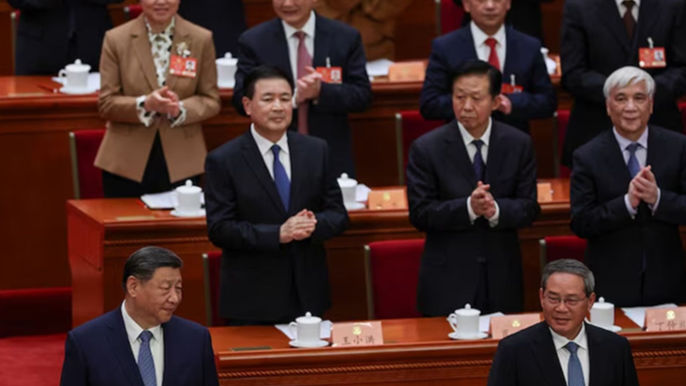
China’s annual parliamentary session starts on Wednesday. Leaders face pressure to boost consumer spending and stabilize the economy. Meanwhile, rising U.S. trade tariffs and deflationary risks demand strong policy measures.
Economic Growth and Policy Shifts
Premier Li Qiang will announce an ambitious economic target for 2025 at the National People’s Congress (NPC). Last year, China barely met its 5% growth goal due to late-stage stimulus efforts. Now, a deepening trade conflict with the U.S., weak consumer demand, and a struggling property sector force the government to rethink its strategy.
At the same time,
US President Donald Trump continues imposing tariffs on Chinese goods, disrupting long-standing trade patterns. Consequently, policymakers face mounting pressure to shift focus from exports and investment-driven growth to domestic consumption.
Budget Deficit and Consumer Support Measures
To address these issues, Li plans to expand the budget deficit to 4% of GDP and increase debt issuance. Additionally, part of this funding will support subsidies for electric vehicles, household appliances, and other consumer goods. However, economists stress the need for deeper reforms in taxation, land policies, and financial systems to create a stronger social safety net.
“With deflationary pressures becoming entrenched against the background of an unfavorable external environment … boosting domestic household consumption demand is a key priority,” said Eswar Prasad, a trade policy professor at Cornell University and former China director at the International Monetary Fund.
“One-off schemes might help at the margin, but durable measures to provide income support and strengthen the safety net are essential.”
Growth Disparities and Trade Pressures
Despite achieving one of the world’s fastest growth rates at 5% last year, many people struggle with job instability and declining wages. Even though China maintains a trillion-dollar trade surplus, economic security remains elusive for many citizens.
Meanwhile, Chinese manufacturers face rising challenges. Since domestic demand is weak, and the U.S., a key export market worth over $400 billion annually, has become more restrictive, companies now seek alternative export markets. However, this shift triggers price wars, squeezes profits, and raises concerns about new trade barriers.
Since taking office, Trump has repeatedly raised tariffs on Chinese goods. In January, his administration added another 20%, with a further 10% hike taking effect on Tuesday.
“We worry that they will add another 10% and then another 10%,” said Dave Fong, a Chinese manufacturer of school bags, talking teddy bears, stationery, and consumer electronics. “That’s a big problem.”
China’s Response and Future Strategy
In response, China swiftly retaliated on Tuesday. Authorities imposed 10%-15% tariff hikes on U.S. agricultural and food products and restricted 25 American firms from export and investment activities.
Since the pandemic, China has prioritized technological advancement over consumer-driven growth. For this reason, the government has invested heavily in high-tech industries to close the gap with geopolitical rivals. As a result, companies like electric vehicle giant BYD and AI firm Deepseek have gained global recognition.
However, Alicia Garcia-Herrero, chief Asia Pacific economist at Natixis, warns that China must balance technological ambitions with consumer spending.
“Technological aspirations and consumer demand growth are competing priorities,” she said. “Finding a balance will be crucial for China to avoid the prolonged stagnation experienced by Japan.”
She also emphasized that while industrial policy and innovation are vital, China must address economic imbalances to ensure sustainable growth.