
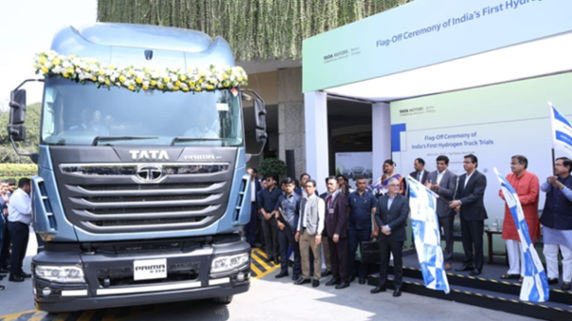

India took a significant step toward clean energy on Tuesday by launching trials for hydrogen-powered heavy-duty trucks. Union Ministers Nitin Gadkari and Pralhad Joshi attended the event in New Delhi. Notably, this marks a major milestone in India's push for sustainable transport.
Tata Motors Begins Hydrogen Truck Trials
Tata Motors initiated the trials on March 4. Importantly, this is India’s first experiment with hydrogen-powered trucks for long-haul cargo. Moreover, the initiative aims to reduce emissions and promote green energy in the transport sector.
Trial Run Starts From Delhi For India's First Hydrogen Powered Trucks Manufactured By Tata Motors.
— KV Iyyer - BHARAT 🇮🇳🇮🇱 (@BanCheneProduct) March 5, 2025
Miss You Late Ratan Tata Sir 🙏
One Of Your Dream Project pic.twitter.com/ZumCrtdwno
Government Backs Hydrogen Fuel
Union Minister Nitin Gadkari emphasized hydrogen’s potential to transform India's transportation sector. He stated, “Hydrogen is the fuel of the future with immense potential to transform India’s transportation sector by reducing emissions and enhancing energy self-reliance.” Furthermore, he praised Tata Motors for taking the lead in this green transition.
Trial Details and Test Routes
The trials will last up to 24 months. During this time, Tata Motors will deploy 16 hydrogen-powered trucks with different configurations and payload capacities. Additionally, these trucks will run on key freight routes, including Mumbai, Pune, Delhi-NCR, Surat, Vadodara, Jamshedpur, and Kalinganagar.
Hydrogen Truck Technology
Tata Motors is testing two hydrogen technologies:
- Hydrogen Internal Combustion Engine (H2-ICE)
- Hydrogen Fuel Cell Electric Vehicle (H2-FCEV)
For this reason, the company introduced the Tata Prima H.55S (available in both H2-ICE and FCEV versions) and the Tata Prima H.28 H2-ICE truck. Notably, these vehicles have a driving range of 300-500 km.
India’s Commitment to Green Energy
Most importantly, this initiative supports the National Green Hydrogen Mission. As a result, the trials will assess real-world performance and help develop infrastructure for large-scale hydrogen-powered transport.