
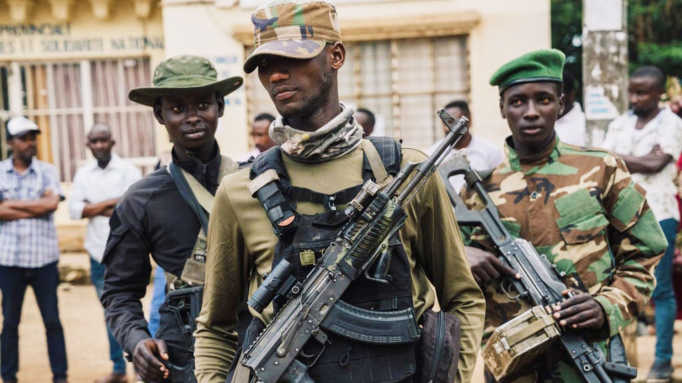

Recently M23 advanced further into Congo on Wednesday. They reached the outskirts of Walikale, a town located 125 kilometers (80 miles) northwest of Goma. Consequently, tensions in the region have escalated.
Who Are the M23 Rebels?
M23 consists primarily of Tutsis and opposes both the Democratic Forces for the Liberation of Rwanda (FDLR), a Rwandan Hutu rebel group, and Mai-Mai militias—local community-based armed groups backed by the Congolese government. The M23 rebel group, which has been fighting in eastern Democratic Republic of Congo (DRC), has decided not to participate in peace talks. This decision follows the European Union (EU) imposing sanctions on its leaders and some Rwandan military officials. Despite this setback, the Congolese government has confirmed that it will attend the peace talks in Angola’s capital, Luanda, on Tuesday.What is M23 Rebels?
The M23 rebellion was an armed conflict in North Kivu, Democratic Republic of the Congo, between the March 23 Movement and government forces from April 4, 2012, to November 7, 2013. It concluded with a peace agreement signed by eleven African nations, leading to the M23 fighters surrendering in Uganda. This rebellion was part of ongoing unrest in the region following the official end of the Second Congo War in 2003. The conflict resurfaced in late 2021 when rebel leader Sultani Makenga, along with 100 fighters, launched an unsuccessful attack on the border town of Bunagana.Why Did M23 Back Out?
For years, the Rwanda-backed M23 rebels have demanded direct negotiations with the DRC government. Recently, after gaining control of major cities in eastern DRC, they acquired more leverage. Over the weekend, the Congolese government, struggling to counter the rebels’ advances, finally agreed to talks. However, M23 then withdrew. M23 spokesperson Lawrence Kanyuka explained on social media that some international organizations are trying to “sabotage peace efforts” in the region. He stated that the latest sanctions make dialogue impossible, forcing M23 to pull out of the meeting.Conflict in Eastern DRC: A Growing Humanitarian Crisis
Earlier this year, M23 launched a major offensive, capturing key mineral-rich areas. This escalation has killed thousands and created one of the world’s worst humanitarian crises. More than seven million people have been displaced due to the ongoing conflict. According to the United Nations, Rwanda has deployed around 4,000 soldiers to support M23. Rwanda, however, claims its forces are acting in self-defense against threats from the Congolese army and local militias.What is the motive of M23 Rebels?
M23’s motives are complex and varied. Some leaders and combatants claim they are protecting the Congolese Tutsi community from armed threats. Others cite issues of nationality and the return of refugees as their primary concerns.Why Are Rwanda and the DRC Fighting?
Tensions between Rwanda and the DRC escalated in 2022 when Rwandan forces entered the DRC to support M23 rebels. They allegedly fought alongside them against the Congolese military (FARDC) and pro-government militias. Since the end of the Second Congo War, eastern DRC has faced persistent violence from numerous armed groups, including M23 in North Kivu and the Allied Democratic Forces (ADF) in Ituri and North Kivu. The current phase of the conflict began in March 2022, when M23 launched an offensive, capturing strategic locations. The DRC, the UN, and Western countries accuse Rwanda of actively supporting and fighting for M23, while Rwanda and M23 accuse the DRC of collaborating with the FDLR, a paramilitary group linked to the Rwandan Genocide. Both sides deny these allegations, despite evidence confirming external involvement.The History of the M23 Rebellion
M23 emerged in 2012, founded by former rebels from the National Congress for the Defence of the People (CNDP). They accused the DRC government of violating a peace agreement and resumed fighting. That year, M23 captured Goma, a major trade center with over a million residents, displacing over 140,000 people. However, by late 2013, the group suffered major defeats in a UN-backed military operation, leading to its fighters surrendering in Uganda.The Conflict Resurfaces in 2021
Despite the 2013 peace deal, M23 resumed attacks in late 2021, beginning with an assault on Bunagana. The rebels rapidly expanded their control over North Kivu province, forcing the DRC government to seek regional military support. For months, Angola has attempted to mediate a ceasefire. In late 2023, Rwanda pushed for direct talks between the DRC and M23, but the Congolese government refused. Recently, Angola announced it would host negotiations, but M23’s withdrawal has placed the peace process in jeopardy.What do Netizens view on M23 Rebels?
According to i24news, M23 is a Liberation movement not Rebels, people are endorsing M23 Leadership. Many people are showing support for M23’s leadership, as seen in videos where Congolese citizens back the AFC_M23.One another user said that M23 are Congolese, they are fighting for their existence, highly trained and disciplined. Here they walk past peacekeepers.DRC 🇨🇩:AFC_M23 is a Liberation movement not Rebels.. people are endorsing M23 Leadership...
— Kivu Info/24 (@Kivuinfo24) February 3, 2025
Like and retweet in order to show world how Congolese support the AFC_M23. pic.twitter.com/fdMSc10fEN
Additionally the DRC government remains open to negotiations, but M23’s refusal to participate casts doubt on the success of peace efforts. The situation remains tense, with millions suffering from the prolonged conflict. The international community continues to monitor the situation, hoping for a peaceful resolution.M23 are Congolese, they are fighting for their existence, highly trained and disciplined. Here they walk past peacekeepers pic.twitter.com/2YcmfCsizL
— African (@ali_naka) March 10, 2024