
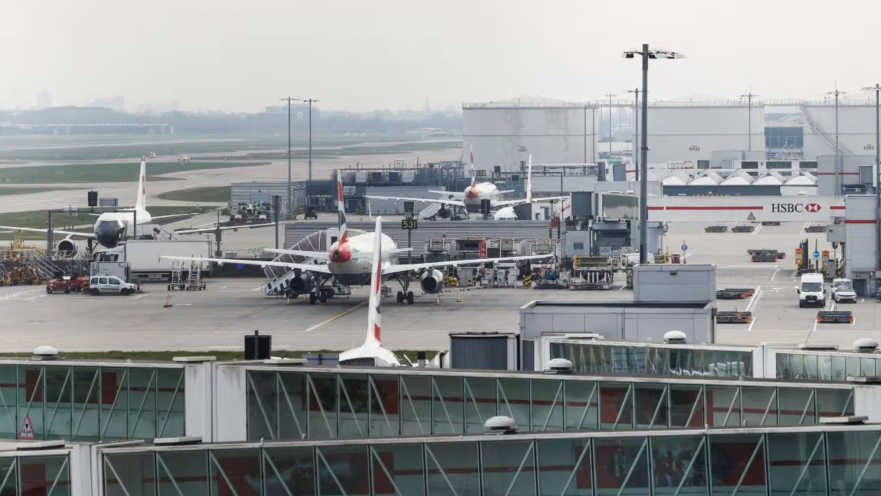

Heathrow Airport, the UK’s busiest airport, shut down due to a power outage caused by a fire at a nearby electrical substation in Hayes, west London. The incident, which happened late Thursday night, severely disrupted flight schedules and affected thousands of passengers worldwide.
The London Fire Brigade (LFB) quickly responded, deploying ten fire engines and 70 firefighters to tackle the blaze. Though they brought the fire under control, authorities are still investigating the cause. Emergency teams arrived at 23:23 GMT. The fire caused explosions and power cuts in nearly 5,000 homes. Officials set up a 200-meter safety cordon and advised residents to keep their doors and windows closed due to heavy smoke.Flight Cancellations and Global Impact
Heathrow Airport announced that operations would remain suspended until 23:59 on March 21, 2025. Authorities urged passengers to avoid traveling to the airport and to check with their airlines for updates. The closure triggered disruptions across the global aviation network. More than 1,351 flights were scheduled at Heathrow on Friday, impacting nearly 291,000 passengers. According to Flightradar24, at least 120 inbound flights were diverted early Friday morning, while several others turned back.Many airlines had to cancel or reroute flights:The official closure NOTAM from Heathrow:
— Flightradar24 (@flightradar24) March 21, 2025
A1918/25 NOTAMN
Q) EGTT/QFALC/IV/NBO/A /000/999/5129N00028W005
A) EGLL B) 2503210143 C) 2503212359
E) AD CLOSED DUE TO A MAJOR INCIDENT IN THE LOCAL VICINTY AFFECTING POWER SUPPLY pic.twitter.com/aWqWrtYutP
- British Airways, Heathrow’s largest carrier, had 341 scheduled flights affected.
- Qantas Airways diverted flights from Perth and Singapore to Paris and arranged alternative transportation.
- United Airlines redirected flights from New York and San Francisco, with some turning back mid-air. Seven flights returned or diverted.
- Air India sent flights back to Mumbai and Delhi and canceled all remaining Heathrow-bound flights for the day.
- Singapore Airlines canceled five flights and diverted others.
- Virgin Atlantic suspended all Heathrow arrivals and departures until midday on March 21.
- Cathay Pacific canceled all flights to London, including CX239 and CX253 from Hong Kong.
- Emirates canceled flights EK001/002, EK029/030, and EK031/032.
- Etihad Airways diverted flight EY61 from Abu Dhabi to Frankfurt and canceled four others.
- Aer Lingus and Scandinavian Airlines (SAS) canceled all Heathrow flights.
Aviation Crisis Compared to Past Disruptions
Experts are comparing Heathrow’s crisis to past aviation shutdowns, such as the September 11 attacks and the 2010 volcanic ash cloud from Iceland. Aviation consultant John Strickland told PA news agency, “It’s a contained version of 9/11 or, to an extent, the Icelandic volcanic eruption... that’s the parallel I would make.” The UK’s Air Traffic Control implemented emergency measures, including diverting aircraft to non-UK airports and stopping flights before takeoff. The last time Heathrow faced a disruption of this scale was in 2010, when a volcanic eruption and heavy snowfall forced flight cancellations for days.Logistical Challenges for Airlines
Airlines rely on carefully planned schedules with aircraft and crew stationed strategically worldwide. The Heathrow shutdown disrupted these operations, making it difficult to realign flight networks. European airports, including Frankfurt, Paris Charles de Gaulle, Amsterdam Schiphol, and Madrid Barajas, are now handling diverted flights, increasing congestion at these hubs. North American airports, such as Newark, Washington DC, Toronto, and Atlanta, are also affected.Heathrow’s Response and Next Steps
As Heathrow remains closed until late Friday night, airlines and passengers are scrambling to adjust their travel plans. The airport apologized for the inconvenience, stating that safety and restoring power are top priorities.UK Energy Secretary Ed Miliband promised to investigate the fire’s cause and evaluate lessons from the incident. Meanwhile, travelers scheduled to fly through Heathrow should remain in close contact with their airlines for updates and alternative travel arrangements.Heathrow Airport was handling 83.9 million passengers last year. That gives about 220k passengers per day. pic.twitter.com/kymm3VpH6N
— Flightradar24 (@flightradar24) March 21, 2025