
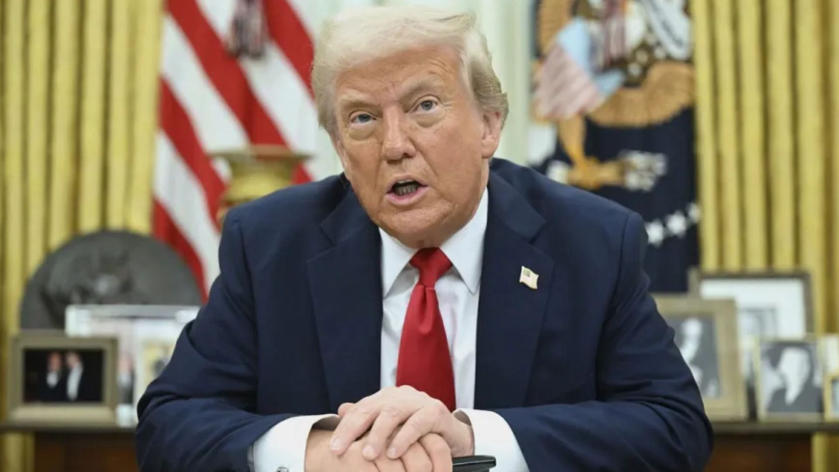

US President Donald Trump made a bold declaration on Wednesday (according to US time). He introduced “reciprocal tariffs” on all imports. According to him, other nations had “looted, pillaged, raped, plundered” the US. Therefore, he called this move “Liberation Day.”
Heavy Tariffs on Major Trade Partners
To begin with, Trump set a baseline tariff of 10% on all imports. However, some countries faced even steeper rates. Specifically, he targeted nations that have a trade surplus with the U.S.
Here’s a breakdown of the new tariffs:
-
China – 34%, responding to what Trump claims is a 67% duty.
-
European Union – 20%, countering an alleged 39% rate.
-
Vietnam – 46%, opposing a supposed 90% tariff.
-
India – 26%, responding to a claimed 52% charge.
Trump called these tariffs “discounted and reciprocal.” Nevertheless, he did not explain how his team calculated these numbers. Consequently, many experts believe the figures are inflated.
Experts Challenge Trump’s Numbers
Meanwhile, economists and analysts have questioned the accuracy of Trump’s claims. For instance, James Surowiecki, Yale Review editor and The Atlantic contributor, criticized the calculations.
He pointed out, “We have a $17.9 billion trade deficit with Indonesia. Its exports to us are $28 billion. $17.9/$28 = 64%, which Trump claims is the tariff rate Indonesia charges us. What extraordinary nonsense this is.”
Clearly, the methodology behind Trump’s numbers is flawed.
Tariffs Hit U.S. Allies Too
Interestingly, Trump’s tariffs did not only target economic rivals. In fact, China now faces a total tariff rate of 54% when previous duties are included. Furthermore, even key U.S. allies were affected. Japan must now pay a 24% tariff, while South Korea faces a 25% charge.
According to Reuters, a White House official confirmed that these new tariffs will take effect on April 9. Additionally, the baseline 10% tariff will start this Saturday.
U.S. Moves Away from Free Trade
Without a doubt, Trump’s decision marks a significant shift in American trade policy. Since World War II, the U.S. has promoted free trade. As a result, this system helped America and its allies grow. However, Trump argues that foreign nations have exploited this model. In his view, these countries have weakened American manufacturing. Thus, he aims to restore past economic strength.
Stock Markets React Sharply
Not surprisingly, Trump’s announcement sent shockwaves through financial markets. Almost immediately, investors lost billions. As NBC reports:
-
S&P 500 futures dropped 3.5%.
-
Nasdaq 100 futures fell 4.3%.
-
Dow Futures plunged nearly 1,000 points (2.3%).
Therefore, these tariffs could have widespread economic consequences.
Impact on U.S. Consumers and India
On one hand, American consumers may suffer. The 26% tariff on Indian imports will likely raise drug prices. Generic medicine producers will face higher costs.
On the other hand, India might see an opportunity. Since China, Vietnam, and Bangladesh face even higher tariffs, New Delhi could attract more manufacturing investment. Consequently, this could give India an edge in global trade.
Uncertain Future
At this point, it’s too soon to measure the full impact. Indian exports could struggle, or they might gain an advantage. Either way, Trump’s policies change quickly. In fact, these tariffs might disappear sooner than expected.