
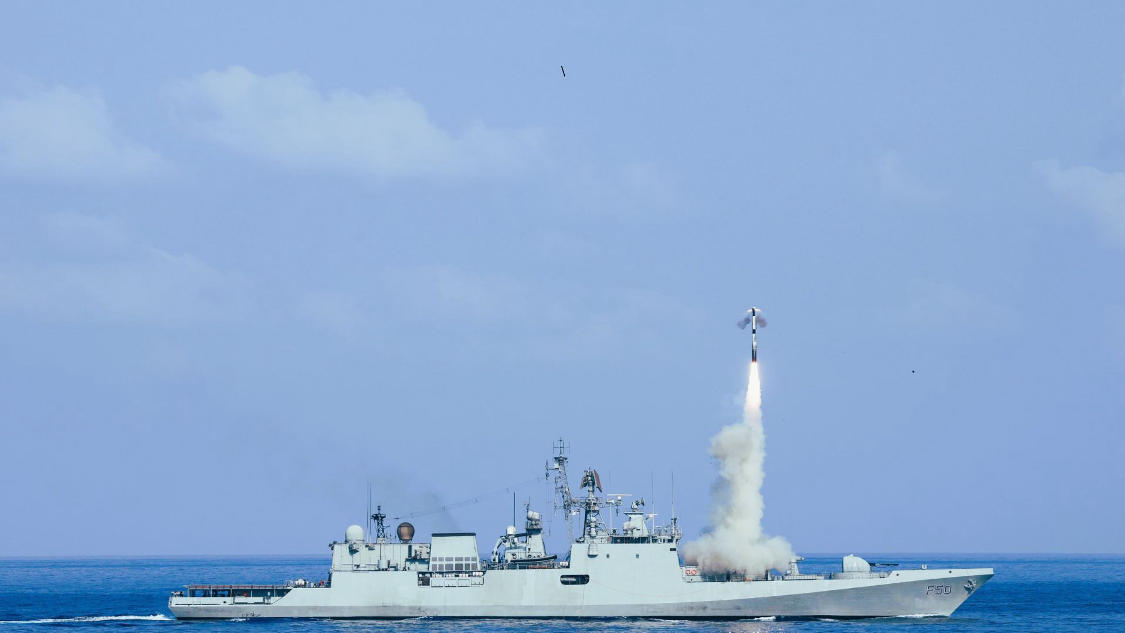

Multiple Indian warships demonstrated their precision strike skills during drills in the Arabian Sea on Sunday. This show of strength comes at a time when tensions between India and Pakistan are growing after the April 22 Pahalgam terror attack.
In a statement, the Indian Navy said, "Indian Navy ships undertook successful multiple anti-ship firings to revalidate and demonstrate readiness of platforms, systems and crew for long range precision offensive strike."
Moreover, the Navy released photos and videos showing warships firing BrahMos supersonic cruise missiles. This action clearly displayed the Navy’s combat readiness in a tense security situation.
Although the Pahalgam attack created fresh tensions, sources told Hindustan Times (HT) that the naval drills had been scheduled earlier. Nevertheless, India has made it clear that a strong response to the attack is being prepared.
Additionally, the Navy stated that it remains "combat ready, credible and future ready"
to protect India’s maritime interests at any time and in any place.
Prime Minister Issues Strong Warning
Meanwhile, Prime Minister Narendra Modi sent a stern warning on Sunday. He declared that the attackers and their planners would face the "harshest response." His message clearly targeted Pakistan.
Following the Pahalgam attack, India announced several retaliatory measures against Pakistan. Furthermore, officials are now seriously considering military options to punish Pakistan for its alleged support to terrorism.
Line of Control Sees Escalating Tensions
At the same time, tensions along the Line of Control (LoC) have also worsened. On Sunday, for the third consecutive day, the Pakistan Army opened fire at several Indian posts. Consequently, the situation along the border has become more dangerous. Many now question whether the February 2021 ceasefire agreement can hold.
Pakistan, on the other hand, responded with countermeasures. However, so far, neither India nor Pakistan has officially said they will abandon the ceasefire deal.
New Challenges for Security Forces
Furthermore, the terror attack at Baisaran near Pahalgam could change the counterterrorism landscape in Jammu and Kashmir. Until now, security forces mainly focused on stopping terrorist infiltrators and maintaining security within the region. Now, they may also need to prepare for attacks on tourist spots.
Earlier, strategic affairs expert Lieutenant General DS Hooda (retd) pointed out that the attack was a deliberate escalation. He explained that it broke the unspoken rule that tourists would not be targeted.
Moreover, Defence Minister Rajnath Singh warned that India would soon retaliate. He said the country would strike not just the attackers but also their handlers. He promised a "crushing response" against the neighboring country.