
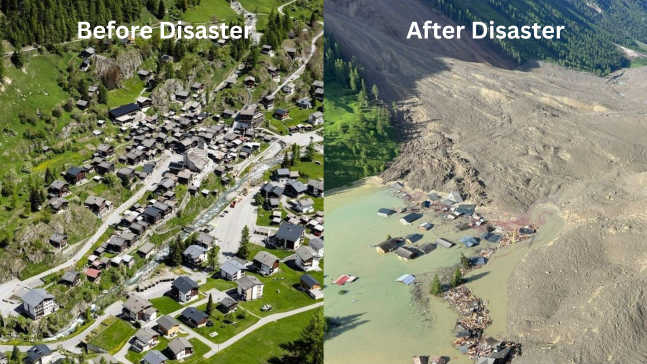

The historic village of Blatten disappeared within moments. A sudden rockfall from Nesthorn mountain buried it under tons of debris.
Earlier, scientists noticed cracks forming on Nesthorn. Rocks had started falling onto the Birch glacier, which increased pressure on the ice. As a result, small rock and ice slides began.
Therefore, authorities evacuated all 300 villagers and their animals. People hoped the danger would pass gradually, allowing them to return in a few weeks.
Unexpected Collapse Shocks Residents
However, disaster struck suddenly on Wednesday. Barbara and Otto Jaggi were in nearby Kippel when it happened. A repairman was fixing their chimney downstairs.
“There was loud banging, and the lights went out,” Barbara said. At first, they thought it was an accident. But the noise grew louder. Then, the repairman rushed upstairs yelling, “The mountain is coming.”
Although Kippel is over 4 km from Blatten, dust filled the whole valley. In the end, Blatten was completely destroyed. Its homes, church, and Edelweiss hotel lay in ruins.
Before and after of Blatten, Switzerland — a village that was buried yesterday following the collapse of the Birch Glacier. Approximately 90% of the village was buried underneath this massive cascade of rocks.
— Daily Overview (@DOverview) May 29, 2025
Read more here: https://t.co/IJeiJKWhzT pic.twitter.com/k03JdspuGY
Experts Didn’t Predict the Scale
Geologists had been monitoring the site. That’s why they evacuated the village. Yet, no one expected such an intense collapse.
“It was the worst case that could happen,” said Matthias Huss, a glacier expert from Zurich’s Federal Institute of Technology. His team regularly monitors Swiss glaciers. In fact, their reports show glaciers are melting much faster due to global warming.
Clean-Up Delayed by Flood Threat
Now, Blatten lies buried in rocks and mud. Meanwhile, the debris has blocked the River Lonza, creating a flood risk. Consequently, clean-up operations are on hold.
Experts cannot fully examine the site yet. Still, Matthias Huss believes thawing permafrost played a major role.
Global Warming Weakens Mountain Structures
According to Huss, many recent Alpine disasters are tied to climate change. “The warming is affecting permafrost thaw,” he explained.
Permafrost acts like glue for mountains. Once it thaws, rocks loosen. Additionally, melting glaciers expose unstable slopes, which collapse without their icy support.
Hazards Are Growing in Alpine Areas
Admittedly, avalanches and landslides are common in the Alps. In fact, villages like Blatten were built outside known danger zones. Switzerland has long used risk maps to guide construction.
However, over the past 20 years, glaciers and permafrost have been melting faster than ever.
Glaciers Are Rapidly Shrinking
Today, Switzerland has less than half the glacier ice it had a century ago. Moreover, some glaciers have vanished completely. As a result, some communities held funerals to mourn them.
If global warming exceeds 1.5°C—as outlined in the Paris Agreement—most of Switzerland’s glaciers may vanish by 2100.
Melting Ice Brings New Dangers
Previously, experts worried mainly about losing fresh water. Glaciers store winter snow and release it in summer, feeding rivers and crops.
But now, Blatten shows a new danger. The quick thaw makes mountain collapses harder to predict—even with close monitoring.
Lives Saved, Homes Destroyed
Thankfully, the evacuation saved lives. Only one man, aged 64, is missing. However, the entire village is gone. Every home is buried under rock and mud.
“This really puts a question mark on living in the high mountains,” Huss warned.
Community Gathers in Grief
The day after the disaster, locals gathered at a church in Wiler for Ascension Day. They prayed for Blatten’s people.
“We all know each other,” said one woman. Another added, “They’ve lost everything.” An elderly man said, “We can cry, but not forever. We must believe in God.”
A Turning Point for Switzerland
Finally, Matthias Huss summed it up: “This is really an event that will be quite decisive for Switzerland. It changes how we perceive the mountains.”