
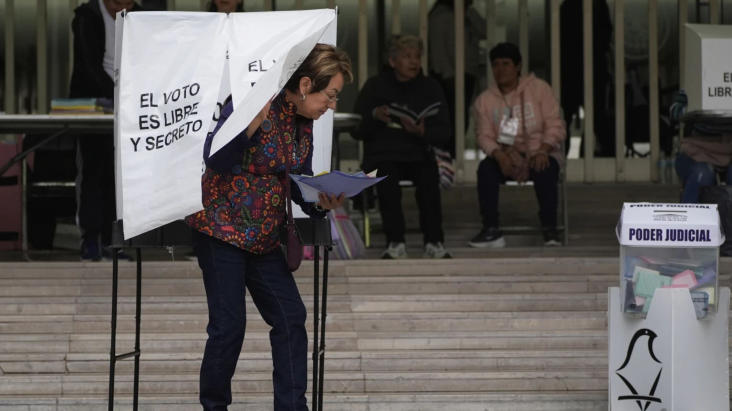

In a first-of-its-kind move, Mexicans cast their votes on Sunday to elect judges across the country. This election marked a major shift, as Mexico became the only nation in the world where people directly choose all judges and magistrates.
A Bold Move to Reform the Justice System
The government defended the decision, claiming it was necessary to clean up a deeply flawed justice system. They believed that electing judges would help fight corruption, crime, and impunity. A 57-year-old retiree, Arturo Giesemann, explained why he voted. He said, “the disgust I have with the current judiciary because of its corruption.”
Voter Confusion and Low Turnout
However, many voters felt unprepared and overwhelmed by the process. Hundreds of mostly unfamiliar candidates stood for election, making it difficult for people to make informed choices.
Lucia Calderon, a 63-year-old teacher, admitted, “We are not very prepared. I think we need more information.” Similarly, Maria Estrada, a housewife from Jalisco, said she relied on her instincts to decide, as she didn’t know any of the candidates.
Experts Raise Red Flags
Many experts feared that this new system could politicize the judiciary. They also warned that criminal groups might find it easier to bribe or threaten judges who are elected rather than appointed.
Margaret Satterthwaite, the United Nations special rapporteur on judicial independence, said, “there is reason to believe that elections may be more easily infiltrated by organized crime than other methods of judicial selection.”
Protests and Public Backlash
Large crowds marched through Mexico City to protest the reforms. Demonstrators carried signs with slogans like “Hands off our democracy” and “No to electoral fraud.” One protester, Ismael Novela, expressed concern: “It was the last counterweight we had against the totalitarianism of the executive branch.”
President Sheinbaum Defends the Reform
President Claudia Sheinbaum responded to critics a day before the vote. She dismissed claims that the election was unfair or aimed at helping a political party control the judiciary.
“Those who want the regime of corruption and privileges in the judiciary to continue say this election is rigged. Or they also say it’s so a political party can take over the Supreme Court,” she said in a video message. “Nothing could be further from the truth.”
Concerns Over Criminal Influence
Though there wasn’t widespread violence before the vote, experts warned that criminal groups likely contacted judges and candidates. Luis Carlos Ugalde, a former election official, said it made sense that “organized criminal groups would have approached judges and candidates who are important to them.”
The rights group Defensorxs listed about 20 candidates they believed were high-risk. Among them was Silvia Delgado, once a lawyer for Sinaloa Cartel co-founder “El Chapo” Guzman. Another candidate in Durango had spent nearly six years in a U.S. prison for drug charges.
Voters Faced a Tough Task
Mexicans had to elect around 880 federal judges, including members of the Supreme Court, along with many state-level judges. The rest of the judges will be selected in another round of elections in 2027.
Candidates needed to meet basic criteria such as holding a law degree, having legal experience, no criminal record, and a “good reputation.”
Still, voters found it hard to evaluate so many contenders. David Shirk, a professor from the University of San Diego, said, “To do a good job, voters would have to spend hours and hours researching the track record and the profiles of each of the hundreds of candidates.”
The Deeper Problem Lies Elsewhere
According to Shirk, the biggest corruption problems in Mexico’s justice system lie within law enforcement and public prosecutors. He stated, “If you can avoid being prosecuted, you don’t have to worry about the judge.”
Reform Rooted in Political History
These elections were pushed forward by former President Andres Manuel Lopez Obrador, mentor to Sheinbaum. During his term, he often clashed with the courts. According to Shirk, the reform mainly happened “because Lopez Obrador had a grudge against the judges.”