
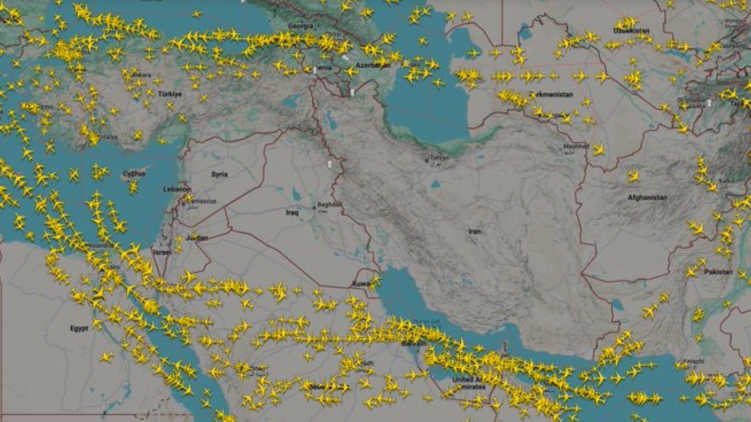

Airlines continued to avoid large parts of the Middle East on Sunday after the United States launched airstrikes on Iranian nuclear sites. The flight tracking service FlightRadar24 confirmed that air traffic is steering clear of the region due to recent tensions and missile attacks.
Flights Divert Around Iran, Iraq, Syria, and Israel
According to FlightRadar24, “Following US attacks on Iranian nuclear facilities, commercial traffic in the region is operating as it has since new airspace restrictions were put into place last week.”
The website showed that airlines were not using airspace over Iran, Iraq, Syria, and Israel. Instead, they are flying through alternate routes — either north via the Caspian Sea or south via Egypt and Saudi Arabia. These detours increase fuel usage, raise crew costs, and cause longer flight times, but airlines are choosing safety over efficiency.
Global Conflict Zones Pose Risk to Flights
With missile and drone attacks rising in many parts of the world, airlines now face greater risks while operating in or near conflict zones. Since Israel’s June 13 strike on Iran, many airlines have suspended flights to the affected areas. However, a few evacuation and return flights have operated from neighboring countries.
Israeli Carriers Halt Rescue Flights
On Sunday, El Al Israel Airlines and Arkia, the two biggest Israeli airlines, said they would stop running special rescue flights for now. El Al also announced it would cancel scheduled flights until June 27.
At the same time, Israel’s airports authority said the country’s airspace is closed to all flights. However, land borders with Egypt and Jordan are still open.
Japan and New Zealand Begin Evacuation Efforts
Meanwhile, Japan's foreign ministry said on Sunday it had evacuated 21 people from Iran, including 16 Japanese nationals. The evacuees traveled overland to Azerbaijan. This was Japan’s second evacuation since Thursday. The ministry said it would carry out more evacuations if necessary.
New Zealand also announced evacuation plans. Its government said it would send a C-130J Hercules military transport plane to the Middle East as a backup option to evacuate New Zealanders. The aircraft and crew were set to leave Auckland on Monday, though the flight would take a few days to reach the region.
In addition, New Zealand said it was talking with commercial airlines to explore other evacuation options if needed.