
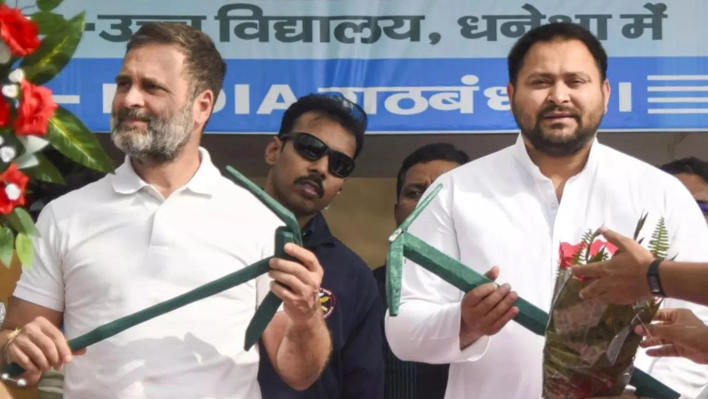

The INDIA alliance, formed by opposition parties, has quietly agreed on a seat-sharing formula for the upcoming Bihar Assembly elections. Though they haven’t made an official announcement, insiders confirmed that the discussions concluded peacefully and without conflict.
RJD and Congress Ready to Sacrifice Seats
The Rashtriya Janata Dal (RJD) and the Congress—the two major players in the alliance—have agreed to contest fewer seats than they did in the 2020 state elections. This move gives more room to smaller allies, aiming to keep the alliance strong and focused on winnability.
One person involved in the talks said, “The focus of the alliance is on keeping the cohesiveness intact and winnability. Each seat was surveyed for unanimous decisions.”
Left Parties Get Modest Gains
The three Left parties—including CPI(ML)—will get slightly more seats than last time. Although they wanted a larger share, the alliance allocated them fewer seats based on a balanced formula. Their good strike rate and ability to transfer votes played a key role in the decision.
VIP Gets More Seats Than Before
To accommodate Mukesh Sahni’s Vikassheel Insaan Party (VIP), the RJD and Congress have given up some of their seats. The alliance decided to offer VIP more seats than it had in 2020, when it was a part of the NDA (National Democratic Alliance).
According to an insider, “The seats of the RJD and the Congress would come down to accommodate the Vikashsheel Inshaan Party (VIP) of Mukesh Sahni, which will get more seats than it had in 2020 as part of the NDA.”
Background: 2020 Election Results
In 2020, RJD became the single largest party, winning 75 seats in the 243-member Bihar Assembly. The Congress secured 19 seats, while the Left parties together won 16. The VIP won four seats as an NDA member, but later all its MLAs switched to the BJP.
That year, the NDA gained 125 seats with 37.9% of the votes, while the INDIA bloc managed 110 seats with 37.6%. The difference between them was just 0.3%, making it a very close contest.
Strike Rates That Mattered
Among all parties, CPI(ML) Liberation had the highest strike rate—winning 12 of the 19 seats it contested (63.15%). RJD followed with a 52.08% strike rate (75 wins from 148 seats). In contrast, the Congress had the lowest strike rate at 27.15%, winning just 19 out of 70.
Sahni Bargained Hard, But INDIA Stuck to Plan
Sources said Mukesh Sahni negotiated strongly to get a better deal. However, the alliance didn’t give in easily, fearing a close fight again like in 2020. The tight vote margin in the last election made them more careful while distributing tickets.
Analyst Predicts Another Close Race
Political analyst NK Choudhary said that the 2025 election could be as close as 2020. He explained, “That is what will keep both the alliances on tenterhooks. The INDIA bloc knows the value of each vote after getting so near and yet so far last time. It is treading cautiously, but the fight again will be intense and close this time.”
He added that the NDA is feeling the pressure due to anti-incumbency and a decline in Nitish Kumar’s popularity. According to him, “The fight will remain close, and that is the reason why the Sahni factor assumes significance despite not being a big one in Bihar.”
RJD Confident of Change in Bihar
RJD spokesperson Mrityunjay Tiwari said the people’s mood in Bihar has uplifted party workers. He stated, “The mood is for change, and that will happen.” He also added that the alliance is preparing for a strong joint campaign, focusing on core issues and the failures of the NDA government.
INDIA Bloc's Joint Manifesto in Final Stages
The INDIA alliance is also finalising its joint election manifesto. Sources say the document will highlight welfare schemes and address key issues like:
-
Job creation
-
Curbing migration
-
Fighting corruption
This time, the alliance wants to build its narrative around governance, accountability, and development to challenge the BJP-led NDA.