
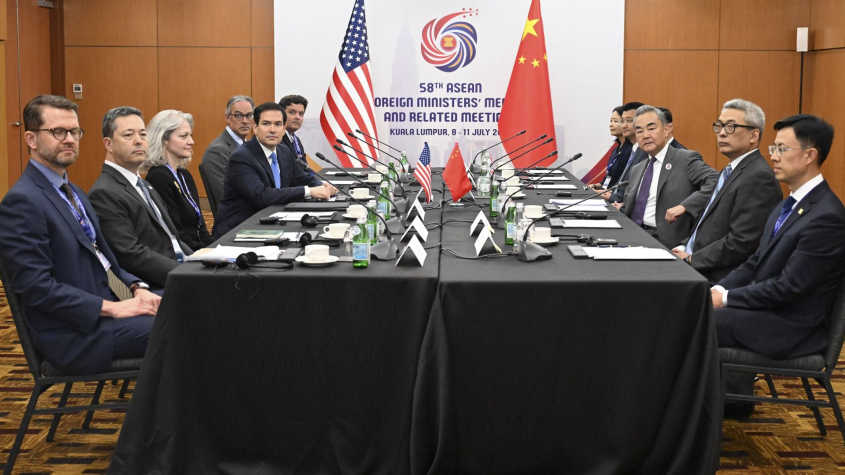

US Secretary of State Marco Rubio said his meeting with Chinese Foreign Minister Wang Yi was “positive and constructive,” despite both countries clashing over influence in Asia and new trade barriers. They met in Malaysia during the East Asia Summit and ASEAN Regional Forum.
Rubio’s trip marked his first official visit to Asia since taking office. However, it came just days after President Donald Trump announced new tariffs on many Asian countries, which put a strain on US relations in the region.
China Warns of Consequences
Beijing warned it would retaliate if the US reimposed heavy duties on Chinese imports next month. It also criticized American pressure on countries to avoid depending on Chinese supply chains.
Wang Yi described the US tariffs as “typical unilateral bullying behaviour,” though both sides later said their meeting was productive. Rubio noted that “we’re two big, powerful countries, and there are always going to be issues that we disagree on,” but he felt their meeting was “constructive” and offered “some areas of potential cooperation.”
A Trump-Xi Summit Likely
Rubio clarified that his meeting with Wang was not a negotiation but an attempt to “establish a constructive baseline” for future dialogue. He confirmed that President Trump had received an invitation to visit China and added, “It’s a visit he wants to undertake.”
Rubio emphasized that both sides would work to “build the right atmosphere” and ensure the visit had “concrete takeaways,” not just symbolic gestures.
China’s foreign ministry agreed with the tone, saying Wang had stressed the need to “translate consensus reached by their leaders into policies and actions.” According to Beijing, both sides described the talks as “positive, pragmatic and constructive.”
Tariffs Dominate the Agenda
Although Rubio aimed to shift attention back to the Indo-Pacific, his visit was overshadowed by the latest round of US tariffs. The new levies included 25% on goods from Japan, South Korea, and Malaysia, 32% on Indonesia, 36% on Thailand and Cambodia, and 40% on Myanmar and Laos.
China faced even harsher penalties, with some tariffs exceeding 100%. Washington has given Beijing until August 12 to reach an agreement and avoid another wave of duties, which would revive the tariff battle seen earlier this year.
Rubio Meets Southeast Asian Leaders
During the trip, Rubio met foreign ministers from Thailand, Cambodia, Vietnam, and Indonesia. Analysts believed he aimed to show that “the United States remains a better partner than China,” as Washington views Beijing as its main strategic rival.
However, Murray Hiebert from the Center for Strategic and International Studies remarked that Trump’s tariff decisions “made it much easier for Wang Yi to talk about China’s stable and reliable economic relations.”
Wang also used his meetings to criticize US policy. In Kuala Lumpur, he told Thailand’s foreign minister that the tariffs “undermined the free trade system” and “interfered with the stability of the global production and supply chain.”
Wang said during talks with Cambodia’s foreign minister that the US was “trying to deprive Southeast Asian countries of their legitimate right to development.” He added that “Southeast Asian countries have the ability to cope with complex situations” and protect their own interests.
Meanwhile, ASEAN foreign ministers released a joint statement expressing concern about rising global trade tensions. While not naming the US, they warned that unilateral tariffs were “counterproductive and risk exacerbating global economic fragmentation.”
Conversations with Russia and Allies
Rubio also met Russian Foreign Minister Sergei Lavrov and described the meeting as “constructive,” saying they discussed “a new or different Russian approach on Ukraine.” He admitted, “I don’t want to oversell it,” but shared that he had already briefed President Trump and the US team.
He also held talks with Japan’s foreign minister and South Korea’s first vice foreign minister. The State Department described this trilateral partnership as “indispensable.”
When asked about Japanese Prime Minister Shigeru Ishiba’s comment that Japan should reduce its dependence on Washington, Rubio responded that it should not be viewed negatively. He stated, “We obviously have very strong commitments and an alliance with Japan. We continue to cooperate very closely with them.”