
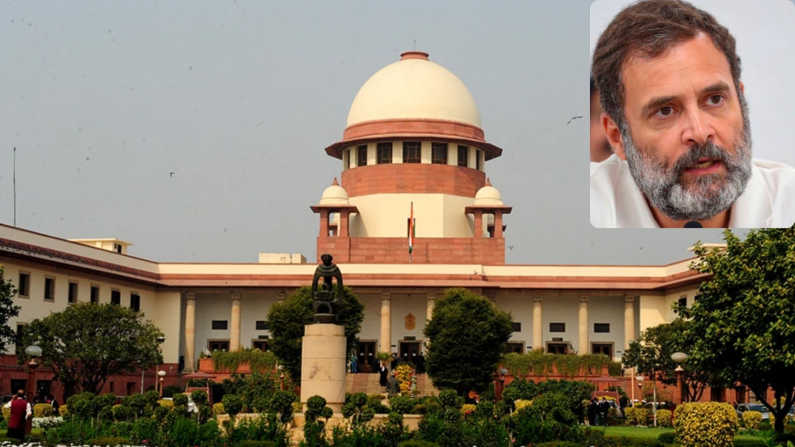

The Supreme Court strongly criticised Congress leader Rahul Gandhi on Monday for his statement that China had occupied a large part of Indian territory. The bench asked him how he knew about such a serious claim, especially without presenting evidence.
“If you were a true Indian, you would not say this," the court said while responding to Gandhi's remarks about the Chinese military allegedly controlling Indian land.
Free Speech Doesn’t Mean You Can Say Anything, Says Court
The bench also stressed that freedom of expression does not allow people to say anything they wish. Justice Dipankar Datta and Justice AG Masih made this point while hearing a plea related to a criminal defamation case filed against Gandhi.
The case stems from his comments about the Indian Army during the 2020 Galwan Valley clash with Chinese troops.
Rahul Gandhi had said, “2000 sq km of Indian territory has been occupied illegally by China.” He also claimed, “Chinese soldiers are beating up Indian Army personnel in Arunachal Pradesh.”
Court Grants Relief But Makes Sharp Remarks
Although the court granted interim relief by staying the criminal case, it did not hold back its concerns. The bench openly disapproved of Gandhi’s comments during the hearing, according to Live Law.
Justice Datta asked pointedly why Gandhi aired such views on social media rather than in Parliament. He said, “Whatever you have to say, why don’t you say in the Parliament? Why do you have to say this in the social media posts? Just because you have 19(1)(a) [freedom of speech], you cannot say anything.”
Where’s the Proof, Asks Supreme Court
Justice Datta also challenged the credibility of Gandhi’s statement about Chinese occupation. He asked Senior Advocate Abhishek Manu Singhvi, who represented Gandhi, how they confirmed the figure of 2,000 square kilometers.
“Were you there? Do you have any credible material? Why do you make these statements without any... If you were a true Indian, you would not say all this. When there is a conflict across the border, is it unusual to have casualties on both sides?” the judge asked.
Singhvi Defends Gandhi’s Right to Question
In response, Singhvi argued that opposition leaders must be able to raise serious issues. He said, “If he can’t say these things which are published in the Press, he can’t be a leader of opposition.” He also claimed that Gandhi’s remarks had been misinterpreted and taken out of context to harass him through legal action.
Background of the Defamation Case
The case was filed in connection with Gandhi’s remarks about the Indian Army and Chinese aggression. Earlier, on May 29, the Allahabad High Court rejected his plea to cancel the defamation case. It also upheld the summoning order issued by an MP-MLA court in Lucknow in February 2025.
Singhvi Points Out Legal Lapse in Procedure
Singhvi told the Supreme Court that Gandhi was not given a chance to be heard before the summons was issued. According to Section 223 of the BNSS, the accused must be heard before any action is taken. Justice Datta noted that this point was not brought up before the High Court but agreed to issue a notice and consider it.