
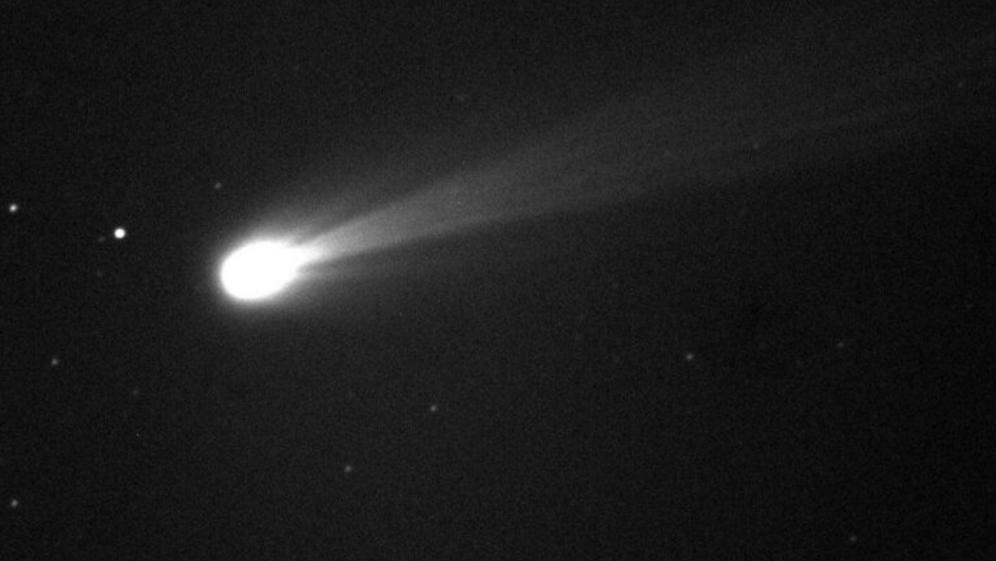

NASA headquarters in Washington, D.C., has shared a new update about a rare visitor to our solar system — 3I/ATLAS. Scientists first spotted it on July 1. The object immediately caught attention because it is racing through space at an incredible speed of 1,30,000 miles per hour (209,000 km/h).
This speed makes it the fastest interstellar object ever recorded, surpassing previous cosmic travelers like Oumuamua and Borisov.
What Makes It So Fast
NASA scientists say its velocity is the result of billions of years of gravitational interactions, a phenomenon called the “gravitational slingshot effect.” As it passed stars, planets, and nebulae, these massive bodies gave it extra momentum.
Because of its extreme speed, scientists only have a short time to observe it. NASA is rushing to collect as much data as possible before it disappears from view.
Size and Structure
Earlier, data from the Vera C. Rubin Observatory suggested 3I/ATLAS’s icy core was about 7 miles (11.2 km) wide. But NASA’s latest Hubble observations reveal it is smaller — at most 3.5 miles (5.6 km) across, and possibly only 1,000 feet (320 meters) in diameter.
Even with the size adjustment, 3I/ATLAS remains the largest interstellar object ever detected.
NASA confirms it is not a solid rock but a comet — an icy body containing frozen gases and dust. Around it, a glowing halo forms as sunlight heats and evaporates its surface.
Ancient Origins
One of the most surprising findings is its age. NASA’s analysis shows 3I/ATLAS has been orbiting the Milky Way for at least eight billion years — nearly twice as old as our 4.6-billion-year-old solar system.
No Threat to Earth
NASA assures there is no danger from 3I/ATLAS. When it reaches its closest point to the Sun in October, it will be on the opposite side of the Sun from Earth. This means no collision risk and no major gravitational effects on our planet.