
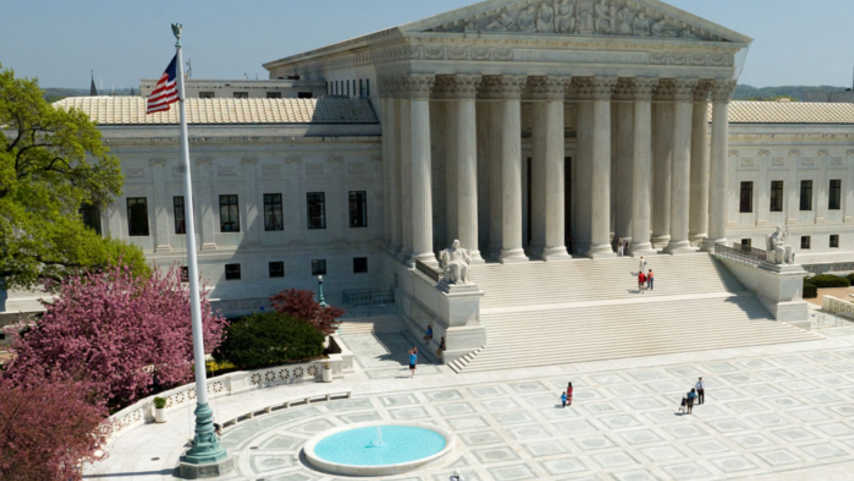

The US Supreme Court agreed on Tuesday to hear arguments in November over whether President Donald Trump’s sweeping tariffs are legal. The decision comes after Trump’s administration requested an expedited ruling to keep the tariffs intact.
Earlier, a lower court ruled that Trump overstepped his authority by using emergency economic powers to impose widespread duties. However, it allowed the tariffs to remain temporarily, giving Trump time to appeal to the nation’s highest court.
Tariffs Under Emergency Powers
Since returning to the presidency in January, Trump has invoked the International Emergency Economic Powers Act (IEEPA) to impose “reciprocal” tariffs on almost every US trading partner.
These tariffs include a 10 percent baseline duty, with higher rates on dozens of economies, including the European Union (EU) and Japan.
Additionally, Trump used similar emergency powers to place separate tariffs on Mexico, Canada, and China, citing their role in the flow of deadly drugs into the United States.
Legal Challenges Intensify
Multiple legal challenges have been filed against Trump’s tariffs. Last month, the US Court of Appeals for the Federal Circuit ruled 7-4 that many of these levies were illegal, upholding a lower court’s decision.
The appeals court ruling also raised concerns about Trump’s trade deals with key partners, including the EU. It left open questions about what would happen to billions of dollars in collected tariffs if the Supreme Court does not rule in Trump’s favor.
Trump Pushes for Fast Ruling
Last week, Trump’s administration urged the Supreme Court to act quickly. Officials argued that the lower court’s decision was already hurting trade negotiations and creating uncertainty for US businesses and foreign partners.
Ongoing Trade Talks With India
Despite ongoing trade disputes, Trump said on Tuesday that talks with India would continue. Relations between the two countries have been tense since Trump imposed 50 percent tariffs on Indian goods over New Delhi’s purchases of Russian oil.
“I am pleased to announce that India and the United States of America are continuing negotiations to address the Trade Barriers between our two Nations,” Trump wrote on his Truth Social platform.
He added that he was “certain that there will be no difficulty in coming to a successful conclusion” for both countries.
Trump also revealed that he plans to speak with Indian Prime Minister Narendra Modi “in the upcoming weeks,” signaling that diplomacy remains a priority despite the tariffs.
What’s at Stake
The Supreme Court’s ruling will determine whether Trump can continue using emergency powers to impose broad tariffs. A decision against him could invalidate billions of dollars in tariffs and disrupt trade agreements with major global partners.
For now, the tariffs remain in effect, while businesses, foreign governments, and US lawmakers wait for the court’s final judgment.