
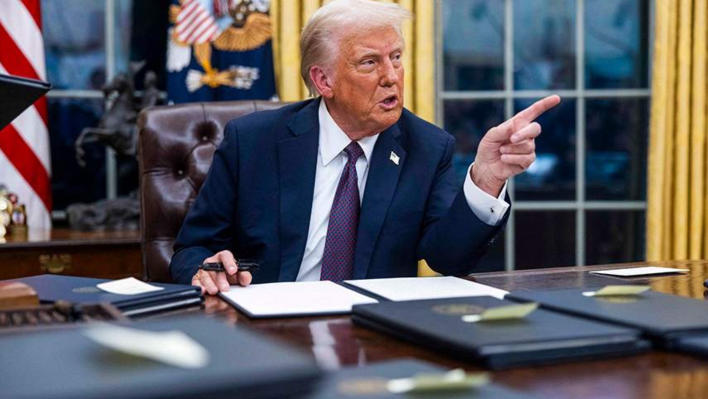

US President Donald Trump signed an executive order on Friday imposing a $100,000 yearly fee for each H-1B visa application. The order immediately shocked the tech industry, which depends heavily on foreign workers, especially from India and China.
Trump has long criticized the H-1B program. He argues that companies should prioritize hiring Americans instead of bringing in foreign workers. “If you’re going to train somebody, you’re going to train one of the recent graduates from one of the great universities across our land,” Trump said during the announcement. “Train Americans. Stop bringing in people to take our jobs.”
Government Says Companies Were Warned
US Commerce Secretary Howard Lutnick confirmed that leading companies were informed about the change before the order was signed. Lutnick said, “A hundred thousand dollars a year for H-1B visas, and all of the big companies are on board. We’ve spoken to them.”
He stressed that the move is part of a broader push to ensure only top talent enters the country. “Either the person is very valuable to the company and America, or they are going to depart and the company is going to hire an American,” Lutnick explained. “That’s the point of immigration. Hire Americans and make sure the people coming in are the top, top people. Stop the nonsense.”
Why It Matters for the Tech Industry
The H-1B program plays a critical role in the US workforce, especially in technology. Government data shows that two-thirds of H-1B jobs are computer-related. Employers also use these visas to bring in engineers, educators, and healthcare professionals.
In the first half of 2025 alone, Amazon received more than 10,000 H-1B visa approvals, while Microsoft and Meta Platforms each received over 5,000 approvals.
The program currently offers 65,000 visas annually for specialized workers and 20,000 additional visas for those with advanced degrees.
Because of this reliance, Trump’s decision could significantly disrupt hiring for many companies. Large corporations may manage the costs, but startups and smaller tech firms are likely to face severe challenges.
A Deeply Divisive Issue
The H-1B program has long divided public opinion. Critics argue that it keeps wages low and pushes qualified Americans out of jobs. They believe companies should focus on hiring citizens first.
Supporters, however, say the visa is vital for filling talent gaps and keeping the US globally competitive. Tesla CEO Elon Musk, who once held an H-1B visa himself, has defended the program. He says it helps bring in “highly skilled talent” that drives innovation and growth.
Immediate Backlash and Concerns
After the order was announced, tech leaders voiced their concerns. Deedy Das, a partner at venture capital firm Menlo Ventures, criticized the move on X. “Adding new fees creates disincentive to attract the world’s smartest talent to the US,” she wrote. “If the US ceases to attract the best talent, it drastically reduces its ability to innovate and grow the economy.”
Industry experts fear the new costs could discourage top professionals from seeking opportunities in the United States. As a result, skilled workers might look to countries with more welcoming immigration policies.
Legal Questions Surround the Order
While the government defends the decision, immigration lawyers are questioning whether Trump even has the authority to impose such a massive fee.
Aaron Reichlin-Melnick, senior fellow at the American Immigration Council, strongly rejected the move on Bluesky. “The president has literally zero legal authority to impose a $100,000 fee on visas,” he wrote. “None. Zip. Zilch. The only authority Congress has ever given the executive branch here is to charge fees to recover the cost of processing the application.”
Currently, H-1B applicants pay a small lottery fee and, if selected, additional charges that usually total only a few thousand dollars. Employers cover almost all these expenses. Typically, these visas are approved for three to six years.
Possible Consequences
The new rule could lead to a talent crisis, particularly for smaller firms. With higher costs, some companies might hire fewer foreign workers or avoid the program altogether.
As Lutnick explained, this is exactly what the administration wants — to encourage companies to hire locally. However, opponents warn that this approach could backfire by driving skilled workers away and weakening US innovation.