
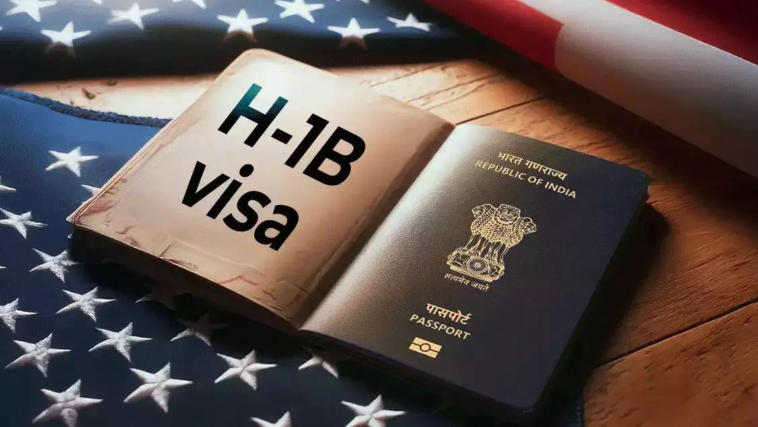

Indian information technology stocks faced heavy selling pressure on Monday after US President Donald Trump announced a steep $100,000 application fee for all new H-1B visa petitions. The move sparked concerns that it could hurt the decades-old outsourcing model that has powered India’s multi-billion-dollar tech sector.
By 10 a.m., the Nifty IT index plunged more than 2.5%, marking one of its sharpest single-day declines in months. The losses deepened later in the morning as panic selling intensified across frontline and mid-cap IT counters.
Trump’s Policy Shift Hits Indian Tech Sector Hard
President Trump signed a proclamation late last week imposing a mandatory $100,000 filing fee on all new H-1B visa applications. The fee will not apply to existing visa holders or renewals but will affect every fresh application filed outside the US.
The H-1B program has long been the backbone of Indian IT companies, allowing them to send thousands of skilled engineers and developers to client locations in the United States. The sudden policy change has rattled the industry, which already faces global economic headwinds and rising operational costs.
Market analysts warned that the new rule would significantly increase costs for Indian IT firms and could impact their profit margins. Companies may be forced to rethink their onsite-offshore workforce models, potentially hiring more local US talent at higher salaries or increasing remote delivery from India and other offshore centers.
Market Selloff and Company-Wise Impact
The announcement triggered an immediate selloff across IT stocks. Tech Mahindra led the decline, opening at ₹1,499, down 6% from Friday’s close of ₹1,533. Other major players, including TCS, Infosys, Wipro, and HCLTech, saw their shares drop between 3-5% in early trade. Mid-tier companies like Persistent Systems, LTIMindtree, and Mphasis were also among the biggest losers, sliding sharply as investors rushed to exit positions. All 10 stocks in the Nifty IT index traded in the red, underscoring the broad-based nature of the selloff.
Dependence on the US Market
The US remains the largest revenue generator for most Indian IT companies, accounting for over 50-60% of their business.
With the new visa fee in place, every employee sent onsite for a new project would cost significantly more, potentially squeezing operating margins.
Analysts estimate the impact could range from 50 to 150 basis points, depending on a company’s dependency on the H-1B visa program and the number of new visa filings planned for the coming year.
As a result, companies may increase investments in near-shore centers across Canada, Latin America, and Eastern Europe while scaling up remote delivery operations from India.
Broader Concerns and Government Response
The move has also raised humanitarian concerns, as many Indian professionals rely on the H-1B program to live and work in the US with their families.
Indian trade bodies have called the decision abrupt and warned that it could disrupt the lives of thousands of workers and create uncertainty for businesses already dealing with global economic volatility.
Industry associations are urging both governments to engage in dialogue and explore alternatives that protect businesses and workers.
There is also speculation that some companies may legally challenge the fee in US courts, citing discrimination and unfair barriers to talent mobility.
Ongoing Trade Talks Add to the Drama
The announcement comes at a sensitive time, as India and the US are currently holding trade negotiations in Washington.
Commerce Minister Piyush Goyal is leading the Indian delegation, with visa regulations and technology sector concerns expected to feature prominently in the discussions.
US President Trump has previously expressed optimism about reaching a broader trade agreement with India, but the new visa rule could complicate matters and strain bilateral relations.
Outlook for the IT Sector
The full financial impact of the $100,000 fee will become clearer in the coming quarters as companies finalize their hiring and visa strategies.
For now, investors are bracing for near-term volatility in IT stocks, with some analysts predicting that the sector could remain under pressure until there is clarity on whether the fee will stay or face legal and diplomatic pushback.
Indian IT firms, meanwhile, are expected to accelerate digital transformation initiatives, adopt AI-driven automation, and explore new global delivery models to reduce their reliance on the traditional onsite visa-dependent system.