
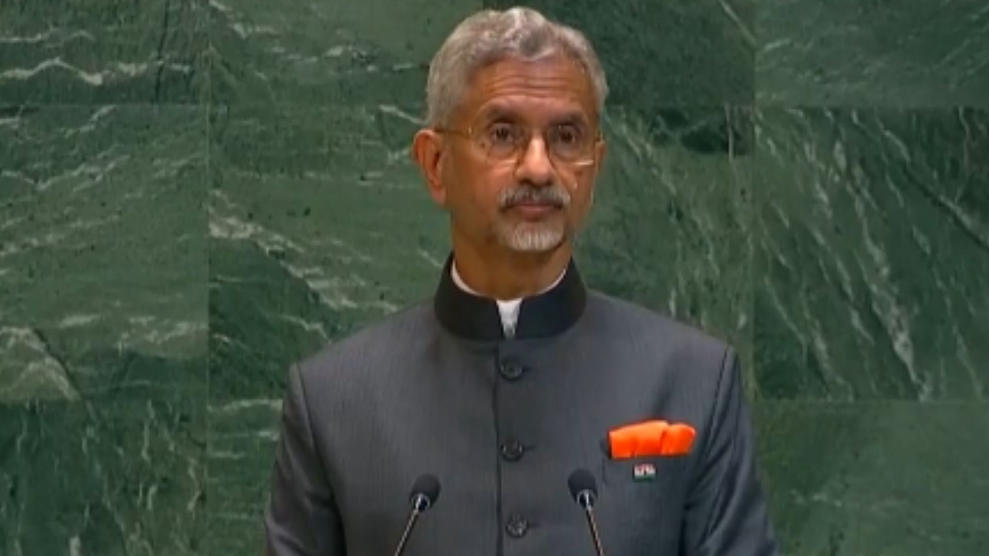

External Affairs Minister Dr S. Jaishankar sharply criticised Pakistan on Thursday for being a centre of international terrorism. He explained that India has faced threats from Pakistan since Independence.
“Countering terrorism is a particular priority because it synthesises bigotry, violence, intolerance and fear. India has confronted this challenge since its Independence, having a neighbour that is an epicentre of global terrorism. For decades now, major international terrorist attacks are traced back to that one country,” he said.
Moreover, Jaishankar highlighted Pakistan’s repeated links to global terrorism. “UN’s designated lists of terrorists are replete with its nationals. The most recent example of cross-border barbarism was the murder of innocent tourists in Pahalgam in April this year. India exercised its right to defend its people against terrorism and brought its organisers and perpetrators to justice,” he added.
Therefore, he reaffirmed India’s firm stance against cross-border terrorism and its commitment to protecting citizens.
India’s Global Contributions
Speaking at the 80th UN General Assembly (UNGA), Jaishankar highlighted India’s role in global peace and development. He said India has helped the people of Afghanistan and Myanmar during recent earthquakes.
In addition, he noted, “Our soldiers maintain peacekeeping, our sailors protect maritime shipping, and our security forces counter terrorism. Our doctors and teachers support human development, our industry produces affordable products, our techies promote digitisation, and our training facilities are open to the world. These remain the core of our foreign policy.”
Our statement at the General Debate of the 80th session of the UNGA. #UNGA80
— Dr. S. Jaishankar (@DrSJaishankar) September 27, 2025
https://t.co/kqiiJo82Iz
UN Security Council Must Expand
Jaishankar questioned the UN’s effectiveness. “How has the UN lived up to expectations? Look at the state of the world. Conflicts rage in Ukraine and West Asia. Countless other hotspots go unnoticed.”
Furthermore, he criticised the slow progress on the Sustainable Development Goals (SDGs) and weak climate action. “If climate action itself is questioned, what hope is there for climate justice?”
Self-Reliance, Security, and Confidence
Jaishankar explained India’s guiding principles, highlighting three key ideas: Atmanirbharta (self-reliance), Atmaraksha (self-protection), and Atmavishwas (self-confidence).
“We protect our people and their interests at home and abroad. We maintain zero-tolerance for terrorism, defend our borders, build partnerships, and support our community overseas. Bharat will always maintain its freedom of choice and speak for the Global South,” he said.
Thus, India combines self-reliance with security and confidence in its foreign policy.
Decolonisation and UN’s Expanding Role
The minister said decolonisation restored global diversity and expanded UN membership. “The UN’s membership quadrupled, and its role grew significantly.”
Moreover, he added, globalisation shifted the UN’s focus to development, climate change, trade, and access to food and health, making these priorities central to global well-being.
UN in Crisis
Jaishankar warned that the UN is in crisis. “Peace is threatened by conflicts. Development stalls due to lack of resources. Human rights are violated by terrorism. Yet the UN remains gridlocked. As its ability to forge common ground shrinks, faith in multilateralism falls,” he said.
In addition, he reminded the world of the UN Charter’s mission: “The UN calls on us to prevent war and build peace. Not just to defend rights, but to uphold human dignity.”
Finally, he highlighted ongoing global challenges. Energy and food security have suffered most since 2022 due to conflicts and disruptions.