
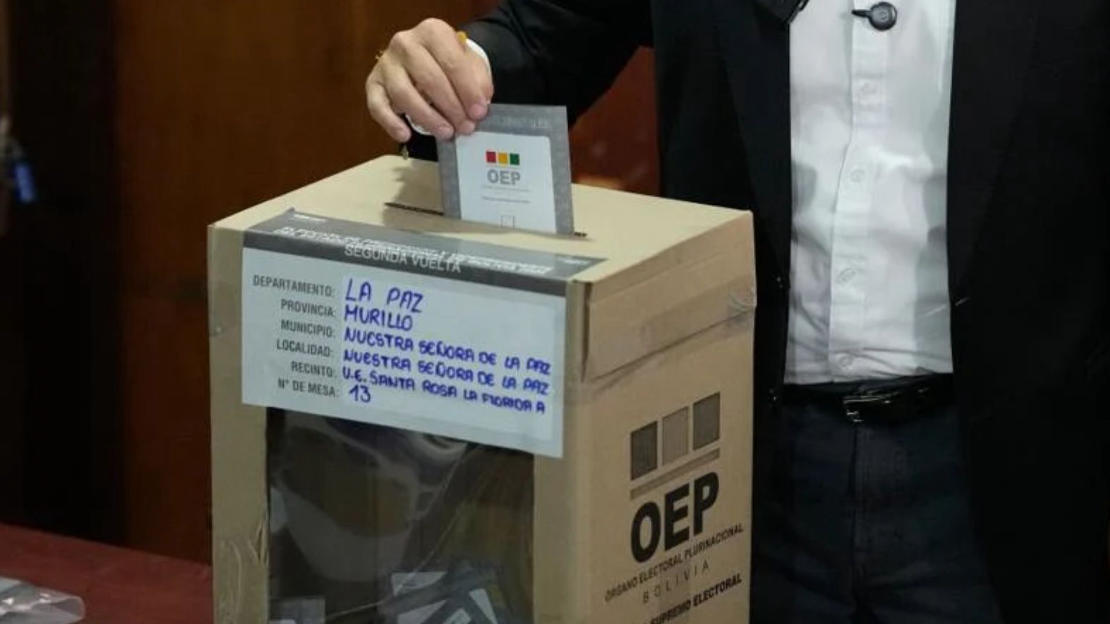

Bolivia went to the polls on Sunday to elect a new president, marking the end of 20 years of socialist governance. The election came at a time when the nation faces severe economic distress, including high inflation, fuel shortages, and dwindling dollar reserves.
Voters rejected the Movement Toward Socialism (MAS) party, founded by former president Evo Morales, during the first round of elections in August. Their decision reflected growing frustration over the country’s worsening living conditions.
“We hope the country improves,” said Maria Eugenia Penaranda, a 56-year-old homemaker in La Paz. “We cannot make ends meet. There is a lot of suffering. Too much,” she told AFP as she waited in line to cast her ballot in the chilly Andean capital.
Nearly eight million citizens were eligible to vote in the election, which began at 8:00 a.m. and closed eight hours later. Voting in Bolivia is compulsory, and early results were expected by midnight GMT.
Two Pro-Business Candidates Compete for the Presidency
The presidential race came down to two experienced figures — 58-year-old economist-turned-senator Rodrigo Paz and 65-year-old former interim president Jorge “Tuto” Quiroga, an engineer by profession.
Both candidates promised to rebuild Bolivia’s struggling economy but offered different approaches. Paz campaigned on a model he described as “capitalism for all,” emphasizing decentralization, fiscal discipline, and reduced taxes. Quiroga, on the other hand, advocated for attracting foreign investment and international loans to stimulate growth.
Despite their differences, both men pledged to maintain key social welfare programs while working to stabilize the economy. However, economists warned that balancing social spending with economic reform would be extremely difficult.
Both candidates also proposed trimming Bolivia’s costly universal fuel subsidy, limiting it only to public transport.
A Country in Deep Economic Crisis
The election followed a period of deep economic turmoil. Under outgoing president Luis Arce, Bolivia suffered fuel shortages, dollar scarcity, and rising inflation—now above 20 percent. Long lines at gas stations have become a daily reality.
The crisis stems from years of underinvestment in the country’s gas sector, once the backbone of the economy. Production has plummeted as previous administrations spent heavily on subsidies and social programs rather than infrastructure and exploration.
Evo Morales’s earlier decision to nationalize gas reserves initially sparked a decade of growth, but the benefits have since evaporated. The state’s dwindling revenues have left the government struggling to pay for fuel imports and maintain its subsidies.
Analysts Warn of Rising Social Tensions
Political observers believe the next president will face a tough road ahead. Daniela Osorio, an analyst at the German Institute for Global and Area Studies, told AFP that people’s patience is “running out.”
Once the election is over, she warned, “if the winner does not take measures to help the most vulnerable, this could lead to a social uprising.”
The World Bank has already declared Bolivia’s economy in recession, suggesting that recovery will be long and challenging.
Candidates Promise Reforms and Hope
Rodrigo Paz emphasized unity as he cast his vote. “If the people of Bolivia grant me the opportunity to be president, my format will be that of consensus,” he said.
Quiroga, meanwhile, focused on immediate relief, promising to restore fuel and US dollar supplies before Christmas through international financing. “A change with hope is coming,” he told reporters after voting in southern La Paz.
Both candidates face another challenge: neither has a clear majority in Congress. According to Bolivian sociologist Maria Teresa Zegada, this means they will need to compromise and build coalitions to pass laws. She also noted that a bitter and personal campaign season has left “wounds that will be difficult to heal.”
Morales Still a Political Force
Outside of Congress, the new president will also have to contend with former leader Evo Morales, who remains influential, especially among Indigenous communities. Morales, barred constitutionally from running again, criticized both candidates.
He told reporters, “The two candidates each represent only a handful of people in Bolivia, they do not represent the popular movement, much less the Indigenous movement.”
Morales currently faces an arrest warrant related to an alleged relationship with a minor, a charge he denies.
Outgoing President Luis Arce, who took office in 2020, is set to step down on November 8 after completing his single term. Bolivia’s constitution allows for two terms, but Arce chose not to seek reelection.