
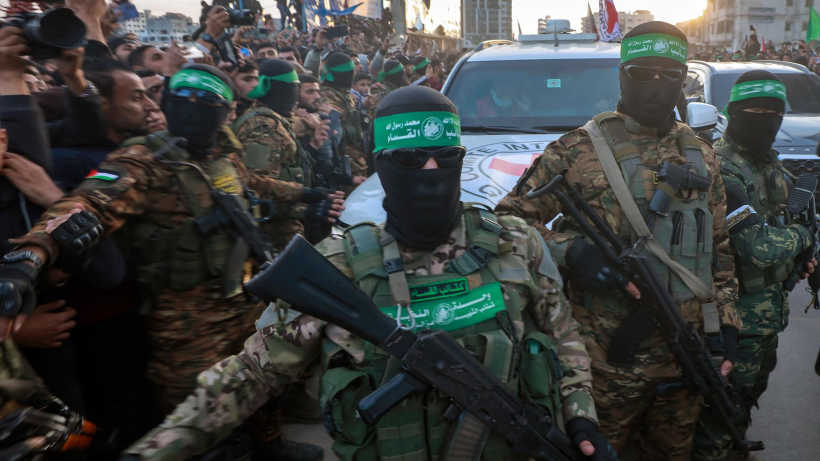

Senior Hamas figure Khaled Meshaal said that the organisation is willing to consider a temporary halt in the use of weapons. However, he firmly rejected the disarmament demand included in the US-sponsored peace framework for Gaza. Meshaal conveyed this in an interview with Al Jazeera on Wednesday.
He stressed that Hamas would never accept giving up its arsenal, even as it explores alternatives with mediators. “The idea of total disarmament is unacceptable to the resistance (Hamas). What is being proposed is a freeze, or storage (of weapons)… to provide guarantees against any military escalation from Gaza with the Israeli occupation,” he said.
Meshaal added that talks are ongoing and that practical US engagement may help bridge gaps. “This is the idea we’re discussing with the mediators, and I believe that with pragmatic American thinking… such a vision could be agreed upon with the US administration,” he said.
Fragile Ceasefire Faces Pressure
The current ceasefire, in force since October 10, paused the conflict that escalated after Hamas’s October 7, 2023 attack. Yet both Israel and Hamas allege near-daily violations, making the truce unstable.
The arrangement has three phases. Israeli Prime Minister Benjamin Netanyahu recently suggested that negotiations are moving toward the second phase.
In that stage, Israeli troops would retreat further from Gaza. An international stabilisation force would take their place. Simultaneously, Hamas would be expected to lay down its weapons.
Netanyahu plans to meet US President Donald Trump later this month to discuss the next steps. However, Hamas has repeatedly signaled that disarmament is not an option. Meshaal emphasised, “Disarmament for a Palestinian means stripping away his very soul. Let’s achieve that goal another way.”
Progress and Exchanges in Phase One
During the first stage of the agreement, Palestinian militants agreed to release the remaining 48 captives, both living and dead. All except one body have been returned.
Israel, in return, freed nearly 2,000 Palestinian prisoners and repatriated the remains of hundreds of Palestinians.
Hamas Accepts Border Peacekeeping Force, Rejects Internal Deployment
Meshaal also commented on the proposed international stabilisation force. He said Hamas could accept such forces along Gaza’s border with Israel but would not permit them inside the territory. He described internal deployment as another form of occupation.
“We have no objection to international forces or international stabilisation forces being deployed along the border, like UNIFIL,” he said. Such deployment, he added, would help “separate Gaza from the occupation.”
But he drew a firm line against internal operations. “As for the presence of international forces inside Gaza, in Palestinian culture and consciousness that means an occupying force.”
Meshaal argued that external mediators or Arab and Islamic nations could act as guarantors to prevent escalations. He claimed, “The danger comes from the Zionist entity, not from Gaza.”