
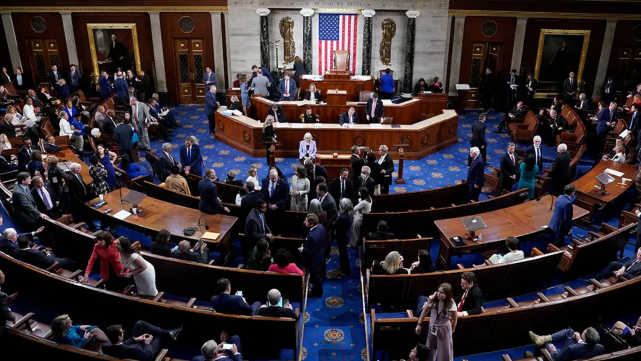

The US Congress on Wednesday voted to permanently end sanctions imposed on Syria during the rule of ousted leader Bashar al-Assad. The move removes long-standing legal barriers and opens the door for foreign investment in the war-damaged country.
President Donald Trump had earlier suspended the sanctions twice. He did so after requests from Saudi Arabia and Turkey, both allies of Syria’s new government led by former jihadist Ahmed al-Sharaa. However, Syria’s new leadership pushed for a full repeal, not temporary relief.
Sharaa argued that as long as the sanctions remained part of US law, global companies would stay away. Businesses feared legal risks linked to operating in the world’s largest economy.
Senate repeals the Caesar Act
The US Senate approved the repeal of the 2019 Caesar Act as part of a broad annual defense bill. Lawmakers voted 77 to 20 in favor of the legislation.
The House of Representatives had already cleared the measure. It now awaits Trump’s signature, which is expected.
The decision received strong support from both Democrats and Republicans.
“This is a decisive step toward giving the Syrian people a real chance to rebuild after decades of unimaginable suffering,” said Senator Jeanne Shaheen, the top Democrat on the Senate Foreign Relations Committee.
Syria welcomes the decision
Syria’s government described the repeal as a major shift.
“We express our gratitude and appreciation to the US Senate for its support of the Syrian people and its vote to repeal the Caesar Act,” Syrian Foreign Minister Asaad al-Shaibani said.
He called the move “a positive development that opens new horizons for cooperation and partnership between our country and the world”.
Officials in Damascus said the end of sanctions would help revive the economy and attract much-needed investment.
What the Caesar Act did
The Caesar Act was named after an anonymous photographer who documented abuse and killings inside Assad’s prisons. The law sharply limited foreign investment in Syria and cut the country off from the global banking system.
US lawmakers passed the act to block reconstruction funding at a time when Assad appeared to have survived the civil war. The conflict lasted more than a decade, displaced millions of people toward Europe, and contributed to the rise of the Islamic State group.
Power shift in Damascus
A year ago, Sharaa’s forces captured Damascus in a rapid military offensive. Since then, he has worked to reshape his image and improve ties with Western countries.
Now seen in business suits instead of military gear, Sharaa has sought international legitimacy. He has reportedly made a strong impression on Trump, including during their first meeting in May in Riyadh.
US officials see the repeal as a step toward stabilising Syria and encouraging reconstruction after years of isolation.