
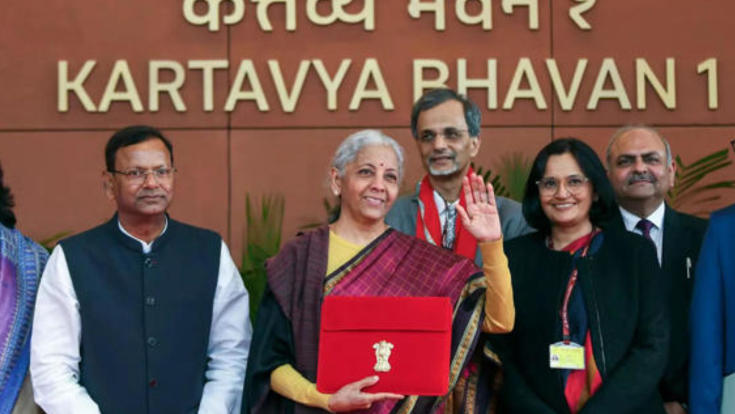

Finance Minister Nirmala Sitharaman highlighted the growing importance of the “orange economy” while presenting Budget 2026 on Sunday. The government signalled strong support for creative industries such as animation, gaming, digital content, and design, linking them to future jobs, innovation, and economic growth.
Below is a clear and detailed explanation of what the orange economy is, why it matters, and how Budget 2026 plans to strengthen it.
Budget 2026 Push for the Orange Economy
During her Budget Speech, Sitharaman underlined the fast growth of India’s creative sector. She stressed its rising demand for skilled professionals and its potential to generate large-scale employment.
“India’s Animation, Visual Effects, Gaming and Comics (AVGC) sector is a growing industry, projected to require 2 million professionals by 2030. I propose to support the Indian Institute of Creative Technologies, Mumbai in setting up AVGC Content Creator Labs in 15,000 secondary schools and 500 colleges," she said.
The proposal focuses on building early talent and expanding training infrastructure across the country. It aims to prepare students for careers in animation, gaming, visual effects, and digital storytelling.
What Is the Orange Economy
The orange economy refers to the creative economy. It relies on ideas, culture, technology, and intellectual property instead of traditional factories and heavy industries.
This sector includes animation, gaming, films, music, fashion, design, advertising, publishing, software, and digital content creation. It also covers new-age creator-led industries driven by online platforms and creative skills.
The concept gained attention as a way to show how culture and creativity can support long-term economic growth. It also helps cities grow, creates jobs for young people, and builds cultural value alongside financial returns.
In recent years, the government has increased its focus on this space. Steps include setting up content creator labs in schools and colleges and strengthening institutions such as the National Institute of Design.
PM Modi’s Remarks on Orange Economy
Prime Minister Narendra Modi also spoke about the rise of the orange economy at the WAVES 2025 Summit. During his inaugural address, he highlighted India’s growing strength in creative industries and content-led growth.
His remarks reinforced the government’s view that creativity and culture can become major economic drivers in the coming years.
What the Economic Survey 2025–26 Said
The Economic Survey 2025–26 identified the orange economy as an important emerging force for employment, urban services, and tourism in India.
It described the creative economy as a key pillar of India’s services-led growth model. According to the survey, creative industries can absorb a large workforce that traditional manufacturing may struggle to employ.
The survey placed special focus on live entertainment, also known as the concert economy. It called this segment a high-multiplier activity. India’s live entertainment industry crossed ₹10,000 crore in 2024.
The impact goes beyond ticket sales. Concerts and live events boost demand for hotels, transport, logistics, food services, and local businesses.
Globally, the survey noted that creative industries contribute between 0.5% and 7% of GDP. In the United States, live music alone supported more than 900,000 jobs and generated over $130 billion in 2019.
However, the survey also flagged challenges. These include complex regulations, limited infrastructure, and operational constraints that slow the sector’s expansion.
Steps Needed to Boost the Orange Economy
The Economic Survey called for a shift in how India views creative industries. It said policymakers should treat them not as “niche entertainment” but as part of a broader urban growth and tourism strategy.
It suggested several key measures:
Simpler Approvals: A single-window clearance system can reduce delays and make it easier to organise live events and cultural activities.
Better Infrastructure Access: Allowing select cultural events at heritage monuments can increase India’s appeal as a global cultural destination.
Focused Skill Development: The sector needs more trained designers, artists, and creative professionals to meet rising demand and support long-term growth.
By backing education, skilling, and infrastructure, Budget 2026 aims to turn India’s creative strength into a major engine of jobs, exports, and cultural influence.