
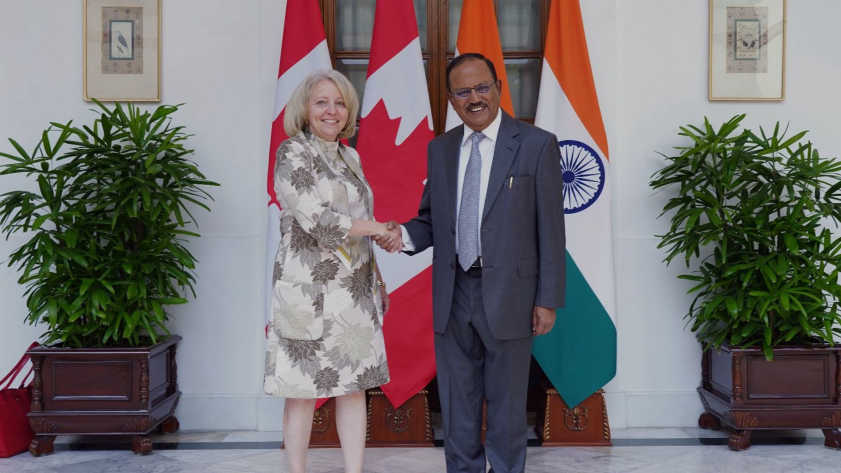

India’s National Security Adviser Ajit Doval visited Canada for a two-day trip and held key talks with Nathalie Drouin, Deputy Clerk and National Security and Intelligence Advisor to the Canadian Prime Minister. The meeting took place as part of a regular security dialogue between the two countries and signaled a renewed effort to strengthen ties.
Top government sources told CNN-News18 that the discussions indicated a reset in India-Canada relations. They also said the talks sent a strong message that violent extremist groups, including Khalistani-linked networks, do not have the backing of the Canadian government.
Focus on intelligence sharing and security cooperation
Sources said both sides focused on starting real-time intelligence sharing on issues such as drug trafficking, cyber threats and extremism. Khalistani-linked groups remained a central concern during the discussions. According to them, Canada appears to be shifting from political positioning to stronger law enforcement action against activities seen as anti-India.
An official statement said both countries reviewed progress on steps aimed at improving the safety and security of their citizens. They agreed on a joint work plan to guide cooperation on national security and law enforcement matters and to ensure practical collaboration on shared priorities.
Plan to appoint liaison officers
During the meeting, India and Canada agreed to appoint security and law-enforcement liaison officers. Their agencies will build closer working relationships to improve communication and allow quick sharing of information on common issues.
This cooperation will help address problems such as the illegal flow of drugs, especially fentanyl precursors, and the activities of transnational organised crime networks. The two sides also decided to strengthen ties in cybersecurity policy and exchange information on cyber threats. They will continue discussions on cooperation in tackling fraud and strengthening immigration enforcement.
Efforts aimed at rebuilding trust
Government sources told CNN-News18 that the talks in Ottawa were not about optics but focused on rebuilding trust. The decision to post law-enforcement liaison officers shows a shared recognition that Khalistani networks are now viewed as organised crime, not free speech.
Doval also raised concerns about extremist fundraising, intimidation and propaganda. He linked these activities to drug money, document fraud and coercion within sections of the diaspora that target India. Sources said the focus on narcotics is strategic, as intelligence inputs suggest that profits from synthetic drugs support transnational groups.
Cyber threats and misuse of immigration channels
Cybersecurity emerged as another key area of discussion. Both countries stressed the need for coordinated cyber policies and data sharing. Extremist groups often use online platforms for recruitment, radicalisation and fundraising. They also try to exploit immigration loopholes to move operatives or avoid scrutiny after targeting India.
Meeting with Canadian public safety minister
Doval also met Gary Anandasangaree, Canada’s Minister for Public Safety. Sources said this meeting reflected Ottawa’s willingness to improve ties with India. They added that the Canadian government is now ready to treat violent extremism targeting India from foreign soil not just as a diplomatic issue but as a matter of public safety.
Visit ahead of possible prime ministerial trip
The visit comes at a time when Canadian Prime Minister Mark Carney is expected to travel to India in the first week of March. India’s High Commissioner to Canada, Dinesh Patnaik, said Carney may visit New Delhi to sign agreements related to uranium, energy, critical minerals and artificial intelligence, further strengthening cooperation between the two nations.