
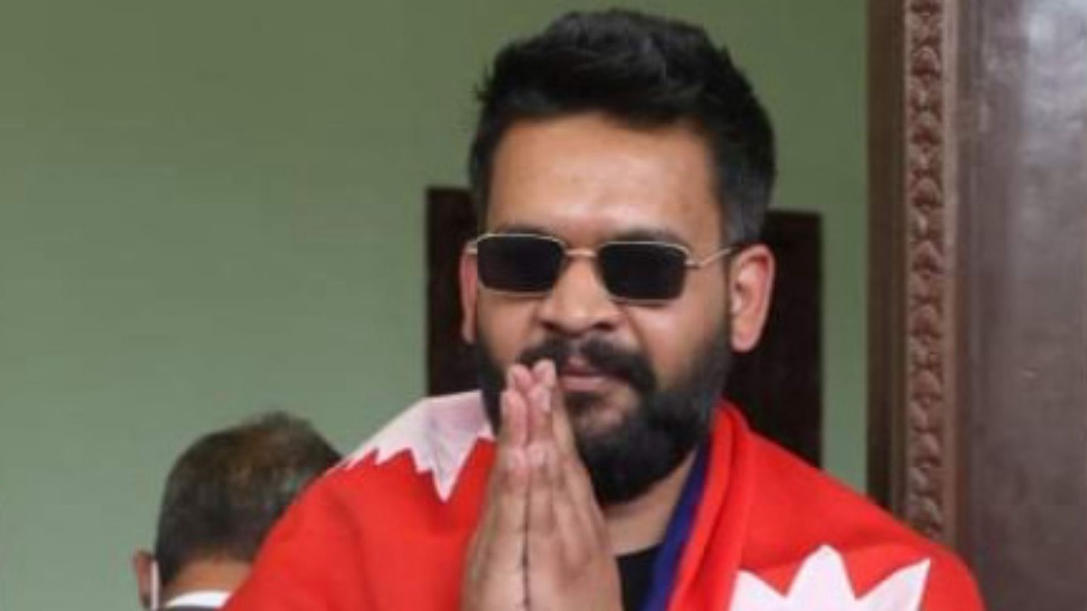

Balendra Shah, widely known as Balen, defeated former Nepal prime minister K. P. Sharma Oli in his own constituency. Data from the Election Commission of Nepal confirmed the result on Saturday.
The 35-year-old politician scored a major victory over the 74-year-old Marxist leader. His rise from city mayor to a potential prime minister marks one of the biggest political shifts in recent Nepali politics.
Election followed deadly protests
Nepal held the election on Thursday. The vote came six months after violent protests removed Oli’s government from power. At least 77 people died during the unrest.
The protests began in September 2025. Many young people joined the demonstrations under a loose Gen Z banner. The movement started after the government briefly banned social media.
However, protesters soon raised wider concerns about corruption and the weak economy.
Shah’s party heads for big win
Early trends showed that Shah’s party, the Rastriya Swatantra Party (RSP), is heading for a major victory. The party looks set to win a majority in the 275-seat House of Representatives of Nepal.
Election Commission spokesperson Narayan Prasad Bhattarai confirmed the strong performance. "Looking at the trend, the Rastriya Swatantra Party has taken the lead in many places and has won several seats," he told AFP.
Shah leads strongly in Jhapa
In the eastern district of Jhapa, Shah built a large lead over Oli. He received more than 59,500 votes. Oli trailed with about 16,350 votes after more than 85 percent of ballots were counted.
Supporters gathered outside the counting centre. They cheered and shouted slogans. Authorities increased security in the area. Political analyst Chandra Dev Bhatta said the result reflects public anger at traditional parties. "This is heading to a landslide victory -- this reflects the frustration that has been building up," he said.
"It is actually the people's revolt against the established political parties," he added.
“The people understand that the new do not really have strong agendas, but it is a punishment to the parties for their decades-long poor governance.”
Young voters celebrate the result
Many young voters welcomed Shah’s victory. Rojan Bhattarai, a 22-year-old student from Jhapa, said he expected Shah to win but not by such a large margin. "I was 99.99 percent sure he will win, but the majority is shocking. That shows how much the people were upset with the previous government," he said.
"He is a performer. He has inspired us all."
Early results favour Shah’s party
Nearly two days after the polls closed, officials announced results for 59 seats. The Rastriya Swatantra Party won 48 seats. The Nepali Congress secured seven seats. Oli’s party won only two.
The party led by former Maoist commander Pushpa Kamal Dahal won one seat. Trends also showed RSP leading in 71 of the remaining 106 constituencies.
Counting continues across Nepal
Election officials said they may finish counting direct election votes by Monday. However, counting proportional representation votes will take longer. "According to our plan, it will take at least a week to count the proportional votes, after which the election will go through the official process," Bhattarai said.
He added that counting is progressing smoothly across the country, from the Himalayan mountains to the southern plains near India.
Supporters celebrate in Kathmandu
Supporters of Shah’s party began celebrating early. Many danced on the streets of Kathmandu. However, RSP deputy chairman DP Aryal urged them to stay calm for now.
"A day will come for us to celebrate," he wrote on social media.
From rapper to political leader
Balen Shah first gained fame as a rapper. He later entered politics and built strong support through social media. In 2022, he won the election to become the first independent mayor of Kathmandu.
Meanwhile, senior Nepali Congress leader Gagan Thapa also trailed in his constituency. Political commentator Kunda Dixit said the election reflects growing anger toward traditional parties.
"This is even a bigger upset than we expected -- it underscores the level of public disenchantment with the old parties for under-performance, as well as anger over the events of September," he said.
Memories of unrest remain
Last year’s protests left deep damage in Jhapa. Protesters burned down Oli’s house during the unrest. Several other buildings also burned, including the parliament complex. Dharmakala Gautam, 74, watched the house burn.
"When the Maoists came to rule, we hoped for change -- but not much happened," she said. “I will keep some hope this time too.”