
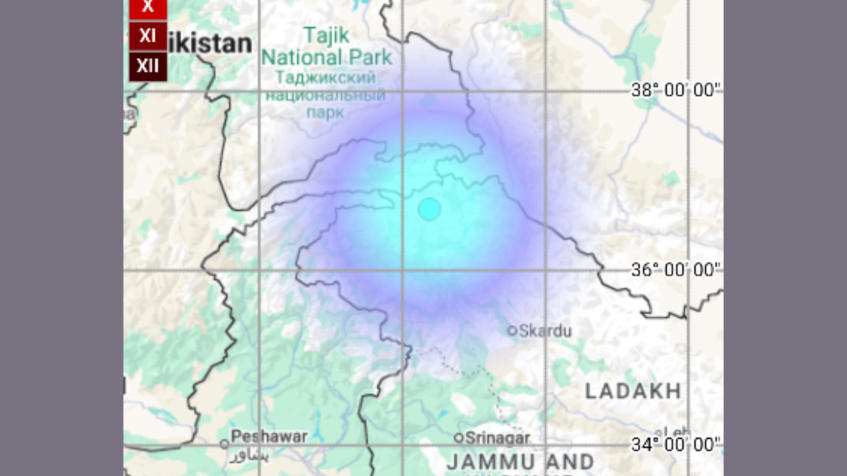

An earthquake measuring 4.7 on the Richter scale struck Leh in Ladakh on Friday. The information was shared by the National Centre for Seismology (NCS). The tremor occurred at a depth of 28 km below the Earth’s surface.
In a post on X, the NCS said, “EQ of M: 4.7, On: 27/03/2026 10:10:15 IST, Lat: 36.706 N, Long: 74.458 E, Depth: 28 Km, Location: Leh, Ladakh.”
EQ of M: 4.8, On: 27/03/2026 10:23:02 IST, Lat: 36.800 N, Long: 74.608 E, Depth: 44 Km, Location: Leh, Ladakh.
— National Center for Seismology (@NCS_Earthquake) March 27, 2026
For more information Download the BhooKamp App https://t.co/5gCOtjdtw0 @DrJitendraSingh @OfficeOfDrJS @Ravi_MoES @GSuresh_NCS @ndmaindia pic.twitter.com/HjSkN1DOgC
Second Quake Reported the Same Morning
Earlier the same day, another earthquake had hit the region. This one measured 3.9 in magnitude and occurred at 8:31 AM. The NCS shared, “EQ of M: 3.9, On: 27/03/2026 08:31:09 IST, Lat: 36.692 N, Long: 74.382 E, Depth: 10 Km, Location: Leh, Ladakh.”
EQ of M: 3.9, On: 27/03/2026 08:31:09 IST, Lat: 36.692 N, Long: 74.382 E, Depth: 10 Km, Location: Leh, Ladakh.
— National Center for Seismology (@NCS_Earthquake) March 27, 2026
For more information Download the BhooKamp App https://t.co/5gCOtjdtw0 @DrJitendraSingh @OfficeOfDrJS @Ravi_MoES @GSuresh_NCS @ndmaindia pic.twitter.com/1DfQ8TbFjD
This means Ladakh experienced two tremors within a short span of time on Friday.
Understanding Earthquake Depth
Earthquakes can occur from near the surface to as deep as 700 km underground. Scientists classify them based on depth into three categories, according to the United States Geological Survey.
- Shallow earthquakes: 0 to 70 km deep
- Intermediate earthquakes: 70 to 300 km deep
- Deep earthquakes: 300 to 700 km deep
Generally, earthquakes deeper than 70 km are called “deep-focus earthquakes”.
Satellite Helps Study Tsunamis
Separately, scientists are gaining new insights into how tsunamis form and spread. This comes from satellite observations after a powerful earthquake near Russia’s Kamchatka Peninsula last year.
The study focused on a massive 8.8 magnitude quake on July 29, 2025. It triggered a tsunami that travelled across the Pacific Ocean.
A tsunami is a series of very long and powerful sea waves. It is usually caused by sudden movements of the seafloor, often during underwater earthquakes or landslides.
New Technology Captures Wave Patterns
The NASA-CNES Surface Water and Ocean Topography (SWOT) satellite played a key role. It recorded data within 70 minutes of the earthquake.
The satellite not only captured the main tsunami wave but also smaller waves following behind it. Scientists had predicted such patterns earlier through models, but real-world evidence was limited.
“I believe SWOT represents a new lens for observing and studying tsunamis and their generation,” said Ignacio Sepúlveda.
“It is also likely to improve our understanding of the physical mechanisms that generate tsunamis, including earthquakes,” he added.
Why This Discovery Matters
Traditional tools like deep-sea sensors and older satellites have limitations. They cannot always capture the full structure of tsunami waves, especially near ocean trenches.
However, SWOT can scan wide ocean areas and create detailed maps of sea surface height. This helps scientists better understand wave shape, direction, and spacing.
Tsunamis Remain a Major Threat
Tsunamis are among the most powerful natural disasters. They spread quickly in all directions from their source and can cause severe coastal flooding.
While the tsunami in this study did not cause major damage, past events have been devastating. One example is the 2004 Indian Ocean tsunami, which killed around 230,000 people.