
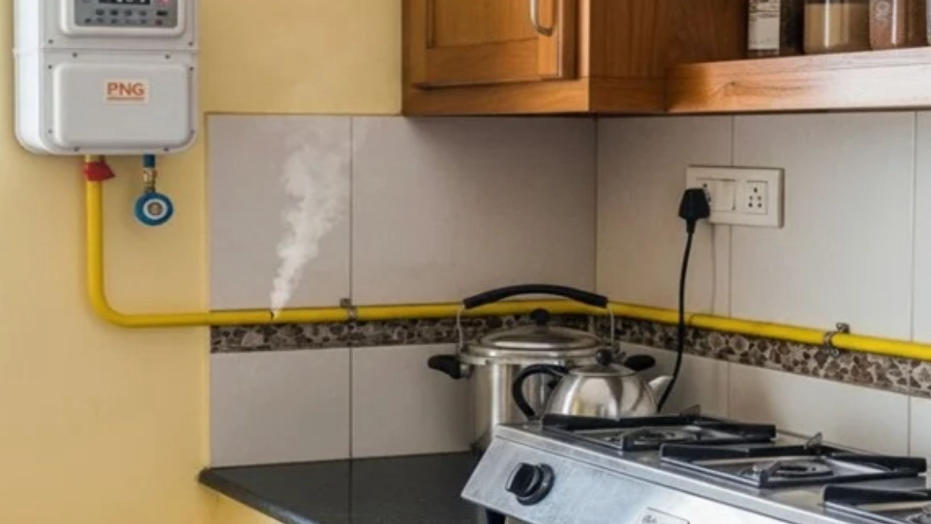

The ongoing conflict involving Iran, the United States, and Israel has disrupted global energy flows. Missile and drone attacks across the oil-rich Gulf region have affected supply routes. As a result, many countries, including India, now face one of the most serious fuel challenges in decades.
In response, the Indian government has started pushing households to shift from LPG cylinders to piped natural gas (PNG). This move comes as Iran tightens its control over the Strait of Hormuz, a critical passage through which nearly one-fifth of the world’s fuel supply moves.
Government Pushes Mandatory Shift to PNG
The government has issued an order directing households to switch to PNG wherever pipeline connections are available. If consumers fail to make the switch, authorities may stop LPG supply in those areas.
Therefore, the policy aims to reduce India’s heavy reliance on imported LPG, which faces immediate risks due to the conflict.
What is PNG and How It Works
Piped Natural Gas (PNG) mainly consists of methane. It reaches homes directly through underground pipelines. Companies extract natural gas from fields and transport it in liquefied form (LNG) before distributing it through city gas networks.
Unlike LPG, PNG flows continuously. It does not require cylinder refills and is supplied at low pressure, ensuring steady and convenient usage.
Sources of PNG in India
India produces PNG domestically from major gas fields such as the Krishna-Godavari Basin, along with regions in Assam and Tripura. The KG Basin is the largest contributor to India’s gas output.
Key fields like R Cluster, Satellites Cluster, and MJ together account for a significant share of production. At the same time, Assam and Tripura contribute heavily to onshore gas supply.
In addition, India imports LNG from countries such as Qatar, the United States, and Australia. This diversified sourcing reduces dependency on any single region.
Why PNG is More Reliable Than LPG
The key difference between PNG and LPG lies in their supply systems. LPG depends on imports shipped through the Strait of Hormuz. However, recent attacks on tankers have disrupted shipping routes, causing delays and shortages.
In contrast, PNG operates through a fixed pipeline network. It draws from both domestic production and imported LNG. Therefore, even if global supply tightens, consumers continue to receive gas without interruption. Any adjustments usually happen at the industrial level rather than affecting households directly.
India imports around 25–26 million metric tonnes of LNG annually. Data from the Petroleum Planning and Analysis Cell shows that nearly 50 per cent of the country’s natural gas demand is met through imports.
Although LNG imports also face some risk, India sources gas from multiple countries. For example, Qatar accounts for a large share, while the United States also supplies a significant portion.
What is LPG and Why It Faces Risk
Liquefied Petroleum Gas (LPG) consists of propane and butane stored in cylinders. It is produced during crude oil refining or natural gas processing.
India imports about 60 per cent of its LPG needs. Out of this, nearly 90 per cent passes through the Strait of Hormuz. Therefore, any disruption in this region immediately affects LPG availability, leading to shortages and delays.
Policy Backed by Supply Concerns
The government’s recent order reflects growing pressure on LPG imports. Officials have asked households with access to PNG to switch within three months or risk losing LPG refill services.
Sujata Sharma explained the reasoning behind the move. “Our import dependency for LPG is much higher than the import dependency for PNG or LNG. We produce 50% domestically as far as PNG is concerned. So, this is in the interest of nation that we shift from LPG to PNG,” she said.
However, the order allows one exemption. Authorities will not cut LPG supply if distributors confirm that providing a PNG connection is technically not possible.
PNG Coverage Still Limited
India currently has about 16.2 million PNG connections. In comparison, more than 332 million households use LPG. This number has grown significantly over the years, including millions of subsidised connections under welfare schemes.
Growing Shift in Energy Strategy
Overall, India’s push toward PNG reflects a broader strategy to secure energy supply during global uncertainty. By reducing reliance on vulnerable import routes and increasing domestic usage, the country aims to protect consumers from sudden fuel disruptions.